

The Ford Transit van is made to order, meaning it’s built according to the customer’s specifications. There are an overwhelming number of options and features from which to choose from, so it makes the ordering process quite stressful! We built FarOutVan 1 from a 2016 Transit, and FarOutVan 2 from a 2021 Transit. This order guide is based on our experience.
Please keep in mind that it’s impossible to define a complete package that would suit everyone! So we’ll try to focus on the essential stuff.
Still in planning mode? Here are a few resources:
First things first, go to the Transit “Build & Price” tool on Ford.com. This will help you customize your own Transit and get a price estimate (the price is updated as options are added or changed) and prevent you from choosing combination of options that are not compatible together. Choose the options you want under “Select Your Configuration” widget on the right-side of the page:

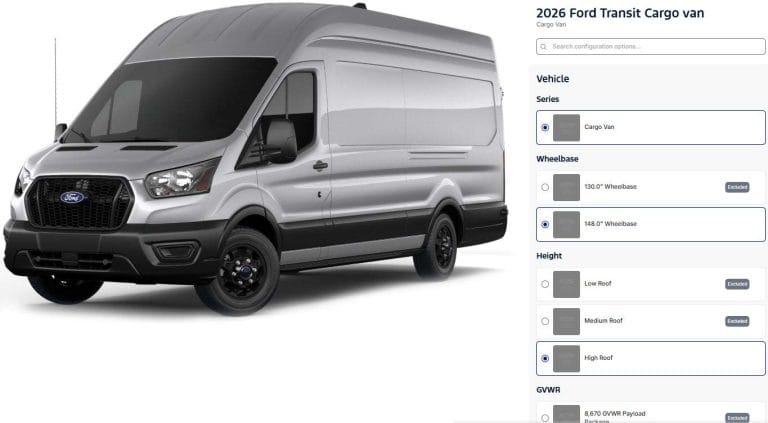
Vehicle
Series
Cargo Van
Start from a fully blank slate! Most flexible and cheapest option. The Transit cargo van is what most people choose for their conversion (including us).
Passenger Van
The passenger van is an interesting option if you want windows all around and plan on reusing the included interior finish for your conversion.
Our experience with the cargo van Transit
That’s what we used for FarOutVan 1, and that’s what we would use again if we had to start over today. In fact, we did! We’re currently building FarOutVan 2, and we went with a Ford Transit again! With a clean slate, we’re in control and can start right away without disassembling anything first.
You might be interested in our Maintenance and Repair Journal for FarOutVan 1 and 2.
Wheelbase
130 Wheelbase
More nimble for urban delivery vans.
148 Wheelbase
More living space, that’s what we would recommend for a campervan. Keep scrolling down for differences between the long and long-extended lengths.
Height
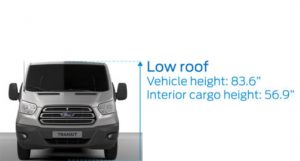
Low Roof
With 56.9″ (4’9″) interior height, it’s not possible to stand up. So we personally don’t recommend going with the Transit low roof for a campervan conversion.
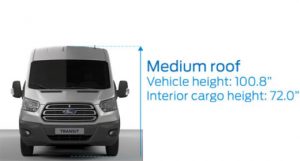
Medium Roof
After adding insulation to the floor and the ceiling, the remaining interior height is around 68″ (5’8″), which is not really enough to be comfortable in our opinion. You might be able to stand up, but it’ll feel cramped in there.
High Roof
After insulation and paneling, we’re left with an interior height of 76″ (6’4″). A high roof means more storage space and greater comfort in the long run (we don’t feel cramped thanks to the clearance above our heads). A must for full-time vanlife in our opinion!

Our experience with the high roof Transit
We honestly don’t see any real downside with the high roof… Some people say it’s hard to drive in high wind conditions; sure it’s a bit more work than a car, but you get use to it and it’s really not that bad, so we don’t see it as a deal breaker. Because we live full time in our van, being able to stand up and still have headroom draw the line between van camping and van living.
Gross Vehicle Weight Rating (GVWR)
The Gross Vehicle Weight Rating is the maximum total weight that a vehicle can handle safely, including the curb weight (empty vehicle), options, passengers, payload, fuel, etc. Driving a vehicle above its GVWR creates a potential safety hazard because the vehicle’s frame, suspension, brakes and tires are not designed for it. It is important to understand that aftermarket modifications (tires, suspension, etc.) do NOT increase the GVWR. You can read this page to learn more: Weight Ratings Explained & Van Conversion Weight Breakdown.
During a van conversion, weight adds up surprisingly fast! We’d recommend to choose the highest GVWR payload package available with the Single Rear Wheel. With Bodystyle “350” (scroll down in the configurator), you should be able to choose 9,500 GVWR Package.
Our Van GVW (Gross Vehicle Weight)
The total final weight of FarOutVan 1 is 8,950lb. That includes the curb weight, the conversion, the passengers, fuel, propane, a full fresh water tank, food, and payload (bike gear, snowboard gear, etc.). More info here:
Length (Bodystyle)
Regular
Because of limited space, we wouldn’t recommend the regular-length (130 wheelbase) Transit for a van conversion.

Long
- Weekend warrior adventure van, or short road trips.
- Limited amenities (no oven, no composting toilet, etc.).
- Gear for one sport.
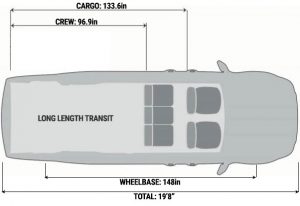
Long-Extended
- Full Time Vanlife.
- With all the amenities (sink, oven, toilet, fridge, etc.).
- Gear for multiple sports.

Our experience with the extended length Transit
We built our van for full time vanlife, with all the amenities and for multiple sports, so the extended length Transit was a no brainer. Indeed, the high roof extended length Transit looks HUGE at first sight, but we quickly realized that the space fills up quickly, very quickly… We would definitely choose the extended length again if we had to start over!
F.A.Q.
Is parking an issue with the extended length Transit?
Every decision is a compromise. Are you willing to compromise interior living/storage space just to make it easier to park? In our opinion, if you feel like you need the interior space, then get the extended length. Yes, it’s more difficult to park, but you’ll get use to it. And if you’re into the outdoors like us, you’ll spend most of your time in rural or semi-rural areas anyway. If the primary use for your van is dwelling in large urban areas, then in this case the extended length might not be ideal.
Is the overhang (2ft) behind the rear wheels an issue for off-roading?
That overhang is definitely the weakest point of the extended length for off-roading; the rear bumper (or trailer hitch if you have one) will touch the ground in water bars (dips) or on steep departure angle. So if the primary use for your van conversion is off-roading and getting anywhere is very important for you, then consider the long length instead. On the other hand, if the primary use for your van is to get you to the trailhead to ride your bike (like us!), then you’ll be able to make it. Personally we wouldn’t want to compromise on interior space, so we don’t look back on the extended length. We see our van more like a very capable RV, not like a Jeep. 🙂
Powertrain

Engine
3.5L PFDi V6 Engine
Standard engine. Less high-tech features often means less potential for failures.
- Direct injection.
- 275 HP
- 262 lb-ft torque
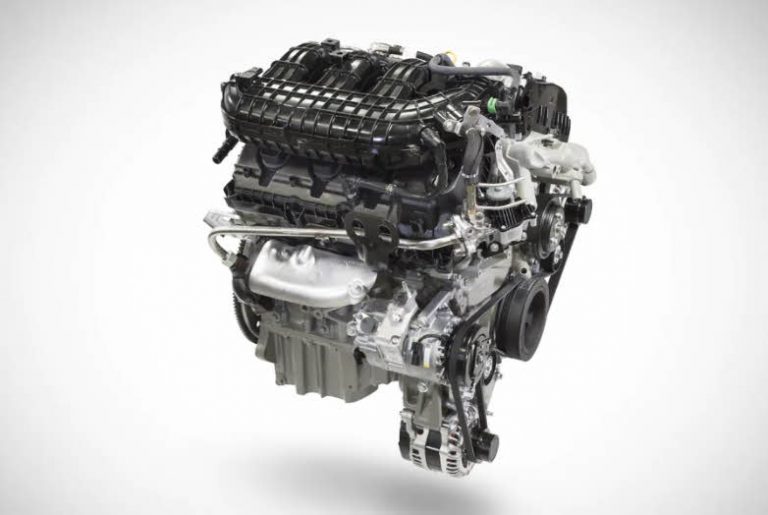
3.5L EcoBoost V6 Engine
More power, more fun. The EcoBoost has been around for a while by now, people LOVE it. Turbo engines perform better at higher altitudes than naturally aspirated engines. It’s a good option for the re-sale value of your van.
- Twin turbo
- 310 HP
- 400 lb-ft torque

Our experience with the 3.7L V6 engine and the 3.5L EcoBoost
Until 2020, the 3.7L V6 engine was the standard engine on the Transit. We went for it because we knew it would be the most reliable choice, and indeed we didn’t get a single issue with it so far (80,000 miles). It’s powerful enough to get us from point A to point B (we do a lot of mountain driving), but we wouldn’t mind the extra power of the EcoBoost… In fact, everyone we talk to absolutely love the EcoBoost, so we’d most likely get that next time!
Our 2021 Transit has the 3.5L EcoBoost, and we can definitely feel the power! It’s SO FUN to drive, very happy so far! Our conversion is not done at the time of writing these lines, so we still don’t carry much weight. But even at max capacity we feel like the van will still have plenty of extra power.
Transmission
The Transit now ships exclusively with the 10-Speed SelectShift transmission. This transmission is part of a joint-venture between Ford Motor Company and General Motors. More cool facts here:
autoinfluence.com/11-things-you-need-to-know-about-ford-gms-10-speed-transmission
Drive
Rear Wheel Drive
That was the only option from 2015 to 2019. This is what we personally have, please read “our experience” below to get our feedback.
All Wheel Drive
On 2020, all wheel drive (AWD) was introduced on the Ford Transit van. The AWD system improves traction by instantly balancing the torque on the axle that needs it the most (front/rear). Note that the AWD van has the same ground clearance as the RWD (no lift kit included). If you’re into the market for a van with enhanced traction, but pushing the limits of where you can get off-road is not your thing, then AWD is the perfect match.
On the other hand, a “true” 4×4 system normally has the ability to lock the 4 wheels (all 4 wheels are turning simultaneously at all time) and also has low-range gear(s). So if you’re an off-road enthusiast and enjoy taking your van as far as you can on rough terrain, then consider getting a 4×4 van with a lift kit. Keep in mind that a full campervan conversion (with all the amenities, etc.) is quite heavy and isn’t much fun to drive off road (think of the dishes rattling and all…).
Our experience with RWD
Since 2017, we’ve been lucky enough to spend most of our time chasing mountain biking trails and backcountry skiing zones throughout North America. This means a LOT of driving on the backroads, in summer AND in winter. We also use our van quite a lot as a mountain biking “shuttle” on steep logging roads here in British Columbia.
From our experience, a RWD van (with limited slip) is very capable, as long as there’s weight in the back (very important) and with appropriate tires (all-terrain tires or snow tires).
After 4 years driving from Mexico up to Alaska, in all kind of conditions (loose dirt, snow, ice), to access remote locations for mountain biking and backcountry skiing, our opinion is that AWD or 4×4 is NOT mandatory. We did just fine with the RWD and limited slip differential.
That being said, if you’re into the outdoors like we are, we would recommend AWD or 4×4 if your budget allows it. Even if we think it’s not mandatory, it’s a nice feature for sure. Indeed, to access some ski areas, AWD or chains (faroutride.com/thule-snow-chains-review) are sometimes required; installing snow chains in the cold/snow sucks, so we wouldn’t miss this. And even if we don’t get stuck (we actually got stuck venturing in the sand twice, and we confirm that the Maxtrax Recovery Board are a life saver!), having AWD would probably give us a little boost in confidence when we’re far out there.
To better grasp what we’re into and where we go with our van, check out our Tales From The Road and our Winter Vanlife Guide.
Battery
Single AGM
Dual AGM
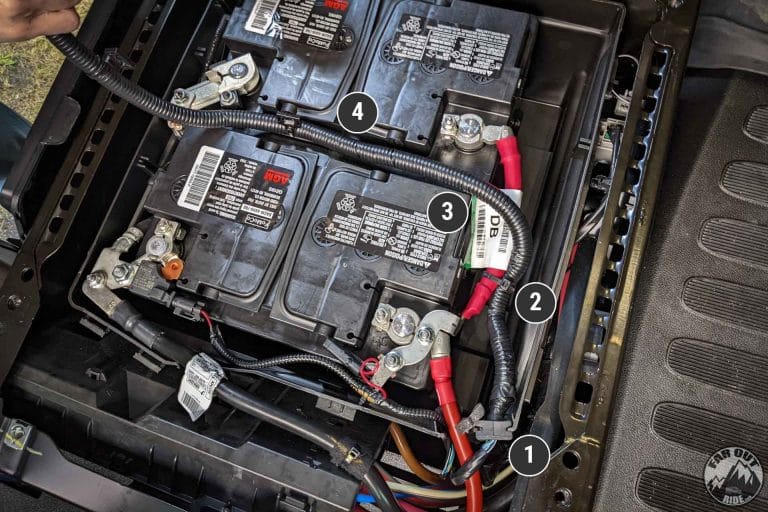
You’ll most likely spend some time using the radio when parked. Or you might want to connect loads to the auxiliary switches (e.g., Air Lift Suspension Kit, LED bar, etc.). Or using the van in winter is harsher on the batteries. At last and most importantly, the single battery often doesn’t come with CCP 2. CCP 2 can handle up to 175A and can be used to charge your aux. battery bank: Ford Transit Alternator Charging.
Rear Axle Ratio
A higher axle ratio offers a better mechanical advantage and is therefore better suited for higher payloads and steep, sustained mountain driving (like mountain bike shuttling). The downside is higher gas consumption on highways, because RPMs are higher.
3.73 Limited Slip Axle
3.73 Non-Limited Slip Axle
4.10 Limited Slip Axle
Limited Slip Differential (LSD)
The Limited Slip Differential (LSD) is a feature to increase traction. If a wheel slips, power is transferred to the other wheel (on the same axle) simultaneously. In other words, both wheels on the axle are working together. It is not an electronically controlled system (by sensors or such); it’s actually a mechanical device (clutch) on the differential. The LSD system cannot be turned off (which is fine). The LSD is an optional feature and we HIGHLY recommend it as it makes a HUGE difference! Here is a quick demo of the LSD in action that we did a while ago:
The LSD is offered both for the RWD and the AWD. Why the AWD? Aren’t all wheel already controlled by the AWD system? The AWD is an electronic system able to balance the torque between the front axle and the rear axle, but not between the left/right wheels. So adding the LSD option still has benefit with the AWD.
Rear Wheels
Single Rear Wheel
Recommended. More interior space, better handling in snow.
Dual Rear Wheel
Extra payload capacity.
Alternators
Single (250A)
The Transit comes with a 250A alternator as standard. The van draw current from the alternator to feed its own electrical systems; it is unclear how much current exactly, but it is believed to be in the 80-100A range. The extra current can then be used to charge the auxiliary battery bank.
Dual (250A each)
In our opinion, the dual alternator option is not required for camper van conversions, as the single 250A alternator has enough “buffer” to charge the auxiliary electrical system.
Packages
The idea behind the packages is to bundle features to make the ordering process easier. Note that these features are all available individually under the “Interior” and “Exterior” sections; the packages do not add new extra features (except for the HD Tow Package below). In our opinion, packages actually make things more confusing, but it is what it is… We won’t list every single package available; we want to focus on what we think is not to be missed.
RV Prep Package
- Modified Vehicle Wiring System
- Dark Palazzo Gray Cloth, 4-way manual swivel Driver and 4-way manual swivel Passenger
- Black Trimmed HID Headlamps
- Wiper Activated Headlamps
- Front Bumper, Body Colored
- Front Fog Lamps
- Carpet, Front only
- 7 speakers (4 front/2 rear)
Modified Vehicle Wiring System
Included with the Upfitter Package (recommended), keep scrolling.
Heavy-Duty Trailer Tow Package
Includes:
• Tow/Haul Mode with Trailer Wiring Provisions
• 4/7 Pin Connector Assembly and Rear Jumper
• Relay system for backup/B+/Running Lights
• Frame Mounted Hitch Receiver
We personally like the Tow/Haul mode for urban driving in heavy traffic (with frequent and unplanned acceleration/deceleration), because the tow mode extends the shift points (the engine revs higher) and adds engine braking when decelerating. For mountain driving, we prefer the SelectShift (to manually select the gear, but that’s us; the normal mode works just fine too!) And also, the hitch receiver acts as a skid plate for the rear bumper.
Upfitter Package
- High Capacity Upfitter Switches
- Large Center Console
- Auxiliary Fuse Panel with High Spec Interface Connector
- Dual AGM Batteries
- Modified Vehicle Wiring System
The key point with this package is the get the CCP2 (customer connection point #2). The CCP2 allows to tap into the alternator power and charge your house battery when driving, using a B2B charger (per our camper van wiring diagram). It consists of an electrical terminal (size M8) rated for up to 175A, located on the driver side pedestal (near the driver door).
Per BEMM: “Most vehicles with single battery will not have CCP2. Only those vehicles with twin batteries or certain SVO options with will have CCP2, check with your local Ford dealer for details. If CCP2 is required then order kit KU5T-14D089-B”
Exterior
Our goal here is to go through the options we think are essential (or useful) for a van conversion. We won’t list every single option available; we want to focus on what we think is not to be missed.
Body Paint
Our experience with a Dark Color

It’s no secret that dark colors absorb more heat. On a hot sunny summer day, the exterior of our van gets so hot that it’s impossible to touch it for more than 1-2 seconds! The metal absorbs heat and then radiates inside the van. Insulation (Thinsulate) will slow down the heat transfer, but over a few hours some heat eventually finds its way inside (just like a beer cooler eventually gets warmer; insulation slows down the heat transfer, it doesn’t completely stop it!). Of course, the dark color plays in our favor in winter, but it’s easier to heat the van (Webasto/Espar Heater) than to cool it down (Maxxfan Installation, Mosquito Screens). On second thought, we will choose a lighter color on our next van.
Windows
We personally enjoy the factory window in the passenger-side cargo door. It’s nice to check out the view when camping, it helps with ventilation (note: the factory side cargo door window does not open anymore since 2020 or so), but most importantly, in some situations, it’s the only way to see the incoming traffic when turning left at a fork. Unfortunately, it comes as a package with the rear cargo door windows and we don’t think they are necessary. With the permanent bed platform and garage layout, we never use the rear windows; our insulated window covers are always on them… To sum it up, we would most likely order a Transit without windows and add one to the sliding door and in the bedroom (bunk window) ourselves.
Mirrors
In our opinion, heated mirrors are a must for sub-freezing areas (the mirrors tend to fog and freeze a lot). And on a large vehicle like the Transit, we think the turn signals are an important safety feature.
Fuel Tanks
31 gallons instead of 25 gallons. Not necessarily a “must have”, but it’s nice to know it’s available as an option.

Options
Wheel Well Liners
Keys: 2 additional (4 total) with key fobs
Spare tire and wheel delete
Select this if you plan on using 3rd party wheels, and hang your spare tire to the rear door, or install an underfloor water tank:
Keyless Entry Keypad
Interior
Seats
Factory or Aftermarket Swivel?
Factory
The benefits of ordering the factory swivel seats are no installation, and shorter base (better driving position). The factory swivels are not offset, meaning that to complete a 180° rotation, you need to play with the seat settings (fwd/rear) in order to clear the steering wheel, the center console and the door panel. The only option available with the swivel is the 4-way manual seat. Also, take note that you cannot start the engine when a seat is not locked in forward position.
Aftermarket
We highly recommend the Scopema swivel; it’s the most popular option with a reason. The Scopema swivel raises the seat by only 0.75in, doesn’t rattle or wobble, operates smoothly, and is slightly cheaper than factory swivels. See our Swivel Seat Side-by-Side Comparison. Going with an aftermarket swivel enables you to choose any seat option (e.g. 10-way powered and heater seats), and you won’t get the safety alarm sound. It shouldn’t take more than a couple hours to install both the driver-side and passenger-side swivels (faroutride.com/swivel-transit), because it’s a simple bolt on procedure. Make sure to get the Push Down Manual Parking Brake option (code 90G, automatically included with all SRW vans) if you go aftermarket, so you don’t need to relocate the parking brake.
Front overhead shelf
We also installed an aftermarket headliner shelf in FarOutVan 2:
Auxiliary fuse panel with high spec interface connector
Included with Upfitter Package (recommended).
The auxiliary fuse panel is used to connect accessories (such as Air Lift Kit, LED bar, etc.) to the dual AGM starter batteries. These accessories can then be switched ON/OFF with the auxiliary switches located on the dashboard.
See you on the road!





Wow, 2021, did you buy it that year? So you’ve been converting for 5 years? 😀
The EcoBoost is fun & great and pretty good on mileage, but it is a complex turbo engine and prone to failure. There was a design flaw in the earlier years, not sure when they fixed it (2020 or 2021 I think?) where the cams would eventually fail and the fix is $5k (although Ford pays for it). If you’re not sure I’d check with your Ford dealer that your engine has that new design/fix already and see if you still have warranty if not!
The Ford AWD system is a beast; I love it. Like you say, unless you’re actively rock crawling, it’ll be a better fit than a true 4WD system for almost everyone. And it can actually lock the diffs electronically, at last in some vehicles. I found this out going up an insane mud slope in Alaska on the way to Deadhorse. You can’t lock it on your own (unless you have an offroad package maybe) but the computer will detect slippage and lock the wheels for you, and give you a message in the dash.
Do you think your 2nd van build will be lighter, heavier, or similar to the first one? Aluminum might make it lighter, and no propane system etc. But sounds like you’ll have quite a lot more battery instead?
I’m not too sure about the weight, it may be a bit more because we have more components (roof rack, etc).
I think I’ll try to weight it this week, as we made good progress now… 5 years later!
Bonjour,
Merci beaucoup pour toutes ces infos!
Il semble que pour (au moins) le modèle 2025, l’option de motorisation Ecoboost n’est disponible que sur la version “commerciale” du Transit, elle n’est pas proposée sur la version “grand public”.
Est-ce que vous savez si cela change quelque chose par rapport à l’assurance/immatriculation au Québec?
Merci d’avance!
Ordered a 2024 XLT 350 Transit van , turbo boost engine, AWD,. 12passenger van
Want to covert to traveling machine,seat 6 comfortable, and foldout backseat fitting 3people.
We want overhead lighting for each seat, seat plugins for electronic laptop work. When stopped back seat folds out to sleep.
Other:when stopping cool/hear back of van. Cargo storage with ladder.Holder for 48”cooler for ice and drinks
Great information. Hope you are still in the conversion game. Question: Would like to be able to transport (seat) 4 people. Any options to add seats to the Cargo van? Thanks