

The Ford Transit van is made to order, meaning it’s built according to the customer’s specifications. There are an overwhelming number of options and features from which to choose, so it makes the ordering process quite stressful! We built FarOutVan 1 from a 2016 Transit, and FarOutVan 2 from a 2021 Transit. This order guide is based on our experience.
Please keep in mind that it’s impossible to define a complete package that would suit everyone! So we’ll try to focus on the essential stuff.
Still in planning mode? Here are a few resources:
First things first, go to the Transit “Build & Price” tool on Ford.com. This will help you customize your own Transit and get a price estimate (the price is updated as options are added or changed) and prevent you from choosing a combination of options that are not compatible together. Choose the options you want under “Select Your Configuration” widget on the right-side of the page:

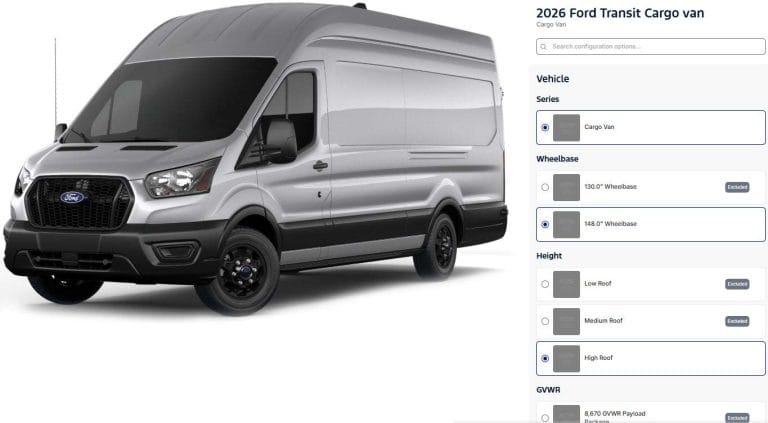
Vehicle
Series
Cargo Van
Start from a fully blank slate! Most flexible and cheapest option. The Transit cargo van is what most people choose for their conversion (including us).
Passenger Van
The passenger van is an interesting option if you want windows all around and plan on reusing the included interior finish for your conversion.
Our experience with the cargo van Transit
That’s what we used for FarOutVan 1, and that’s what we would use again if we had to start over today. In fact, we did! We’re currently building FarOutVan 2, and we went with a Ford Transit again! With a clean slate, we’re in control and can start right away without disassembling anything first.
You might be interested in our Maintenance and Repair Journal for FarOutVan 1 and 2.
Wheelbase
130 Wheelbase
More nimble for urban delivery vans.
148 Wheelbase
More living space, that’s what we would recommend for a campervan. Keep scrolling down for differences between the long and long-extended lengths.
Height
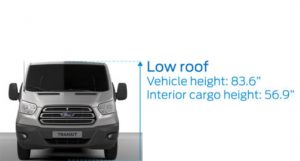
Low Roof
With 56.9″ (4’9″) interior height, it’s not possible to stand up. So we personally don’t recommend going with the Transit low roof for a campervan conversion.
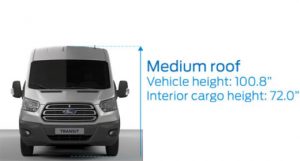
Medium Roof
After adding insulation to the floor and the ceiling, the remaining interior height is around 68″ (5’8″), which is not really enough to be comfortable in our opinion. You might be able to stand up, but it’ll feel cramped in there.
High Roof
After insulation and paneling, we’re left with an interior height of 76″ (6’4″). A high roof means more storage space and greater comfort in the long run (we don’t feel cramped thanks to the clearance above our heads). A must for full-time vanlife in our opinion!

Our experience with the high roof Transit
We honestly don’t see any real downside with the high roof… Some people say it’s hard to drive in high wind conditions; sure it’s a bit more work than a car, but you get used to it and it’s really not that bad, so we don’t see it as a deal breaker. Because we live full time in our van, being able to stand up and still have headroom draws the line between van camping and van living.
Gross Vehicle Weight Rating (GVWR)
The Gross Vehicle Weight Rating is the maximum total weight that a vehicle can handle safely, including the curb weight (empty vehicle), options, passengers, payload, fuel, etc. Driving a vehicle above its GVWR creates a potential safety hazard because the vehicle’s frame, suspension, brakes and tires are not designed for it. It is important to understand that aftermarket modifications (tires, suspension, etc.) do NOT increase the GVWR. You can read this page to learn more: Weight Ratings Explained & Van Conversion Weight Breakdown.
During a van conversion, weight adds up surprisingly fast! We’d recommend to choose the highest GVWR payload package available with the Single Rear Wheel. With Bodystyle “350” (scroll down in the configurator), you should be able to choose 9,500 GVWR Package.
Our Van GVW (Gross Vehicle Weight)
The total final weight of FarOutVan 1 is 8,950lb. That includes the curb weight, the conversion, the passengers, fuel, propane, a full fresh water tank, food, and payload (bike gear, snowboard gear, etc.). More info here:

Length (Bodystyle)
Regular
Because of limited space, we wouldn’t recommend the regular-length (130 wheelbase) Transit for a van conversion.

Long
- Weekend warrior adventure van, or short road trips.
- Limited amenities (no oven, no composting toilet, etc.).
- Gear for one sport.
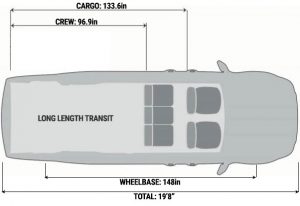
Long-Extended
- Full Time Vanlife.
- With all the amenities (sink, oven, toilet, fridge, etc.).
- Gear for multiple sports.

Our experience with the extended length Transit
We built our van for full time vanlife, with all the amenities and for multiple sports, so the extended length Transit was a no brainer. Indeed, the high roof extended length Transit looks HUGE at first sight, but we quickly realized that the space fills up quickly, very quickly… We would definitely choose the extended length again if we had to start over!
F.A.Q.
Is parking an issue with the extended length Transit?
Every decision is a compromise. Are you willing to compromise interior living/storage space just to make it easier to park? In our opinion, if you feel like you need the interior space, then get the extended length. Yes, it’s more difficult to park, but you’ll get used to it. And if you’re into the outdoors like us, you’ll spend most of your time in rural or semi-rural areas anyway. If the primary use for your van is dwelling in large urban areas, then in this case the extended length might not be ideal.
Is the overhang (2ft) behind the rear wheels an issue for off-roading?
That overhang is definitely the weakest point of the extended length for off-roading; the rear bumper (or trailer hitch if you have one) will touch the ground in water bars (dips) or on steep departure angle. So if the primary use for your van conversion is off-roading and getting anywhere is very important for you, then consider the long length instead. On the other hand, if the primary use for your van is to get you to the trailhead to ride your bike (like us!), then you’ll be able to make it. Personally we wouldn’t want to compromise on interior space, so we don’t look back on the extended length. We see our van more like a very capable RV, not like a Jeep. 🙂
Powertrain

Engine
3.5L PFDi V6 Engine
Standard engine. Fewer high-tech features often means less potential for failures.
- Direct injection.
- 275 HP
- 262 lb-ft torque
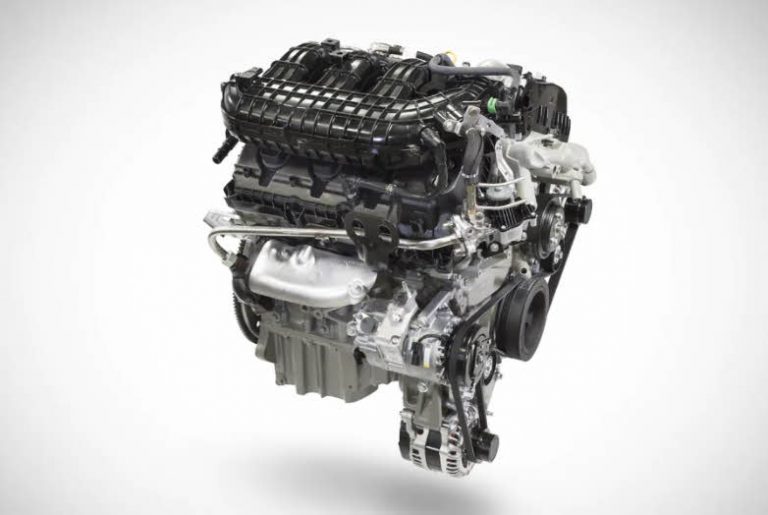
3.5L EcoBoost V6 Engine
More power, more fun. The EcoBoost has been around for a while by now, people LOVE it. Turbo engines perform better at higher altitudes than naturally aspirated engines. It’s a good option for the re-sale value of your van.
- Twin turbo
- 310 HP
- 400 lb-ft torque

Our experience with the 3.7L V6 engine and the 3.5L EcoBoost
Until 2020, the 3.7L V6 engine was the standard engine on the Transit. We went for it because we knew it would be the most reliable choice, and indeed we didn’t get a single issue with it so far (80,000 miles). It’s powerful enough to get us from point A to point B (we do a lot of mountain driving), but we wouldn’t mind the extra power of the EcoBoost… In fact, everyone we talk to absolutely loves the EcoBoost, so we’d most likely get that next time!
Our 2021 Transit has the 3.5L EcoBoost, and we can definitely feel the power! It’s SO FUN to drive, very happy so far! Our conversion is not done at the time of writing these lines, so we still don’t carry much weight. But even at max capacity we feel like the van will still have plenty of extra power.
Transmission
The Transit now ships exclusively with the 10-Speed SelectShift transmission. This transmission is part of a joint-venture between Ford Motor Company and General Motors. More cool facts here:
autoinfluence.com/11-things-you-need-to-know-about-ford-gms-10-speed-transmission
Drive
Rear Wheel Drive
That was the only option from 2015 to 2019. This is what we personally have, please read “our experience” below to get our feedback.
All Wheel Drive
In 2020, all wheel drive (AWD) was introduced on the Ford Transit van. The AWD system improves traction by instantly balancing the torque on the axle that needs it the most (front/rear). Note that the AWD van has the same ground clearance as the RWD (no lift kit included). If you’re in the market for a van with enhanced traction, but pushing the limits of where you can get off-road is not your thing, then AWD is the perfect match.
On the other hand, a “true” 4×4 system normally has the ability to lock the 4 wheels (all 4 wheels are turning simultaneously at all times) and also has low-range gear(s). So if you’re an off-road enthusiast and enjoy taking your van as far as you can on rough terrain, then consider getting a 4×4 van with a lift kit. Keep in mind that a full campervan conversion (with all the amenities, etc.) is quite heavy and isn’t much fun to drive off road (think of the dishes rattling and all…).
Our experience with RWD
Since 2017, we’ve been lucky enough to spend most of our time chasing mountain biking trails and backcountry skiing zones throughout North America. This means a LOT of driving on the backroads, in summer AND in winter. We also use our van quite a lot as a mountain biking “shuttle” on steep logging roads here in British Columbia.
From our experience, a RWD van (with limited slip) is very capable, as long as there’s weight in the back (very important) and with appropriate tires (all-terrain tires or snow tires).
After 4 years driving from Mexico up to Alaska, in all kinds of conditions (loose dirt, snow, ice), to access remote locations for mountain biking and backcountry skiing, our opinion is that AWD or 4×4 is NOT mandatory. We did just fine with the RWD and limited slip differential.
That being said, if you’re into the outdoors like we are, we would recommend AWD or 4×4 if your budget allows it. Even if we think it’s not mandatory, it’s a nice feature for sure. Indeed, to access some ski areas, AWD or chains (faroutride.com/thule-snow-chains-review) are sometimes required; installing snow chains in the cold/snow sucks, so we wouldn’t miss this. And even if we don’t get stuck (we actually got stuck venturing in the sand twice, and we confirm that the Maxtrax Recovery Board are a life saver!), having AWD would probably give us a little boost in confidence when we’re far out there.
To better grasp what we’re into and where we go with our van, check out our Tales From The Road and our Winter Vanlife Guide.
Battery
Single AGM
Dual AGM
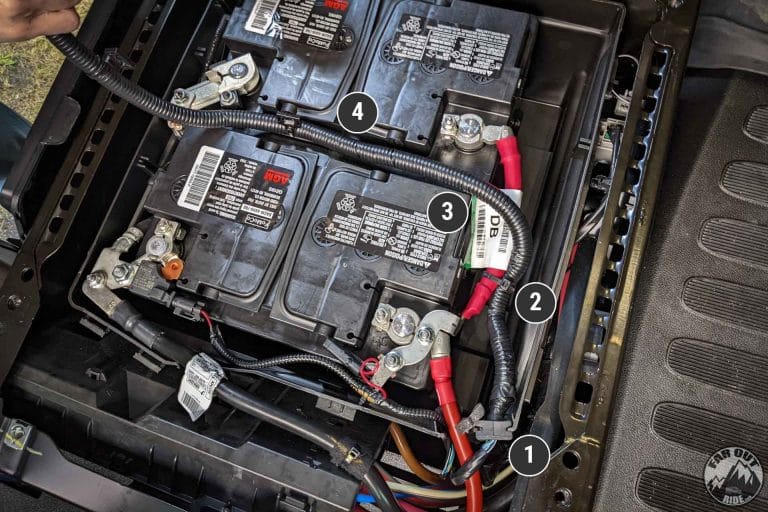
You’ll most likely spend some time using the radio when parked. Or you might want to connect loads to the auxiliary switches (e.g., Air Lift Suspension Kit, LED bar, etc.). Or using the van in winter is harsher on the batteries. At last and most importantly, the single battery often doesn’t come with CCP 2. CCP 2 can handle up to 175A and can be used to charge your aux. battery bank: Ford Transit Alternator Charging.
Rear Axle Ratio
A higher axle ratio offers a better mechanical advantage and is therefore better suited for higher payloads and steep, sustained mountain driving (like mountain bike shuttling). The downside is higher gas consumption on highways, because RPMs are higher.
3.73 Limited Slip Axle
3.73 Non-Limited Slip Axle
4.10 Limited Slip Axle
Limited Slip Differential (LSD)
The Limited Slip Differential (LSD) is a feature to increase traction. If a wheel slips, power is transferred to the other wheel (on the same axle) simultaneously. In other words, both wheels on the axle are working together. It is not an electronically controlled system (by sensors or such); it’s actually a mechanical device (clutch) on the differential. The LSD system cannot be turned off (which is fine). The LSD is an optional feature and we HIGHLY recommend it as it makes a HUGE difference! Here is a quick demo of the LSD in action that we did a while ago:
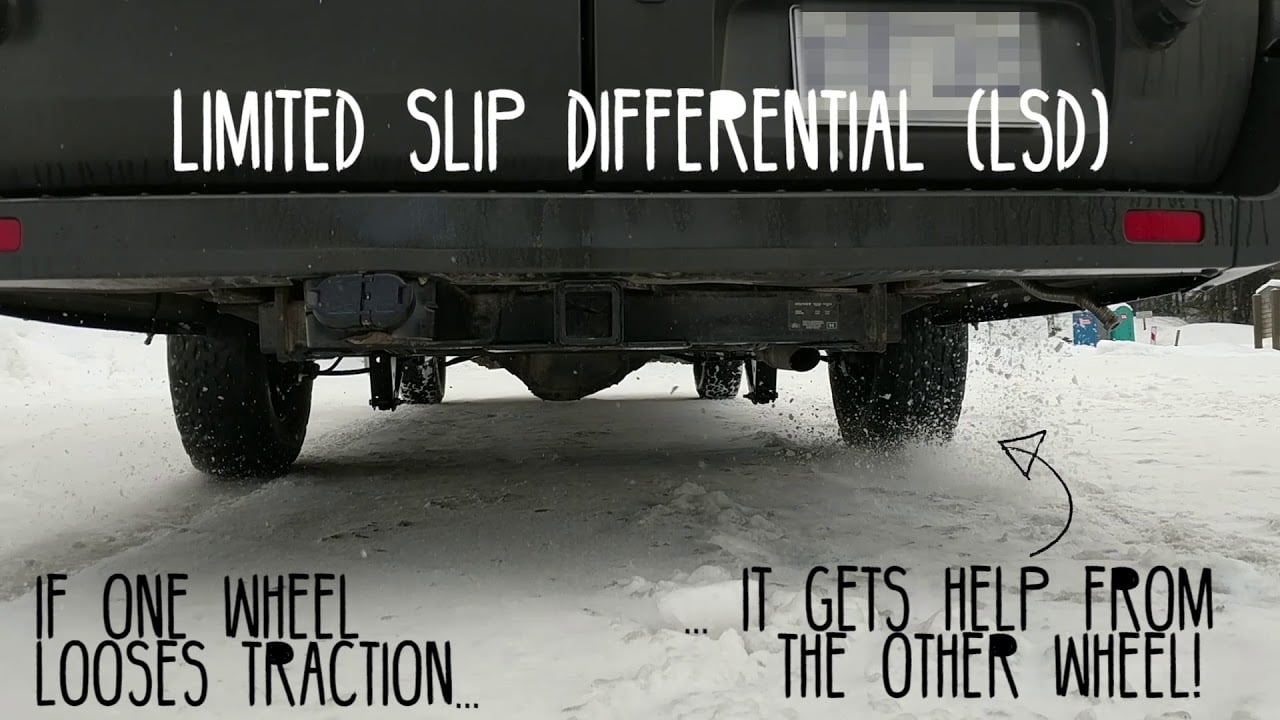
The LSD is offered both for the RWD and the AWD. Why the AWD? Aren’t all wheels already controlled by the AWD system? The AWD is an electronic system able to balance the torque between the front axle and the rear axle, but not between the left/right wheels. So adding the LSD option still has benefit with the AWD.
Rear Wheels
Single Rear Wheel
Recommended. More interior space, better handling in snow.
Dual Rear Wheel
Extra payload capacity.
Alternators
Single (250A)
The Transit comes with a 250A alternator as standard. The van draws current from the alternator to feed its own electrical systems; it is unclear how much current exactly, but it is believed to be in the 80-100A range. The extra current can then be used to charge the auxiliary battery bank.
Dual (250A each)
In our opinion, the dual alternator option is not required for camper van conversions, as the single 250A alternator has enough “buffer” to charge the auxiliary electrical system.
Packages
The idea behind the packages is to bundle features to make the ordering process easier. Note that these features are all available individually under the “Interior” and “Exterior” sections; the packages do not add new extra features (except for the HD Tow Package below). In our opinion, packages actually make things more confusing, but it is what it is… We won’t list every single package available; we want to focus on what we think is not to be missed.
RV Prep Package
- Modified Vehicle Wiring System
- Dark Palazzo Gray Cloth, 4-way manual swivel Driver and 4-way manual swivel Passenger
- Black Trimmed HID Headlamps
- Wiper Activated Headlamps
- Front Bumper, Body Colored
- Front Fog Lamps
- Carpet, Front only
- 7 speakers (4 front/2 rear)
Modified Vehicle Wiring System
Included with the Upfitter Package (recommended), keep scrolling.
Heavy-Duty Trailer Tow Package
Includes:
• Tow/Haul Mode with Trailer Wiring Provisions
• 4/7 Pin Connector Assembly and Rear Jumper
• Relay system for backup/B+/Running Lights
• Frame Mounted Hitch Receiver
We personally like the Tow/Haul mode for urban driving in heavy traffic (with frequent and unplanned acceleration/deceleration), because the tow mode extends the shift points (the engine revs higher) and adds engine braking when decelerating. For mountain driving, we prefer the SelectShift (to manually select the gear, but that’s us; the normal mode works just fine too!) And also, the hitch receiver acts as a skid plate for the rear bumper.
Upfitter Package
- High Capacity Upfitter Switches
- Large Center Console
- Auxiliary Fuse Panel with High Spec Interface Connector
- Dual AGM Batteries
- Modified Vehicle Wiring System
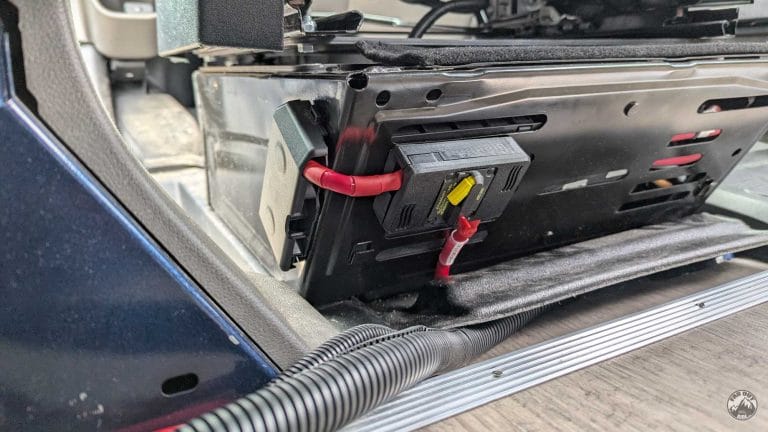
The key point with this package is to get the CCP2 (customer connection point #2). The CCP2 allows to tap into the alternator power and charge your house battery when driving, using a B2B charger (per our camper van wiring diagram). It consists of an electrical terminal (size M8) rated for up to 175A, located on the driver side pedestal (near the driver door).
Per BEMM: “Most vehicles with single battery will not have CCP2. Only those vehicles with twin batteries or certain SVO options with will have CCP2, check with your local Ford dealer for details. If CCP2 is required then order kit KU5T-14D089-B”
Auxiliary Heater Prep Package
Factory-installed engine-coolant loop under the vehicle (option code 62C), with tap points ready for a coolant-heated appliance. If you plan to make hot water from engine heat (like our Isotemp water heater install), ticking this box at order time saves you from splicing into the heater hoses later.
Exterior
Our goal here is to go through the options we think are essential (or useful) for a van conversion. We won’t list every single option available; we want to focus on what we think is not to be missed.
Body Paint
Our experience with a Dark Color

It’s no secret that dark colors absorb more heat. On a hot sunny summer day, the exterior of our van gets so hot that it’s impossible to touch it for more than 1-2 seconds! The metal absorbs heat and then radiates inside the van. Insulation (Thinsulate) will slow down the heat transfer, but over a few hours some heat eventually finds its way inside (just like a beer cooler eventually gets warmer; insulation slows down the heat transfer, it doesn’t completely stop it!). Of course, the dark color plays in our favor in winter, but it’s easier to heat the van (Webasto/Espar Heater) than to cool it down (Maxxfan Installation, Mosquito Screens). On second thought, we will choose a lighter color on our next van.
Windows
We personally enjoy the factory window in the passenger-side cargo door. It’s nice to check out the view when camping, it helps with ventilation (note: the factory side cargo door window does not open anymore since 2020 or so), but most importantly, in some situations, it’s the only way to see the incoming traffic when turning left at a fork. Unfortunately, it comes as a package with the rear cargo door windows and we don’t think they are necessary. With the permanent bed platform and garage layout, we never use the rear windows; our insulated window covers are always on them… To sum it up, we would most likely order a Transit without windows and add one to the sliding door and in the bedroom (bunk window) ourselves.
Mirrors
In our opinion, heated mirrors are a must for sub-freezing areas (the mirrors tend to fog and freeze a lot). And on a large vehicle like the Transit, we think the turn signals are an important safety feature.
Fuel Tanks
31 gallons instead of 25 gallons. Not necessarily a “must have”, but it’s nice to know it’s available as an option.

Options
Wheel Well Liners
Keys: 2 additional (4 total) with key fobs
Spare tire and wheel delete
Select this if you plan on using 3rd party wheels, and hang your spare tire to the rear door, or install an underfloor water tank:


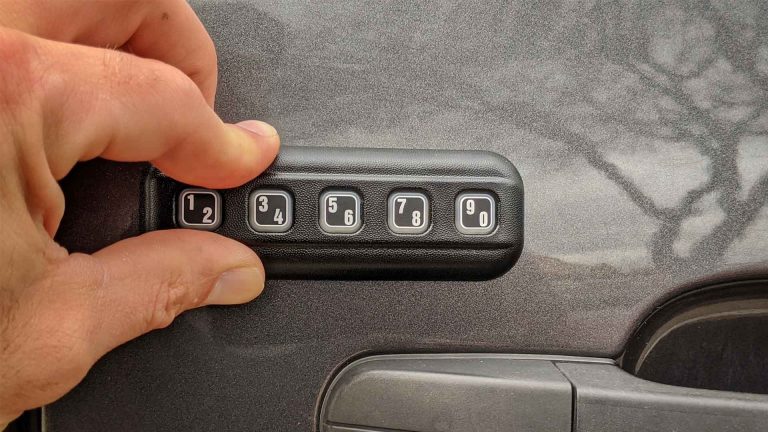
Keyless Entry Keypad
Interior
Seats
Factory or Aftermarket Swivel?
Factory
The benefits of ordering the factory swivel seats are no installation, and shorter base (better driving position). The factory swivels are not offset, meaning that to complete a 180° rotation, you need to play with the seat settings (fwd/rear) in order to clear the steering wheel, the center console and the door panel. The only option available with the swivel is the 4-way manual seat. Also, take note that you cannot start the engine when a seat is not locked in forward position.
Aftermarket
We highly recommend the Scopema swivel; it’s the most popular option with a reason. The Scopema swivel raises the seat by only 0.75in, doesn’t rattle or wobble, operates smoothly, and is slightly cheaper than factory swivels. See our Swivel Seat Side-by-Side Comparison. Going with an aftermarket swivel enables you to choose any seat option (e.g. 10-way powered and heated seats), and you won’t get the safety alarm sound. It shouldn’t take more than a couple hours to install both the driver-side and passenger-side swivels (faroutride.com/swivel-transit), because it’s a simple bolt on procedure. Make sure to get the Push Down Manual Parking Brake option (code 90G, automatically included with all SRW vans) if you go aftermarket, so you don’t need to relocate the parking brake.

Front overhead shelf
We also installed an aftermarket headliner shelf in FarOutVan 2:

Auxiliary fuse panel with high spec interface connector
Included with Upfitter Package (recommended).
The auxiliary fuse panel is used to connect accessories (such as Air Lift Kit, LED bar, etc.) to the dual AGM starter batteries. These accessories can then be switched ON/OFF with the auxiliary switches located on the dashboard.

See you on the road!





Do you recommend the 250 or 350 and why?
350, as the weight adds up surprisingly fast in a conversion! You can learn more about that here: https://faroutride.com/weight/
All the best,
Antoine
All electric drive eTransit & eSprinter ranges are improving, approaching 250 miles or so. Is it practical to upfit one of those into a campervan yet or should we wait for anything in particular? Could the RV components tap into the built in battery modules or would we still have to install our own?
I am wondering the same as well!
RV air conditioning is important, but not mentioned yet. I do not recommend roof ACs because they consume too much power, take up room for solar panels, cause wind drag, increase top-heaviness and are extremely loud. Instead, a “backpack” AC can be mounted on the rear door (or) a window unit can be installed on the back door (inverter type highly recommended). I installed a mini split on my Transit back door, but that’s highly technical. An inverter window unit is as efficient and easier to install.
Any chance you’ve seen a pdf of the 2024 order guide?
Not out yet, so it seems.
Looks like a good place for a heads up: https://www.fordtransitusaforum.com/threads/current-ford-transit-production-scheduling.95892/
This is amazingly helpful! Great to confirm my choices and get more context on why some upgrades are/aren’t worth it. Buying the builders package all-access is some of the best money I’ve ever spent! Thank you!
One question I do have is about the vinyl front/rear flooring can you expand on what you mean when you say “can be used as a template for your floor!” ?
Thanks!
For example, you can place the flooring on top of plywood to trace the contour. That’s what I meant by that 🙂
Hope this makes sense,
Antoine
This is a great web site. Your experiences are very valuable since I have also been thinking about converting a Ford Transit due to the AWD and low roof height. Here in Vancouver, BC we have problems parking overheight vehicles on the street and we often get tickets if we park for more than 3 hours even in front of our homes. Therefore, I have been thinking about getting a low roof Transit Long and adding a Sportsmobile pop-up roof. I had Westfalias previously and enjoyed the pop top. I’m just wondering if you considered the option of a pop-up roof on the Transit along your journey and any pros/cons you might be aware of. Thanks.
Personally we didn’t consider a pop top:
– We like to be able to stand up and have clearance above our head (without have to pop the top).
– We designed our van so that there is no need to make any transition between day/night.
– We use our van in winter and a pop top wouldn’t offer much insulation.
But that’s us, we all have our own requirements!
Cheers,
antoine
Hello! This page has been very helpful, informative, and thorough which I appreciate. Thanks so much! Wondering if/how often you had van trouble with a new van and how that compared w/stories from ppl you came across w/used buys. Thank you!
Hi!
We keep a logbook of all the repair we had to do on the van: https://faroutride.com/ford-transit-repair-cost/
This should answer your question 🙂
I am working with the 2023 Transit cargo van at the ford site to configure a van. I noticed they have a “trail package” quite expensive but it raises up the clearance which I would like to do. but if doing this – they don’t offer virtual rearview (which you don’t mention but is a draw to me), or remote start – (I really like remote start option). The package covers many things but also provides things I don’t want like swivel seats – (i am planning to build so cargo is cut off from cab with door). I don’t see the tires you suggested as options so I am assuming that is after market issue to get better tires? I am new here. also you did not mention roof vent . what are your thoughts for that?
Hi Michele!
Correct, we went aftermarket for the tires. And for a roof vent we recommend MAXFAN. We cover both these topics (and way more) in our Build Journal: https://faroutride.com/build-journal/
You should find answer to your questions there 🙂 If not, let me know!
Good luck with your project,
antoine
Bonjour à vous deux,
Félicitations, votre site est incroyable.
Nous pensons avoir fait une grave erreur en prenant le T 250 avec une capacité de charge maximale 9070 lbs .
Si, vous avez pris un T 350 avec une charge de 9500 livres et que vous arrivez à 8950 lbs full, et que nous, notre capacité de charge est 9070 lbs C’est limite , peu sécuritaire. Trop juste à mon avis.
Ça serait difficile de convertir la van avec cette capacité de charge ,car nous voulons vIvre à temps plein pour un long voyage.
Qu’en pensez-vous?
On nous mentionnait que t-350 venait seulement avec roue doubles.?? Donc, nous avons été induit en erreur de la part du vendeur. Nous aurions pu prendre le T-350 roue simple avec une charge de 9500lbs. Ou peut être le t-250 avec une capacité de 9500 lbs.roue simple
Est-ce que vous avez un t-350 ou un T-250 ?
Notre véhicule est le Ford transit T-250 AWd écoboost .toit haut et longueur allongée.
Entre en production en février. Il sera livré fin mars . Le vendeur nous mentionne qu’il ne peut plus rien changé sur la van . Je vais faire mes devoirs et appeler la protection du consommateur.
Sinon, nous devrons annuler la commande . Ouf!
Il faut savoir que la seule différence entre le T250 et le T350 est au niveau de la suspension arrière, qui est plus rigide sur le T350. La modification pour ajouter affermir la suspension est relativement simple et peu coûteuse, il s’agit d’une pièce similaire à celle-ci (un dealer pourrait valider et installer la bonne pièce): https://www.sdtrucksprings.com/index.php?main_page=product_info&products_id=53661
Je pense qu’idéalement il faudrait un T350 (notre Transit 2021 est un 350 roues simple), mais notre van grise 2016 était en fait aussi un T-250, nous avons ajouté un “Air Lift” pour affermir la suspension et par le fait même on peut mettre la van à niveau facilement: https://faroutride.com/air-lift-springs-installation/
À mon avis vous ne devriez pas canceller la commande, sachant la différence MINEURE entre le 250 et le 350 et qu’il est facile de faire l’upgrade de suspension!
Alors voilà, pas si mal 🙂
Just ordered a 2023 Transit today! Fingers crossed that I actually get it this year. There was an option for a “modified vehicle wiring system” and I was unsure if this would be useful connecting the new electrical system. Does anyone have experience? I could still add it to my build before production begins.
It looks like there’s a new option for 9950 GVWR with the SRW but there’s an 80mph limit?? Would you recommend going this route vs the 9500?
Hi, I’ve looked into it and I still don’t have all the info about the changes that increase the GVWR to 9,950 (apart the speed limitation)… I’ll try to find more info!
Excellent information and very helpful!
Hi there. Thanks as always for the great info.
After reading your description of the Upfitter Package, it kind of sounds like you can’t connect a DC to DC charger in the Adventure Package(and I ordered the dual battery). Is connecting a DC to DC charger possible in the Adventure Package? Also, does the Adventure Package have the Upfitter Aux Switches available? Thx!!
The adventure prep package comes with the Aux switches and you CAN charge with DC-to-DC. Please refer to page 45 of the Option List: https://faroutride.com/wp-content/uploads/2021/05/Ford-Transit-2021-Order-Guide.pdf
Regards,
antoine
Extremely detailed and thorough, thank you so much Isabelle and Antoine! Will definitely be going with a Transit after reading through all this!
The only issue I foresee in my situation is the fact that you listed 76″ as the interior height with a full install, which just so happens to be how tall I am. I really don’t want to have to hunch over in my van, so knowing this, do you have any suggestions of how I can add an extra inch or two to that height?
Our floor is quite thick. You could have less or less thicker layers and gain some room there. Hope you’ll be able to make it work!
Hello!
I just received my 2021 (extended high roof) transit and have started converting (largely based on your guides!). I have a question related to configuration that can’t be done when ordering in theory but instead needs to be done at a dealer.
Question is: Did you consider getting your SBG programmed as a ‘camper’ (described in 2020 BEMM)? I’m trying to get this done by the dealership that I purchased my transit in order to save battery when I leave the doors open, but my salesperson has never heard of it.
Cheers!
We did not, what would be the advantages?
Probably a leap or an alarm I’m not a transit user but a Ford driver.
Hey guys,
I am considering converting a my 2020 Ford Transit from a single starter battery to dual batteries as I want to increase the battery capacity. My thought is that the 2nd battery would be used for items we are adding to our cargo van like an Espar heater & Maxxair fan w/o impacting our ability to start the van (which uses the other starter battery). We are having a pop-top added this fall w/ some lights also which will also utilize this 2nd battery.
Does this sound like a sound plan? Appreciate it.
What you describe is what most people do (including us): adding a second battery bank which is used exclusively to power the “house” items (fridge, fan, espar, etc). We have a thorough article about that (with a wiring diagram): https://faroutride.com/electrical-system/
Hope that helps!
antoine
First off, just WOW what an amazing resource! Thank you very much for putting this out there.
In your recommended Ford build you chose the manual folding mirrors over the included power folding mirrors.
I would like to have the blind spot detection, but that requires the power folding mirrors in place of your recommended manual folding mirrors. So I am curious, what was your reasoning for choosing the manual folding mirrors? Thank you.
Isabelle, Antoine,
Thanks for sharing, your experience and how you have documented it, has inspired us. Our Transit, is ordered and we were confirmed that production of our order is now confirmed and scheduled for the first week of November, delivery December (keeping our fingers crossed). We’ll have to find a place to work indoors to start the conversion during winter. We might see you on the road in 2022!
cheers,
Excellent, good luck and happy conversion! 🙂
Hello Michel,
I am following Isabelle and Antoine too and was trying to order a 2021 since end of May. I am been told ( here in Gatineau QC) that the orders for 2021 ended and I will need to wait for 2022’s. They also added that the production shouldn’t start before November. I am curious to hear when did you sign your order?
Very helpful and detailed. You explain a lot about the process and the vehicle options that are not really available on the Ford site.
Thanks, glad it helped 🙂
Great Blog! Love you guys! My question is about diesel?
Do you recommend?
Do you discourage?
The vehicle will be traveling in California. I heard the diesel in Mexico is different and can mess up your engine. Have you heard this?
On new Transits, in U.S.A., the diesel is no longer an option. In case you’re considering used I’ve heard that repairs on the past diesels can be a painful experience. U.S. diesels have required ULSD ) Ultra Low Sulfur Diesel) since ~2006/8. Word is availability in Mexico is improving but you would be placing a lot of trust in the honesty of what a pump down there claims to be pumping. And, yes, the wrong fuel can cost you $$$$ in a newer diesel – think somewhere around the price of two new gas powered engines (not counting the tow back to the U.S. to have the repairs done. You didn’t want to be bitten twice, did you?)