

Van Electrical Calculator: Battery, Solar & Inverter Sizing
Tell the calculator what you’ll run in your van and for how long. It works out your daily energy use for summer and winter, sizes the battery bank, solar, alternator charger, shore charger and inverter, then builds the matching parts list. We used it to size FarOutVan #1’s system. It’s Part C of our DIY Van Electrical Guide, after Part A: Build Your Knowledge and Part B: How to Size Your System.

- Hover / tap any underlined wordUseful Tooltip! to reveal a useful tooltip.
- Start with our Electrical System Guide if you’re new to this!
12V DC
SUMMER |
WINTER |
|||||
|---|---|---|---|---|---|---|
| LOADName of the appliance. | CUR (A)AVERAGE CURRENT (in amps) drawn during operation. Find it on the product’s website, owner’s manual or spec sheet. |
HRS / DAY (h)How many HOURS per day this appliance is in operation. It’s a guesstimate. |
DAILY USAGE (Ah)CURRENT x HOURS |
CUR (A)AVERAGE CURRENT (in amps) drawn during operation. Find it on the product’s website, owner’s manual or spec sheet. |
HRS / DAY (h)How many HOURS per day this appliance is in operation. It’s a guesstimate. |
DAILY USAGE (Ah)CURRENT x HOURS |
| TOTAL | ||||||
120V AC
SUMMER |
WINTER |
|||||||
|---|---|---|---|---|---|---|---|---|
| LOADName of the appliance. | PWR (W)MAX POWER (in watts) of the load. Find it on the product’s website, owner’s manual or spec sheet. |
HRS / DAY (h)How many HOURS per day this appliance is in operation. It’s a guesstimate. |
DAILY USAGE (Ah)[(POWER/12) x HOURS] / 0.85 |
INVThis column is used to size the inverter. Check all the appliances that you plan on using simultaneously. Note that the biggest load is automatically selected by the calculator. | PWR (W)MAX POWER (in watts) of the load. Find it on the product’s website, owner’s manual or spec sheet. |
HRS / DAY (h)How many HOURS per day this appliance is in operation. It’s a guesstimate. |
DAILY USAGE (Ah)[(POWER/12) x HOURS] / 0.85 |
INVThis column is used to size the inverter. Check all the appliances that you plan on using simultaneously. Note that the biggest load is automatically selected by the calculator. |
| TOTAL | ||||||||
Battery Type
Your Type
WINTER columns added. The calculator compares summer vs winter and sizes for the worst case (highest usage).
Alternator
Size Your Main Components
Use the calculator above
Daily Energy Usage
? Ah
Battery Bank
? Ah
Solar Panels
? W
Solar Charger
?|?
Alternator Charge
? A
Shore Charger
? A
INVERTER
? W
Manual Mode Enabled.
Bold options = automagic values.
- DIAGNOSIS
- Does not compute. I need at least one load (12V DC or 120V AC) to size your system. Beep boop!
- Battery Bank: You need over 600Ah. Consider switching to Lithium instead.
- Battery Bank: You need over 600Ah and that’s over my capacity. Beep boop!
- Battery Bank: You need over 600Ah and that’s over my capacity. Beep boop!
- Battery Bank: Consider upgrading to a larger battery bank or adjusting your needs in 12V DC & 120V AC tables.
- SOLAR: The selected solar delivers too much current for this battery bank. Choose a smaller solar array or upgrade the battery bank.
- Alternator: Consider limiting the charger’s output current to 30A or upgrading the battery bank.
- Alternator: The selected charger is too big for your vehicle’s alternator (Small, Regular or Heavy-Duty/Dual). Choose a smaller alternator charger.
- Shore: The selected charger delivers too much current for your battery bank. Choose a smaller charger or upgrade the battery bank.
- Inverter: You need over 3000W and the wiring diagram doesn’t support that. Beep boop! Make sure to only check loads that’ll run simultaneously in the INV column of the 120V AC table.
- Inverter: Consider choosing a smaller inverter or upgrading your battery bank. Your autonomy is very short with the current selections.
- Inverter: The selected inverter draws too much current for this battery bank. Choose a smaller inverter or upgrade the battery bank.
- Inverter: Consider upgrading to a larger inverter or adjusting your needs in the 120V AC table.
- Heads up! We had to adjust the battery bank: no equivalent matched your new selection.
- SHORE CHARGER: not needed with inverter/charger.
Size Your Wires, Fuses & Breakers
+ Wire Lengths & Terminals Calculator

Appropriate wire gauge (AWG) varies with length & load and, therefore, is unique to each installation. Our wiring diagram automatically sizes the wire gauge, fuses & breakers to ensure that your own system is safe and performs as it should. Bonus: it also calculates all the wire lengths & terminals that you’ll need by type/gauge, which will make STEP 3 (customize your items list) super easy to complete. No other diagram does this!
- With the inputs you entered, we recommend downloading the HIGH-POWER wiring diagram.
Customize Your Items List
Fill these tables per your wiring diagram:
WIRES LENGTH (FT)
| AWG | 4/0 | 3/0 | 2/0 | 1/0 | 1 | 2 | 4 | 6 | 8 | 10 | 12 | 14 | 16 |
|---|---|---|---|---|---|---|---|---|---|---|---|---|---|
| RED | |||||||||||||
| BLACK | |||||||||||||
| DUPLEX |
TERMINALS QUANTITY
| AWG | 4/0 | 3/0 | 2/0 | 1/0 | 1 | 2 | 4 | 6 | 8 | 10/12 | 14/16 |
|---|---|---|---|---|---|---|---|---|---|---|---|
| #8 | |||||||||||
| #10 | |||||||||||
| 1/4 | |||||||||||
| 5/16 | |||||||||||
| 3/8 |
Cost EstimateIncludes everything on your Items List, except the 12V & 120V loads (appliances) and Tools. Prices on Amazon change frequently, so our estimate is subject to change.
$X,XXX USD
Items List
The list below defines your entire electrical system. Click on “ADD ITEMS TO AMAZON CART” section-by-section; make sure that all the items are valid (links to Amazon products sometimes change, please let us know if that’s the case!), and make sure all items are in stock at the moment.
Main
| # | Item | Description | Quantity | View on Amazon |
|---|---|---|---|---|
| 1 | Terminal Fuse Block with Fuse 250A | Blue Sea (Catastrophic Fail Safe. Connects directly to battery post.) | 1 | Block + Fuse |
| 2 | System Switch | Blue Sea (Main System Switch) | 1 | View |
| 3 | Bus Bar (250A, 4 studs) | Blue Sea | 2 | View |
| 4 | Cover for Bus Bar (for 250A 4 studs) | Protect the Bus Bar | 2 | View |
| 5 | 40A Breaker/Switch, Surface Mount | Between Fuse Block and Bus Bar | 1 | View |
| 6 | Fuse Block (12 circuits) | Blue Sea (12V Distribution Panel) | 1 | View |
| 7 | Fuses Kit | Assorted Fuses (2A 3A 5A 7.5A 10A 15A 20A 25A 30A 35A) | 1 | View |
| 8 | Battery Monitor | Victron BMV-712 with Bluetooth | 1 | View |
Main
| # | Item | Description | Quantity | View on Amazon |
|---|---|---|---|---|
| 1 | Class T Fuse, 300A | Blue Sea (Catastrophic Fail Safe) | 1 | View |
| 2 | Class T Fuse Block | Blue Sea (Holds the Class T Fuse) | 1 | View |
| 3 | System Switch | Blue Sea (Main System Switch) | 1 | View |
| 4 | Bus Bar (600A, 4 studs) | Blue Sea | 2 | View |
| 5 | Cover for Bus Bar (for 600A 4 studs) | Protect the Bus Bar | 2 | View |
| 6 | 40A Breaker/Switch, Surface Mount | Between Fuse Block and Bus Bar | 1 | View |
| 7 | Fuse Block (12 circuits) | Blue Sea (12V Distribution Panel) | 1 | View |
| 8 | Fuses Kit | Assorted Fuses (2A 3A 5A 7.5A 10A 15A 20A 25A 30A 35A) | 1 | View |
| 9 | Battery Monitor | Victron BMV-712 with Bluetooth | 1 | View |
Main
| # | Item | Description | Quantity | View on Amazon |
|---|---|---|---|---|
| 1 | Class T Fuse, 400A | Blue Sea (Catastrophic Fail Safe) | 1 | View |
| 2 | Class T Fuse Block | Blue Sea (Holds the Class T Fuse) | 1 | View |
| 3 | System Switch | Blue Sea (Main System Switch) | 1 | View |
| 4 | Bus Bar (600A, 4 studs) | Blue Sea | 2 | View |
| 5 | Cover for Bus Bar (for 600A 4 studs) | Protect the Bus Bar | 2 | View |
| 6 | 40A Breaker/Switch, Surface Mount | Between Fuse Block and Bus Bar | 1 | View |
| 7 | Fuse Block (12 circuits) | Blue Sea (12V Distribution Panel) | 1 | View |
| 8 | Fuses Kit | Assorted Fuses (2A 3A 5A 7.5A 10A 15A 20A 25A 30A 35A) | 1 | View |
| 9 | Battery Monitor | Victron BMV-712 with Bluetooth | 1 | View |
Battery
Nothing to show here. You need to enter some 12V and/or 120V loads, or choose a battery bank if you are in manual mode.
Battery
| # | Item | Description | Quantity | View on Amazon |
|---|---|---|---|---|
| 1 | AGM 100 Ah | Renogy AGM 100 Ah 12V | 1 | View |
Battery
| # | Item | Description | Quantity | View Link |
|---|---|---|---|---|
| 1 | AGM 200 Ah | Renogy AGM 200 Ah 12V | 1 | View |
Battery
Battery
Battery
Battery
Battery
| # | Item | Description | Quantity | Link |
|---|---|---|---|---|
| 1 | LiFePO4 105 Ah | Epoch LiFePO4 105 Ah 12V (Essential Series) | 1 | View |
Battery
| # | Item | Description | Quantity | Link |
|---|---|---|---|---|
| 1 | LiFePO4 300 Ah | Epoch LiFePO4 300 Ah 12V (Essential Series) | 1 | View |
Battery
| # | Item | Description | Quantity | Link |
|---|---|---|---|---|
| 1 | LiFePO4 300 Ah | Epoch LiFePO4 300 Ah 12V (Essential Series) | 1 | View |
Battery
| # | Item | Description | Quantity | Link |
|---|---|---|---|---|
| 1 | LiFePO4 460 Ah | Epoch LiFePO4 460 Ah 12V (Essential Series) | 1 | View |
Battery
| # | Item | Description | Quantity | View on Amazon |
|---|---|---|---|---|
| 1 | LiFePO4 100 Ah | Renogy LiFePO4 100 Ah 12V | 1 | View |
Battery
| # | Item | Description | Quantity | View on Amazon |
|---|---|---|---|---|
| 1 | LiFePO4 200 Ah | Renogy LiFePO4 200 Ah 12V | 1 | View |
Battery
Battery
Battery
Battery
Battery
Battery
Battery
Battery
Battery
| # | Item | Description | Quantity | Link |
|---|---|---|---|---|
| 1 | LiFePO4 300 Ah | Epoch LiFePO4 300 Ah 12V (Essential Series) | 1 | View |
Battery
| # | Item | Description | Quantity | Link |
|---|---|---|---|---|
| 1 | LiFePO4 460 Ah | Epoch LiFePO4 460 Ah 12V (Essential Series) | 1 | View |
Battery
Battery
Battery
Battery
Solar
Nothing to show here. You can add solar charging later if you change your mind, as our wiring diagram allows for future expansion!
Solar
| # | Item | Description | Quantity | View on Amazon |
|---|---|---|---|---|
| 1 | 100W Solar | Renogy 100W Mono Panel | 1 | View |
| 2 | Extension Cables, 8 AWG, 15 ft Red + 15 ft Black | With MC4 Connectors | 1 | View |
| 3 | Double Cable Entry Gland | For 8 AWG or 10 AWG Cable | 1 | View |
| 4 | 25A Breaker/Switch, Surface Mount | Between Panels and MPPT Charger | 1 | View |
| 5 | MPPT Solar Charger | Victron 75|15 SmartSolar MPPT | 1 | View |
| 6 | 25A Breaker/Switch, Surface Mount | Between MPPT Charger & Battery | 1 | View |
Solar
| # | Item | Description | Quantity | View on Amazon |
|---|---|---|---|---|
| 1 | 180W Solar | NewPowa 180W Mono Panel | 1 | View |
| 2 | Extension Cables, 8 AWG, 15 ft Red + 15 ft Black | With MC4 Connectors | 1 | View |
| 3 | Double Cable Entry Gland | For 8 AWG or 10 AWG Cable | 1 | View |
| 4 | 25A Breaker/Switch, Surface Mount | Between Panels and MPPT Charger | 1 | View |
| 5 | MPPT Solar Charger | Victron 75|15 SmartSolar MPPT | 1 | View |
| 6 | 25A Breaker/Switch, Surface Mount | Between MPPT Charger & Battery | 1 | View |
Solar
| # | Item | Description | Quantity | View on Amazon |
|---|---|---|---|---|
| 1 | 200W Solar | Renogy 100W Mono Panel | 2 | View |
| 2 | Extension Cables, 8 AWG, 15 ft Red + 15 ft Black | With MC4 Connectors | 1 | View |
| 3 | Double Cable Entry Gland | For 8 AWG or 10 AWG Cable | 1 | View |
| 4 | 25A Breaker/Switch, Surface Mount | Between Panels and MPPT Charger | 1 | View |
| 5 | MPPT Solar Charger | Victron 75|15 SmartSolar MPPT | 1 | View |
| 6 | 25A Breaker/Switch, Surface Mount | Between MPPT Charger & Battery | 1 | View |
Solar
| # | Item | Description | Quantity | View on Amazon |
|---|---|---|---|---|
| 1 | 300W Solar | Renogy 100W Mono Panel | 3 | View |
| 2 | Extension Cables, 8 AWG, 15 ft Red + 15 ft Black | With MC4 Connectors | 1 | View |
| 3 | Double Cable Entry Gland | For 8 AWG or 10 AWG Cable | 1 | View |
| 4 | 40A Breaker/Switch, Surface Mount | Between Panels and MPPT Charger | 1 | View |
| 5 | MPPT Solar Charger | Victron 100|30 SmartSolar MPPT | 1 | View |
| 6 | 40A Breaker/Switch, Surface Mount | Between MPPT Charger & Battery | 1 | View |
*Item #5 (Victron MPPT) is sold by Vanlife Outfitters, so it isn’t in this Amazon cart.
Solar
| # | Item | Description | Quantity | View on Amazon |
|---|---|---|---|---|
| 1 | 360W Solar | NewPowa 180W Mono Panel | 2 | View |
| 2 | Extension Cables, 8 AWG, 15 ft Red + 15 ft Black | With MC4 Connectors | 1 | View |
| 3 | Double Cable Entry Gland | For 8 AWG or 10 AWG Cable | 1 | View |
| 4 | 40A Breaker/Switch, Surface Mount | Between Panels and MPPT Charger | 1 | View |
| 5 | MPPT Solar Charger | Victron 100|30 SmartSolar MPPT | 1 | View |
| 6 | 40A Breaker/Switch, Surface Mount | Between MPPT Charger & Battery | 1 | View |
*Item #5 (Victron MPPT) is sold by Vanlife Outfitters, so it isn’t in this Amazon cart.
Solar
| # | Item | Description | Quantity | View on Amazon |
|---|---|---|---|---|
| 1 | 540W Solar | NewPowa 180W Mono Panel | 3 | View |
| 2 | Extension Cables, 8 AWG, 15 ft Red + 15 ft Black | With MC4 Connectors | 1 | View |
| 3 | Double Cable Entry Gland | For 8 AWG or 10 AWG Cable | 1 | View |
| 4 | 60A Breaker/Switch, Surface Mount | Between Panels and MPPT Charger | 1 | View |
| 5 | MPPT Solar Charger | Victron 100|50 SmartSolar MPPT | 1 | View |
| 6 | 60A Breaker/Switch, Surface Mount | Between MPPT Charger & Battery | 1 | View |
*Item #5 (Victron MPPT) is sold by Vanlife Outfitters, so it isn’t in this Amazon cart.
Solar
| # | Item | Description | Quantity | View on Amazon |
|---|---|---|---|---|
| 1 | 720W Solar | NewPowa 180W Mono Panel | 4 | View |
| 2 | Extension Cables, 8 AWG, 15 ft Red + 15 ft Black | With MC4 Connectors | 1 | View |
| 3 | Double Cable Entry Gland | For 8 AWG or 10 AWG Cable | 1 | View |
| 4 | 70A Breaker/Switch, Surface Mount | Between Panels and MPPT Charger | 1 | View |
| 5 | MPPT Solar Charger | Victron 150|60 SmartSolar MPPT | 1 | View |
| 6 | 70A Breaker/Switch, Surface Mount | Between MPPT Charger & Battery | 1 | View |
Solar
| # | Item | Description | Quantity | View on Amazon |
|---|---|---|---|---|
| 1 | 100W Solar | Renogy 100W Mono Panel | 1 | View |
| 2 | Extension Cables, 8 AWG, 15 ft Red + 15 ft Black | With MC4 Connectors | 1 | View |
| 3 | Double Cable Entry Gland | For 8 AWG or 10 AWG Cable | 1 | View |
| 4 | 30A Breaker/Switch, Surface Mount | Between Panels and MPPT Charger | 1 | View |
| 5 | MPPT Solar Charger | Renogy Rover LI 20A MPPT | 1 | View |
| 6 | 30A Breaker/Switch, Surface Mount | Between MPPT Charger & Battery | 1 | View |
Solar
| # | Item | Description | Quantity | View on Amazon |
|---|---|---|---|---|
| 1 | 180W Solar | NewPowa 180W Mono Panel | 1 | View |
| 2 | Extension Cables, 8 AWG, 15 ft Red + 15 ft Black | With MC4 Connectors | 1 | View |
| 3 | Double Cable Entry Gland | For 8 AWG or 10 AWG Cable | 1 | View |
| 4 | 30A Breaker/Switch, Surface Mount | Between Panels and MPPT Charger | 1 | View |
| 5 | MPPT Solar Charger | Renogy Rover LI 20A MPPT | 1 | View |
| 6 | 30A Breaker/Switch, Surface Mount | Between MPPT Charger & Battery | 1 | View |
Solar
| # | Item | Description | Quantity | View on Amazon |
|---|---|---|---|---|
| 1 | 200W Solar | Renogy 100W Mono Panel | 2 | View |
| 2 | Extension Cables, 8 AWG, 15 ft Red + 15 ft Black | With MC4 Connectors | 1 | View |
| 3 | Double Cable Entry Gland | For 8 AWG or 10 AWG Cable | 1 | View |
| 4 | 30A Breaker/Switch, Surface Mount | Between Panels and MPPT Charger | 1 | View |
| 5 | MPPT Solar Charger | Renogy Rover LI 20A MPPT | 1 | View |
| 6 | 30A Breaker/Switch, Surface Mount | Between MPPT Charger & Battery | 1 | View |
Solar
| # | Item | Description | Quantity | View on Amazon |
|---|---|---|---|---|
| 1 | 300W Solar | Renogy 100W Mono Panel | 3 | View |
| 2 | Extension Cables, 8 AWG, 15 ft Red + 15 ft Black | With MC4 Connectors | 1 | View |
| 3 | Double Cable Entry Gland | For 8 AWG or 10 AWG Cable | 1 | View |
| 4 | 40A Breaker/Switch, Surface Mount | Between Panels and MPPT Charger | 1 | View |
| 5 | MPPT Solar Charger | Renogy Rover LI 30A MPPT | 1 | View |
| 6 | 40A Breaker/Switch, Surface Mount | Between MPPT Charger & Battery | 1 | View |
Solar
| # | Item | Description | Quantity | View on Amazon |
|---|---|---|---|---|
| 1 | 360W Solar | NewPowa 180W Mono Panel | 2 | View |
| 2 | Extension Cables, 8 AWG, 15 ft Red + 15 ft Black | With MC4 Connectors | 1 | View |
| 3 | Double Cable Entry Gland | For 8 AWG or 10 AWG Cable | 1 | View |
| 4 | 40A Breaker/Switch, Surface Mount | Between Panels and MPPT Charger | 1 | View |
| 5 | MPPT Solar Charger | Renogy Rover LI 30A MPPT | 1 | View |
| 6 | 40A Breaker/Switch, Surface Mount | Between MPPT Charger & Battery | 1 | View |
Solar
| # | Item | Description | Quantity | View on Amazon |
|---|---|---|---|---|
| 1 | 540W Solar | NewPowa 180W Mono Panel | 3 | View |
| 2 | Extension Cables, 8 AWG, 15 ft Red + 15 ft Black | With MC4 Connectors | 1 | View |
| 3 | Double Cable Entry Gland | For 8 AWG or 10 AWG Cable | 1 | View |
| 4 | 70A Breaker/Switch, Surface Mount | Between Panels and MPPT Charger | 1 | View |
| 5 | MPPT Solar Charger | Renogy Rover LI 60A MPPT | 1 | View |
| 6 | 70A Breaker/Switch, Surface Mount | Between MPPT Charger & Battery | 1 | View |
Solar
| # | Item | Description | Quantity | View on Amazon |
|---|---|---|---|---|
| 1 | 720W Solar | NewPowa 180W Mono Panel | 4 | View |
| 2 | Extension Cables, 8 AWG, 15 ft Red + 15 ft Black | With MC4 Connectors | 1 | View |
| 3 | Double Cable Entry Gland | For 8 AWG or 10 AWG Cable | 1 | View |
| 4 | 70A Breaker/Switch, Surface Mount | Between Panels and MPPT Charger | 1 | View |
| 5 | MPPT Solar Charger | Renogy Rover LI 60A MPPT | 1 | View |
| 6 | 70A Breaker/Switch, Surface Mount | Between MPPT Charger & Battery | 1 | View |
Alternator
Nothing to show here. You can add alternator charging later if you change your mind, as our wiring diagram allows for future expansion!
Alternator
Shore
Nothing to show here. You can add shore charging later if you change your mind, as our wiring diagram allows for future expansion!
Shore
Shore
Inverter
Nothing to show here. You can add an inverter later if you change your mind, as our wiring diagram allows for future expansion!
Inverter
Optional Items:
Inverter
Optional Items:
Inverter
| # | Item | Description | Quantity | View on Amazon |
|---|---|---|---|---|
| 1 | 2000W Inverter | Samlex NTX-2000-12 Pure Sine | 1 | View |
| 2 | Remote Control for Inverter | Included |
Optional Items:
Inverter
Optional Items:
Inverter
| # | Item | Description | Quantity | View on Amazon |
|---|---|---|---|---|
| 1 | 1500W Inverter | AIMS 1500W Pure Sine | 1 | View |
| 2 | Remote Control for Inverter | AIMS Remote ON/OFF (optional, no compatible remote on Amazon right now) | 1 | – |
| 3 | Terminal Fuse Block with Fuse 200A | Blue Sea (Connects directly on the Bus Bar. To protect inverter’s cable.) | 1 | Block + Fuse |
Optional Items:
Inverter
| # | Item | Description | Quantity | View on Amazon |
|---|---|---|---|---|
| 1 | 2000W Inverter | Renogy 2000W Pure Sine | 1 | View |
| 2 | Remote Control for Inverter | Included |
Optional Items:
Inverter/Charger
| # | Item | Description | Quantity | View on Amazon |
|---|---|---|---|---|
| 1 | 2000W Inverter/Charger | Victron Multiplus Compact 12|2000|80 | 1 | View |
| 2 | Remote Control for Inverter | Victron Digital Multi Control 200/200A GX | 1 | View |
| 3 | Class T Fuse, 300A | Blue Sea (To protect inverter’s cable) | 1 | View |
| 4 | Class T Fuse Block | Blue Sea (Holds the Class T Fuse) | 1 | View |
| 5 | 30A Shore Inlet | Park Power 30A Easy Lock RV Inlet | 1 | View |
| 6 | 30A AC Main | Breaker Between Power Inlet and Inverter/Charger | 1 | View |
| 7 | 120V AC Distribution Panel (4 Positions*) | Blue Sea Panel: AC Main + 4 Positions* | 1 | View |
| 8 | 10/3 AWG Triplex AC Marine Wire | Between power inlet & inverter/charger | 1 | View |
| 9 | 6/3 AWG Triplex AC Marine Wire | Between inverter/charger & AC distribution panel | 1 | View |
| 10 | 120V AC GFCI Outlet | GFCI, 15A | 1 | View |
| 11 | 14/3 AWG Triplex AC Marine Wire | To wire load that requires 15A or 10A breaker | 1 | View |
Optional Items:
| # | Optional Item | Description | View on Amazon |
|---|---|---|---|
| 1 | 50A Breaker (Double-Pole) | To upgrade 120V AC distribution panel to 50A instead of 30A | View |
| 2 | 20A Breaker | For load that requires 20A breaker (e.g. A/C) | View |
| 3 | 10A Breaker | For load that requires 10A breaker | View |
| 4 | 120V AC Distribution Panel (6 Positions*) | *The 6-position panel is sometimes cheaper, check it! | View |
| 5 | 12/3 AWG Triplex AC Marine Wire | To wire load that requires 20A breaker (e.g. A/C) | View |
Inverter/Charger
| # | Item | Description | Quantity | View on Amazon |
|---|---|---|---|---|
| 1 | 2000W Inverter/Charger | Victron Multiplus Compact 12|2000|80 | 1 | View |
| 2 | Remote Control for Inverter | Victron Digital Multi Control 200/200A GX | 1 | View |
| 3 | Class T Fuse, 300A | Blue Sea (To protect inverter’s cable) | 1 | View |
| 4 | Class T Fuse Block | Blue Sea (Holds the Class T Fuse) | 1 | View |
| 5 | 30A Shore Inlet | Park Power 30A Easy Lock RV Inlet | 1 | View |
| 6 | 30A AC Main | Breaker Between Power Inlet and Inverter/Charger | 1 | View |
| 7 | 120V AC Distribution Panel (4 Positions*) | Blue Sea Panel: AC Main + 4 Positions* | 1 | View |
| 8 | 10/3 AWG Triplex AC Marine Wire | Between power inlet & inverter/charger | 1 | View |
| 9 | 6/3 AWG Triplex AC Marine Wire | Between inverter/charger & AC distribution panel | 1 | View |
| 10 | 120V AC GFCI Outlet | GFCI, 15A | 1 | View |
| 11 | 14/3 AWG Triplex AC Marine Wire | To wire load that requires 15A or 10A breaker | 1 | View |
Optional Items:
| # | Optional Item | Description | View on Amazon |
|---|---|---|---|
| 1 | 50A Breaker (Double-Pole) | To upgrade 120V AC distribution panel to 50A instead of 30A | View |
| 2 | 20A Breaker | For load that requires 20A breaker (e.g. A/C) | View |
| 3 | 10A Breaker | For load that requires 10A breaker | View |
| 4 | 120V AC Distribution Panel (6 Positions*) | *The 6-position panel is sometimes cheaper, check it! | View |
| 5 | 12/3 AWG Triplex AC Marine Wire | To wire load that requires 20A breaker (e.g. A/C) | View |
Inverter/Charger
| # | Item | Description | Quantity | View on Amazon |
|---|---|---|---|---|
| 1 | 3000W Inverter/Charger | Victron Multiplus Compact 12|3000|120 | 1 | View |
| 2 | Remote Control for Inverter | Victron Digital Multi Control 200/200A GX | 1 | View |
| 3 | Class T Fuse, 400A | Blue Sea (To protect inverter’s cable) | 1 | View |
| 4 | Class T Fuse Block | Blue Sea (Holds the Class T Fuse) | 1 | View |
| 5 | 30A Shore Inlet | Park Power 30A Easy Lock RV Inlet | 1 | View |
| 6 | 30A AC Main | Breaker Between Power Inlet and Inverter/Charger | 1 | View |
| 7 | 120V AC Distribution Panel (4 Positions*) | Blue Sea Panel: AC Main + 4 Positions* | 1 | View |
| 8 | 10/3 AWG Triplex AC Marine Wire | Between power inlet & inverter/charger | 1 | View |
| 9 | 6/3 AWG Triplex AC Marine Wire | Between inverter/charger & AC distribution panel | 1 | View |
| 10 | 120V AC GFCI Outlet | GFCI, 15A | 1 | View |
| 11 | 14/3 AWG Triplex AC Marine Wire | To wire load that requires 15A or 10A breaker | 1 | View |
Optional Items:
| # | Optional Item | Description | View on Amazon |
|---|---|---|---|
| 1 | 50A Breaker (Double-Pole) | To upgrade 120V AC distribution panel to 50A instead of 30A | View |
| 2 | 20A Breaker | For load that requires 20A breaker (e.g. A/C) | View |
| 3 | 10A Breaker | For load that requires 10A breaker | View |
| 4 | 120V AC Distribution Panel (6 Positions*) | *The 6-position panel is sometimes cheaper, check it! | View |
| 5 | 12/3 AWG Triplex AC Marine Wire | To wire load that requires 20A breaker (e.g. A/C) | View |
Inverter/Charger
| # | Item | Description | Quantity | View on Amazon |
|---|---|---|---|---|
| 1 | 3000W Inverter/Charger | Victron Multiplus Compact 12|3000|120 | 1 | View |
| 2 | Remote Control for Inverter | Victron Digital Multi Control 200/200A GX | 1 | View |
| 3 | Class T Fuse, 400A | Blue Sea (To protect inverter’s cable) | 1 | View |
| 4 | Class T Fuse Block | Blue Sea (Holds the Class T Fuse) | 1 | View |
| 5 | 30A Shore Inlet | Park Power 30A Easy Lock RV Inlet | 1 | View |
| 6 | 30A AC Main | Breaker Between Power Inlet and Inverter/Charger | 1 | View |
| 7 | 120V AC Distribution Panel (4 Positions*) | Blue Sea Panel: AC Main + 4 Positions* | 1 | View |
| 8 | 10/3 AWG Triplex AC Marine Wire | Between power inlet & inverter/charger | 1 | View |
| 9 | 6/3 AWG Triplex AC Marine Wire | Between inverter/charger & AC distribution panel | 1 | View |
| 10 | 120V AC GFCI Outlet | GFCI, 15A | 1 | View |
| 11 | 14/3 AWG Triplex AC Marine Wire | To wire load that requires 15A or 10A breaker | 1 | View |
Optional Items:
| # | Optional Item | Description | View on Amazon |
|---|---|---|---|
| 1 | 50A Breaker (Double-Pole) | To upgrade 120V AC distribution panel to 50A instead of 30A | View |
| 2 | 20A Breaker | For load that requires 20A breaker (e.g. A/C) | View |
| 3 | 10A Breaker | For load that requires 10A breaker | View |
| 4 | 120V AC Distribution Panel (6 Positions*) | *The 6-position panel is sometimes cheaper, check it! | View |
| 5 | 12/3 AWG Triplex AC Marine Wire | To wire load that requires 20A breaker (e.g. A/C) | View |
Wires
Nothing to show here. You need to fill the “Wires” table in the calculator above.
Terminals
Nothing to show here. You need to fill the “Terminals” table in the calculator above.
Hardware
| # | Item | Description | Quantity | View on Amazon |
|---|---|---|---|---|
| 1 | Heat Shrink Butt Connector, Ancor Marine | To connect to Loads (75 Pack Kit) | 1 | View |
| 2 | Heat Shrink Disconnect, 10-12 AWG Cable, 1/4″ Tab, Female |
To connect to certain loads (e.g. 12V sockets), to make “removable” connections (e.g. fridge, LEDs) and to connect cables of different gauges together (e.g. LED dimmer) (25 Pack) |
1 | View |
| 3 | Heat Shrink Disconnect, 10-12 AWG Cable, 1/4″ Tab, Male | 1 | View | |
| 4 | Heat Shrink Disconnect, 14-16 AWG Cable, 1/4″ Tab, Female | 1 | View | |
| 5 | Heat Shrink Disconnect, 14-16 AWG Cable, 1/4″ Tab, Male | 1 | View | |
| 6 | Heat Shrink Disconnect, 18-22 AWG Cable, 1/4″ Tab, Male | 1 | View | |
| 7 | 3M Scotchlok Quick Splice with Gel (14 AWG stranded) | We used that to parallel our LED lights (25 Pack) | 1 | View |
| 8 | Heat Shrink Tubing Kit (with adhesive) | To protect lugs after crimping | 1 | View |
| 9 | Split Loom Tubing, 3/8″ diameter 25 feet | To protect wire bundles | 1 | View |
| 10 | Split Loom Tubing, 1/2″ diameter 25 feet | To protect wire bundles | 1 | View |
| 11 | Split Loom Tubing, 3/4″ diameter 10 feet | To protect wire bundles | 1 | View |
| 12 | Nylon Cable Clamps Kit | To secure cable/split-loom to wood | 1 | View |
| 13 | Zip Tie Mount with Adhesive | To secure cable/split-loom to metal | 1 | View |
| 14 | Nylon Zip Ties Kit | To secure cable/split-loom | 1 | View |
| 15 | Rubber Grommet Kit | To protect wires from sharp edges (through metal holes) | 1 | View |
12V Loads
These are the appliances we used in FarOutVan #1:
| # | Item | Quantity | Buy Link | More Info |
|---|---|---|---|---|
| 1 | Maxxair 6200K Roof Fan | 1 | Amazon | Fan Installation |
| 2 | LED Ceiling Lights (Dimmable) | 3 | Amazon | |
| 3 | PWM Dimmer for LED Lights, 12V, Slider | 1 | Amazon | |
| 4 | Blue Sea 12V Socket | 4 | Amazon | Electrical System Guide |
| 5 | Shurflo Revolution Water Pump, 3 GPM | 1 | Amazon | |
| 6 | ON/OFF Switch for Water Pump | 1 | Amazon | |
| 7 | Webasto Air Top 2000 STC Gasoline Heater | 1 | Vanlife Outfitters | Webasto Installation |
| 8 | Propex HS2000 Propane Heater | 1 | Dealers | Propex Installation |
| 9 | Novakool R5810 Fridge, 12V only | 1 | Campervan-HQ | Fridge Guide |
| 10 | Sirocco II Gimbal Fan, 12V | 1 | Amazon | Sirocco II Installation / Review |
| 11 | Nature’s Head Composting Toilet | 1 | Amazon | Toilet Installation |
| 12 | Propane Solenoid Shutoff Valve | 1 | Amazon | |
| 13 | ON/OFF Switch for Propane Solenoid | 1 | Amazon |
Tools
These are essential to build your electrical system. Do NOT cheap out on tools (e.g. using pliers to crimp), or you’ll compromise the performance and safety of your system.
| # | Item | Description | QTY | View on Amazon |
|---|---|---|---|---|
| 1 | Cable Cutter (up to 4/0 AWG) | For large gauge cables | 1 | View |
| 2 | Wire & Cable Cutter (2/0 – 22 AWG) | Nothing to add! | 1 | View |
| 3 | Wire & Cable Stripper (4/0 – 20 AWG) | Nothing to add! | 1 | View |
| 4 | Hydraulic Crimping Tool (4/0 – 10 AWG) | Provides adequate, repeatable results for larger gauge lugs. | 1 | View |
| 5 | Crimping Tool, Single-Crimp (8 – 22 AWG) | Single-Crimp should be used with Heat Shrink connectors to prevent tearing the insulation and loosening the watertight connection (corrosion prevention) | 1 | View |
| 6 | Heat Gun for Heat Shrink Connectors | 1800W, Variable Temperature Control | 1 | View |
| 7 | Digital Multimeter (Voltage, Current, Continuity, Resistance) | You don’t need it until you need it! Your friend when you need to troubleshoot… | 1 | View |
Made with ❤ in our van.
Sharing this tool with others is the best way to say thanks if you found it useful. Thanks for supporting us and for keeping this website alive! See you on the road 🙂
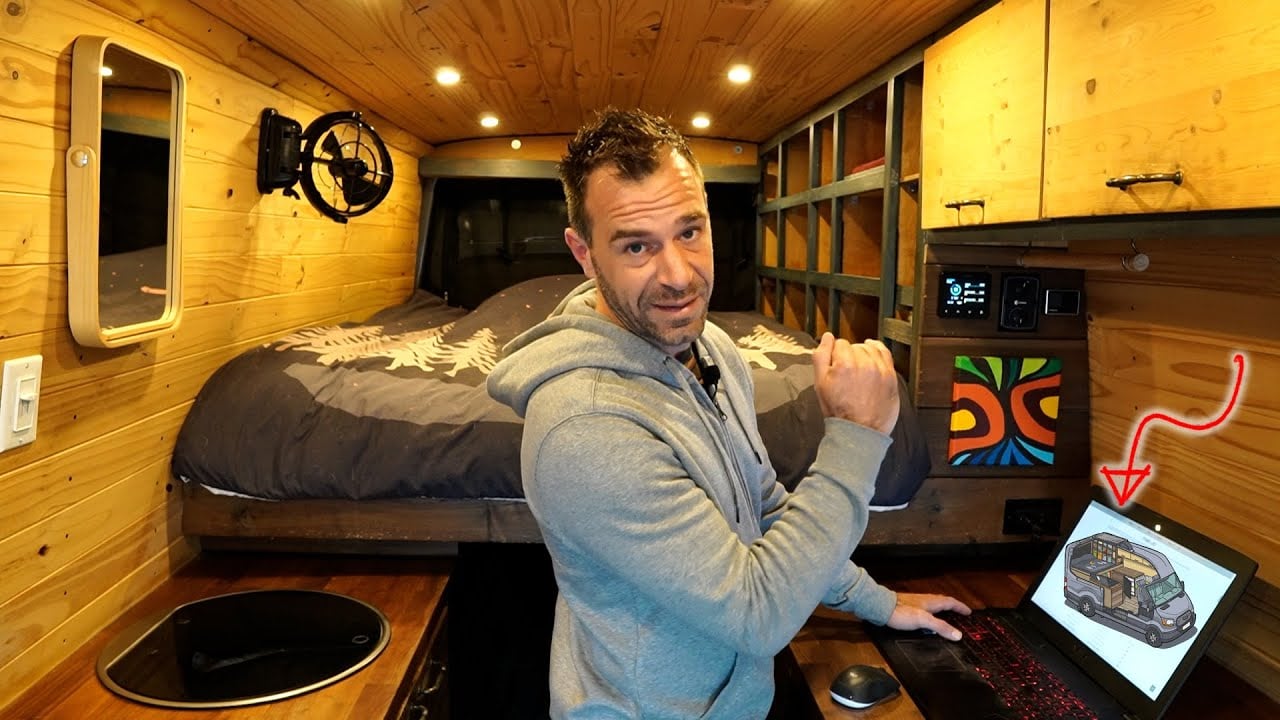
How the Calculator Works
The calculator runs the same steps as Part B of our guide, How to Size Your Van Electrical System, just faster. Here’s what happens behind each number, so you can sanity-check the results (and argue with them in the comments).
- Daily energy use. A 12V DC load uses its current times its hours per day: a fridge drawing 4 A for 10 hours is 40 Ah. A 120V AC load goes through the inverter first, so its watts are converted to amp-hours at 12V, plus 15% for inverter losses: watts × hours ÷ 12 ÷ 0.85. A 1,000 W coffee maker running 15 minutes is about 25 Ah.
- Season profile. Sun Seeker and 3 Seasons size from your summer usage. Snow Chaser adds winter columns (longer nights, heater fan, more lighting) and sizes from whichever season uses more.
- Battery bank. Daily use × 1.25 for lithium (you can use about 80% of it) or × 2 for AGM (about 50%), then × 1.5, 1.75 or 2 depending on the profile, to carry you through cloudy days. The result is rounded up to the next 100 Ah: 60 Ah a day on lithium with 3 Seasons is 60 × 1.25 × 1.75 ≈ 131 Ah, so 200 Ah. The calculator then checks that the bank can feed the inverter, at about 1 Ah of battery per 10 W of inverter: a 1,500 W inverter wants about 150 Ah.
- Solar. Watts = daily amp-hours × 4 (× 3.2 for Sun Seeker, × 4.8 for Snow Chaser). In other words, the panels have to put back your day’s amp-hours in about 3 hours of full sun (3.75 and 2.5 hours for the other profiles). That’s conservative on purpose: panels rarely deliver their rated watts on a van roof. 60 Ah a day is 240 W, so a 300 W kit.
- Chargers. The alternator (DC-DC) and shore chargers are sized from how fast the battery can take a charge: about half its capacity in amps for lithium, a fifth for AGM. The calculator warns you when a charger is too big for your alternator or your battery.
- Inverter. The bigger of your largest AC load and the loads you check as running at the same time, plus a margin: +100 W under 1,000 W, +20% above. A 1,500 W kettle alone lands on a 2,000 W inverter. Past 3,000 W, you’re beyond what our wiring diagram covers.
Our Experience
We used the calculator to size FarOutVan #1’s system, our home from 2017 to 2021: 200 Ah of lithium, 320 W of solar, a Sterling B2B alternator charger (later a Victron Orion XS 50A) and a 1,000 W inverter, with propane for cooking and hot water. In summer, solar covered our daily use on its own. In winter, harvest dropped way down and the alternator charger did most of the work: Plan B in summer, Plan A in winter. That’s why we still think solar plus alternator is the balanced combo for a van.
FarOutVan #2 runs an EcoFlow all-in-one system with an all-electric galley, which this calculator doesn’t size: it’s built for classic 12V component systems. We log what each of our appliances actually uses on our Real-World Power Data page. Handy when you’re guessing the “hours per day” column.
Frequently Asked Questions
How Much Battery Do I Need for a Camper Van?
Take your daily amp-hours, multiply by 1.25 for lithium (2 for AGM), then by 1.5 to 2 for cloudy-day reserve, and round up. A van using 60 Ah a day lands on 200 Ah of lithium. The calculator does this for you and also checks that the bank can feed your inverter.
How Much Solar Do I Need for My Van?
About 4 W of panel per daily amp-hour for three-season use (3.2 W for summer trips, 4.8 W for winter). 60 Ah a day means about 240 W, so a 300 W kit. Roof space is usually the real limit, which is why an alternator charger earns its place. Our Roof Layout Planner shows what fits.
Lithium or AGM?
Lithium (LiFePO4) gives you about 80% of its rated capacity, AGM about 50%, so AGM needs 60% more amp-hours for the same day. Lithium is also lighter, lasts more cycles and is less fussy about charging. AGM costs less up front and can be charged in sub-freezing temperatures. A lithium battery must not be charged below freezing (0°C / 32°F) unless it has a built-in heater.
What Size Inverter Do I Need?
Size it for the loads you’ll run at the same time, not your daily total. A 1,500 W kettle alone calls for about 1,800 W, so a 2,000 W inverter. Induction cooktops and microwaves usually push vans into the 2,000 to 3,000 W range.
Does It Work for 230V (UK/EU) Leisure Battery Setups?
The sizing does. A 1,000 W appliance draws the same energy from a 12V leisure (house) battery whether the inverter outputs 120V or 230V, so enter your appliances’ watts as they are. The parts list and wiring diagram use North American 120V gear, so take the sizes and shop locally.
What About 24V, 48V or All-in-One Systems?
The calculator sizes 12V systems, but the energy is the same at any voltage: a 200 Ah bank at 12V holds about as much as 100 Ah at 24V or 50 Ah at 48V. All-in-one units like EcoFlow are rated in watt-hours, so multiply your daily amp-hours by 12.5 to compare (60 Ah ≈ 750 Wh). More on choosing a voltage in 12V vs 24V vs 48V.
Is My Data Saved?
Yes, in your browser only. Your loads and choices are stored locally so they’re still there next time; nothing is sent to us. Use CLEAR to start over.
This is the third part of our DIY Van Electrical Guide trilogy:
- Van electrical system in a nutshell
- Electricity for dummies
- Battery bank
- Charge sources
- 12V DC loads
- 120V AC loads
- Monitoring
- Wires & Cables
- Terminals & Connectors
- Fuses & Breakers
- Power distribution
- Plug-and-Play (all-in-one) Systems
- Real-World Data


Part B: How to size Your System
- Calculate your power usage
- Size your inverter
- Size your battery bank
- Size your solar
- Size your alternator charger
- Size your shore charger
Part C: Calculator & Diagram





Hi Antoine,
You guys truly struck gold with this site. Well done! I noticed when using this calculator that the MPPT charger selected for me is the 150/60, which I believe is rated for 60A, but the suggested breakers to use are 70A. Why would that be? Thanks!
60A would be consider within normal range operation, so a 60A fuse could blow during normal operation. Overcurrent protection are generally 15-25% higher than the device (MPPT in this case), then the wire is sized accordingly to the overcurrent protection.
Hope this makes sense!
antoine
Your web page is an excellent resource and my thanks to both of you for putting it together.
I have one question I’d like to get your input on. I’m using your high power wiring diagram. It is my understanding that the protective device (i.e. breaker or fuse) should be located near the source of power for the cable it is protecting. The wiring diagram depicts the 400A fuse associated with the Victron inverter and the 60A breaker associated with the output of the MPPT controller inside the “Main” block close to the bus bar. I’m not sure this implies those devices should be located near the respective bus bar. My question is should the respective fuse and breaker be physically located close to inverter and MPPT controller respectively or am I mistaken on what the fuse and breaker are protecting?
Thanks
great tool! is it possible to add 230V AC for europe!?
greetings from germany!
That whuld be very nice for perfect settup
Greetings from iceland
Hey, I am planning a high-powered build (including 1800W induction, 12V-fridge) for use as all-season van-home resulting in an estimated daily use of 109Wh; I just bought a used fuel-cell from efoy (the 80Ah/d version) – how would you think that alters the requisite battery and solar dimensions? My gut feeling is it takes away 100-150Ah of estimated battery needs (which would otherwise be 340ah) and lowers the solar need by a similar wattage (as you can additionally charge 80Ah with the fuel cell even on stationary cloudy/snowy days)?
I am following your plans for a “snow chaser” setup and when looking at battle born batteries I noticed that they now have heated battery kits for colder climates. For the added cost, do you think this is something worth including? My van will be in Colorado full time. Thanks!
Yeah it wouldn’t hurt for sure!
I am learning so much! What I am worried about is mixing this with a Skoolie, 27ft bus, how interchangeable would this system be with a bus?
Hi there!
Am I able to use this instead of the blue sea brand which is out of stock? (IE is it the same product?)
https://amzn.to/3bv7Du5
Yes that’ll do! Studs are 1/4″, same as the BlueSea.
Question: I have 2015 Transit diesel with duel “heavy duty” batteries; however, the window sticker sheet makes no mention of type/s of alternater (I always thought they were called generators for diesel). Anyways, should I use 30A or 60A B2B?
My 350 duelly was purchased as a standard ‘fleet’ vehicle with no bells or whistles. Trying to finally upgrade this van properly after ripping everything out due to mold attack after 5 years of use (cheap setup with shore power via extension cord; fan-tactic fan powered by gel battery, 90 watt solar with 8 amp charge controller. No other features. Goodbye).
Your website and your builders package is really getting my brain in shape. Thank you. Geoffrey
Hey! You can definitely use a 60A B2B, that’s what most folks use for Transit with “normal” alternator.
Cheers!
Hey! I was looking at the Wiring Diagram versus the Electrical Calculator Shopping List and noticed that an item between the Batteries and the Bus Bar going towards the Fuse Block is not listed. Is this item not absolutely needed? If it is, what would that item be?
Thank you for putting this all together. You guys are awesome and if you’ve seen a surge in views in Arkansas, that would definitely be me! I’m slowly piecing the electrical all together and almost done with my plumbing!
A SHUNT. A shunt is required only if you opt for a system monitor (e.g. Victron BMV-712, Simarine). The shunt is included with the system monitor, that’s why you don’t see it in the items list 🙂
Antoine
Hi there! Thank you for all of the great information. I purchased the interactive package and am unable to see any changes made to the diagram on Adobe when I try to change the options from the drop down menus. I am on a computer for this, but nothing on the diagram changes for me when I change the options. I followed all the steps on the tutorial, but no luck. What am I doing wrong? Thanks for your help!
Vinnie L.
Do you use a Mac?
If you used Apple Preview to save the diagram, it disables the interactive features. You need to re-download the diagram again without using Apple Preview. Please follow the instructions here (scroll down until “How to download” section): https://faroutride.com/my-account/downloads/
Let me know,
antoine
Hi!
Like many have expressed – I’d be adrift without your resource. I’m plugging away with minimal frustration and a building confidence. I followed your lead for a pair of longer run 12V sockets but I’m uncertain how to connect wire to outlet (I can’t seem to find any 8AWG female disconnects)?
Also, did you keep any outlets on the same circuit (i.e. could I wire the above mentioned outlets together?)?
Thanks for any guidance you can offer. Before it’s all said and done, I’m having my work checked by an auto electrician for peace of mind. Onward!
I bought the build package which has been a great help but can’t seem to get the wiring diagram wire sizing to function on my iPad Pro to work. I assume I should be able to change wire lengths on the diagram.
When I am sure of my wire size I plan to order from Amazon and want to make sure you get your commission so if I go directly into Amazon from your diagrams etc that will insure that would occur?
Do I put everything in a cart then checkout through my account?
Hi Mark, thanks for your support!
Unfortunately interactive features do not work on phones or tablets; you must use a computer. This is an Adobe limitation we don’t have control over 🙁
Using any Amazon link on our site will work, or you can use this link to search for products and we’ll also get a commission: https://amzn.to/3xVSefL
Thanks for asking 🙂
Terminal Fuse Block with Fuse 250A Blue Sea (Catastrophic Fail Safe. Connects directly to battery post.) This is the first item on my ‘shopping list’. Amazon is providing a choice of 225 A and 300 A there is no 250A to select. So, which one should I use?
Thanks Kim
Looks like the 250A is out of stock at the moment. You can try other than Amazon, look for : “Blue Sea Systems Battery Terminal Fuse 250-AMP”
Do NOT go for the 300A instead.
Good luck,
antoine
Hello, thanks for all the great info and resources. I had a couple of questions with the High-Power diagram. I was looking to install 400 watts of solar on the roof. I don’t see that as an option in the diagram and wondered how that would change the wiring size from the charge controller to the bus bars. Also, I am stuck with understanding the 300A fuses between the system and the batteries and the one between the system and the Inverter/Charger. How are those sizes determined.
Thanks again. I look forward to your answers.
i am unable to figure out how to get my electrical choices on an electrical diagram. Does it create a custom diagram or just a parts list?
The calculator generates a custom parts list (just scroll down this page to see it); for the wiring diagram, after you download and open it in Acrobat Reader, you’ll have to manually input the value of solar, shore, inverter, etc., because it cannot be done automatically (it’s an Adobe limitation).
Cheers,
antoine
Hi, thanks for all your great information. I am planning a big electrical upgrade on my camper and I purchased your high-power wiring diagram to assist with the design. I do have a couple clarifying questions I am wondering if you could address. First, why are there 2 Class T fuses in the system between the Multiplus and battery bank? Is this necessary? Also you place a class T fuse (400 amp in my case of a 3000 watt Multiplus) between the battery and disconnect switch. Would it not be better to place the disconnect first and then the fuse, so if the fuse ever blows the switch can be shut off and you will not be working on a hot wire? Anyway, would like to get your input on this as I am making the final adjustments to my plan.
I’m so lost I don’t even KNOW how to begin to tackle all of this! I’ve been studying up and doing so much research but it’s just NOT clicking yet. These tools are so helpful, so thank you for taking the time to do this so beautifully!
120V Daily usage equation shows [(Power/12) * hours]/0.85
Shouldn’t this be [(Power/120) * hours]/0.85 ?? (Watts/120v)
Thanks – great website!
120V is converted to 12V by the inverter, because your power source (battery bank) is 12V. So that’s why we use 12V in the equation!
Isabelle and Antoine,
A big THANK YOU for providing us with all of this excellent information and also for continuing to update as you learn more and gain experience with your designs.
I have a couple questions:
I have two 100Ah lithium batteries and just purchased a 30A Samlex Smart shore charger per your recommendation. I just realized that Samlex recommends this charger for lead-acid batteries. Will it work well for lithium as well?
On your wiring diagram, you have two 12V sockets, and the wire you selected (12/2 AWG for 15 feet and 8/2 AWG for 30 feet) seems really thick for a 12V socket, especially the 8/2. Is this just to enable the use of something that has a big draw rather than just charging a phone for example?
Hope you’re getting some fresh lines this year. We’re having a pretty good season here in Taos, NM.
Marcus
I know 8/2AWG looks like a really big wire, but we didn’t want to “remember” this socket can’t take to much by limiting the wire/fuse. And if we ever sell the van, we know it is safe and functional.
As for the Samlex question, I think this comment will give you the answer you are looking for.
Good to hear you’re having a good season in NM 🙂
Did you vent your battery bank?
AGM or Lithium doesn’t have to be vented!