The Maxxfan Deluxe has been the default roof fan choice for years, but not without its quirks. The new AirPlus (a.k.a. ProBreeze) showed up in 2024, promising to address them all. Does it live up to expectations? Let’s find out!
What Is the AirPlus, Exactly?
The AirPlus is a 14″ x 14″ roof vent fan, and the first serious challenger to the Maxxfan Deluxe. It launched in Europe in 2024 and reached North America at the end of that year. It’s a direct swap for the Maxxfan, and probably not a coincidence.
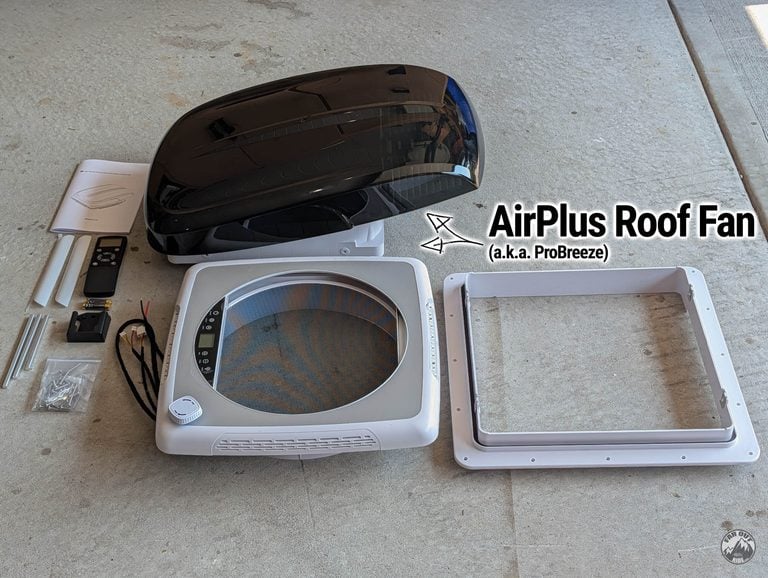
One Fan, Different Brands
There’s no single company behind this fan the way Maxxair is behind the Maxxfan. It’s designed and built in China by an OEM (Jiangsu Sanjo, model “3J-PF”) and wears a different badge depending on where you shop:
- AirPlus (NomadicArk): Nomadic Supply, DIYvan, and other US van-gear shops
- ProBreeze: Campervan HQ (USA) and Tecvan (Canada)
- Plus Fan: some US resellers
- Carbest Vanvent, Vechline, Belluna, GoCamp: Europe
The Expired Maxxfan Patent
Ever wondered why the Maxxfan went two decades without real competition? Patents. Maxxair patented its rain-shield design back in 2004, and hooded competitors only started showing up once the patent expired in 2024. The AirPlus is the first of them aimed squarely at the Deluxe rather than at the budget end: it sells for Maxxfan money.
A Better Fan?
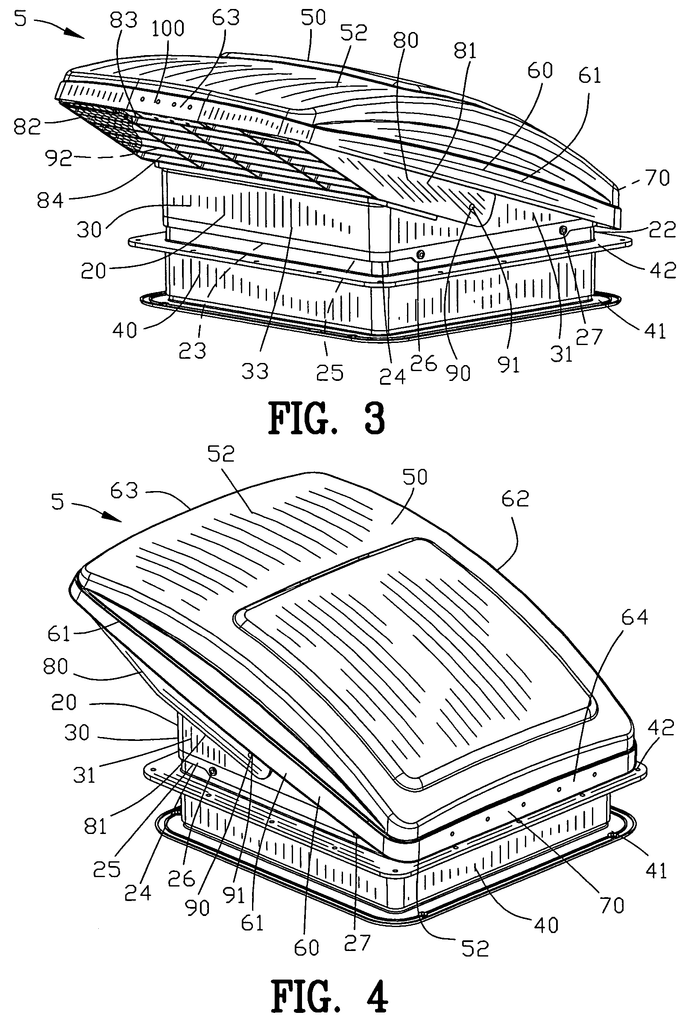
On paper, the AirPlus addresses pretty much every long-standing Maxxfan gripe:
- A brushless motor (no brushes to wear out or squeal)
- A radio-frequency remote (no need to aim directly at the fan)
- A built-in blackout blind and LED lights
- A control board that accepts 9-16 V (Maxxfan: 10.6-13.6 V).
That’s the sales pitch, anyway; the rest of this article is us putting it to the test.
Specs at a Glance
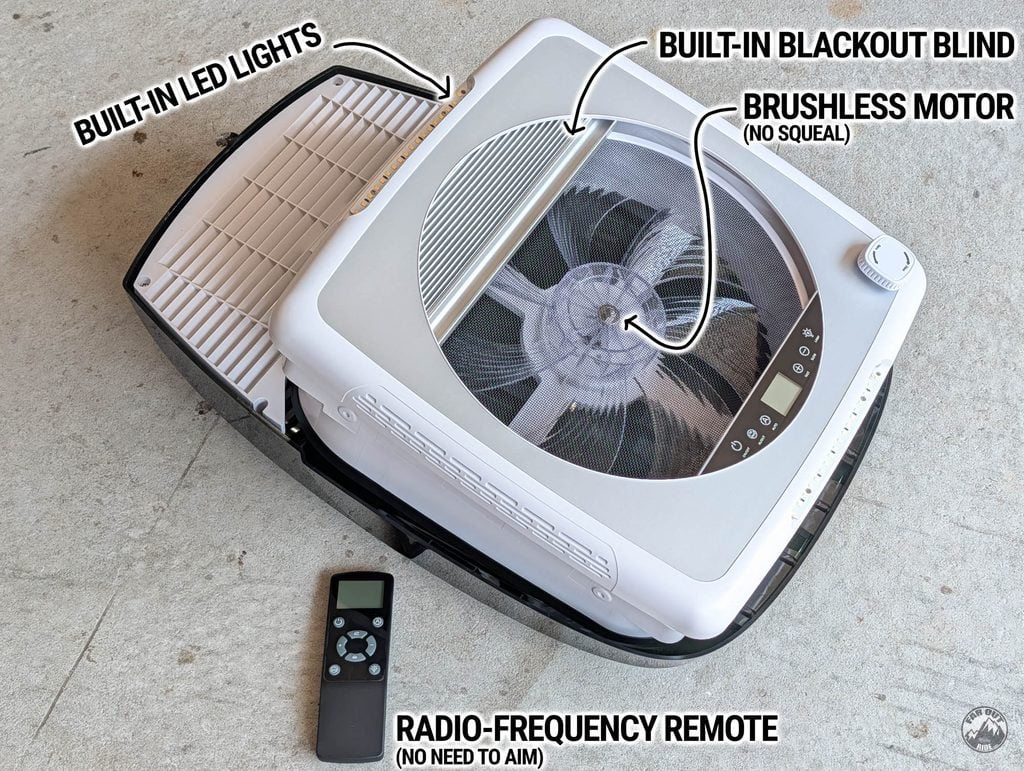
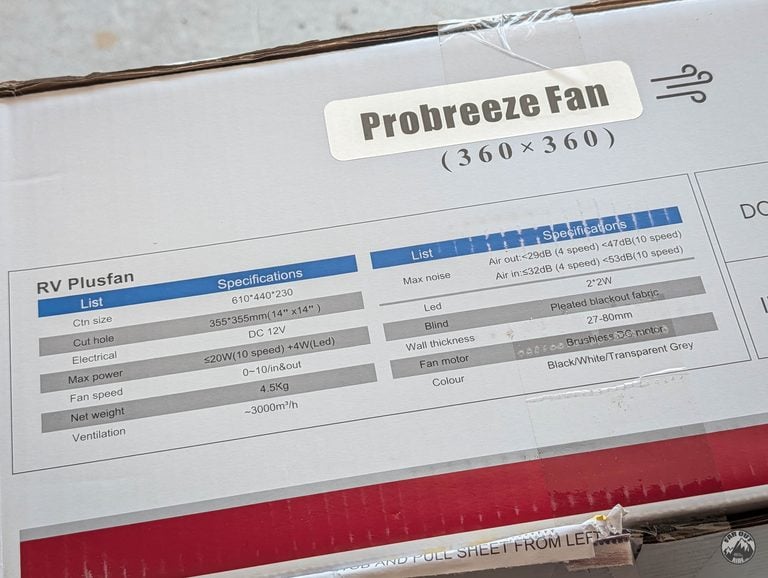
Here’s how the two compare on paper. The rows marked with an asterisk (*) are manufacturer numbers, and manufacturers are known to be, let’s say, optimistic. We measure those ourselves later in this article.
| Spec | Maxxfan Deluxe | AirPlus |
|---|---|---|
| Cutout size | 14″ x 14″ | 14″ x 14″ (400 mm version in Europe) |
| Claimed airflow* | 900 CFM | 1,765 CFM (3,000 m³/h) |
| Claimed max power draw* | 2.8 to 5 A (varies) | 1.6 A |
| Claimed noise* | Not published | 29 dB (speed 4), 53 dB max |
| Speeds | 10, intake or exhaust | 10, intake or exhaust |
| Motor | Brushed | Brushless |
| Input voltage | 10.6 to 13.6 V | 9 to 16 V |
| Lid | Electric or manual crank | Electric, with manual backup knob |
| Remote | IR, needs line of sight (7500K/7000K) | RF, works through walls; LCD screen |
| Runs in rain | Yes (built-in rain shield) | Yes (built-in rain hood) |
| Air circulation, lid closed | Yes, any speed | Limited to ~10% power |
| Blackout blind | Aftermarket | Built-in |
| Interior lights | No | Built-in LEDs, dimmable |
| Interior trim | Flush with ceiling | Sticks out ~1″ to 1.5″ |
| Roof thickness | 1-1/8″ to 6-1/2″ | 1″ to 3-1/8″ (extensions available) |
| Weight | 10.34 lb | 9.22 lb |
| Warranty | 2 years (lifetime on the lid) | 1 year (some retailers claim 2) |
| Street price (USD) | $300 to $475 | $350 to $390 |
| Street price (CAD) | ~$500 | CA $489 to $645 (varies by badge) |
| Where to buy | Campervan HQ (USA), Amazon.ca (Canada) | Campervan HQ (USA), Tecvan (Canada) |
* Manufacturer claims; see our measured results below. Prices are street prices as of August 2026.
Measured: Airflow
At 1,765 CFM, the AirPlus is rated at almost double the Maxxfan (900 CFM). Surprising, especially after being told by early adopters that the AirPlus “feels” like it moves less air than the Maxxfan… We’re very skeptical of the AirPlus claims, so we decided to check those claims on a bench.
Data Acquisition
We used aluminum flashing (leftovers from the D-pillar upholstery) to force the air through a cylinder of known diameter. Average air velocity through the cylinder is measured with an anemometer. DC power comes from a bench DC power supply, which can also measure the actual power draw (W).
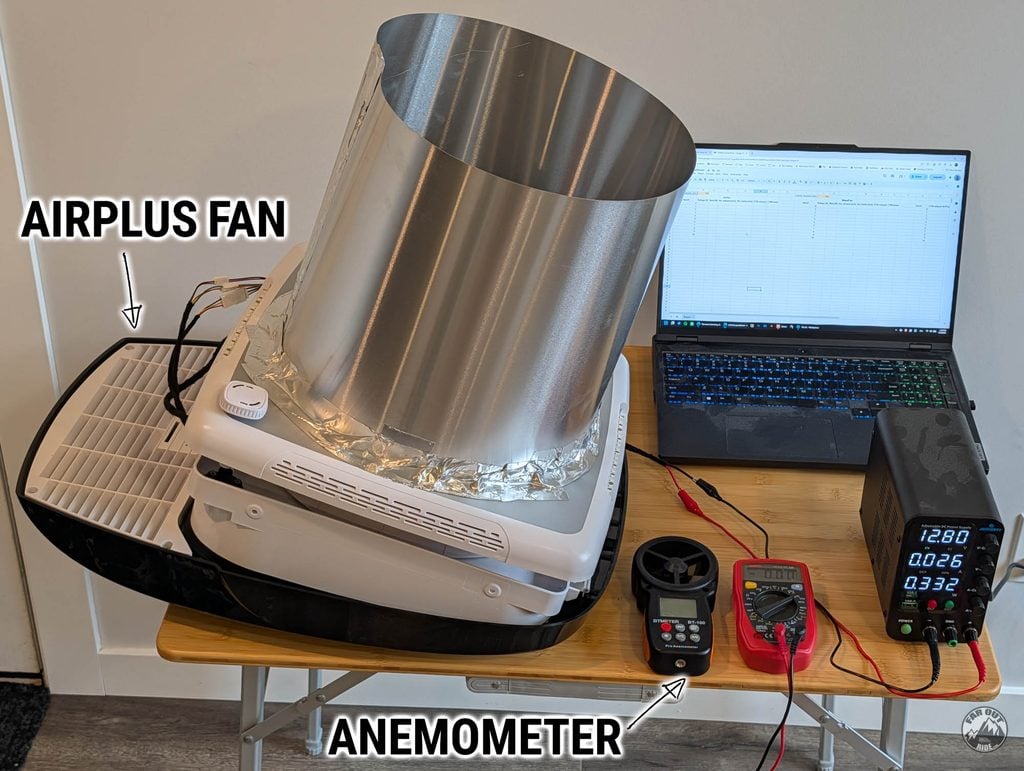
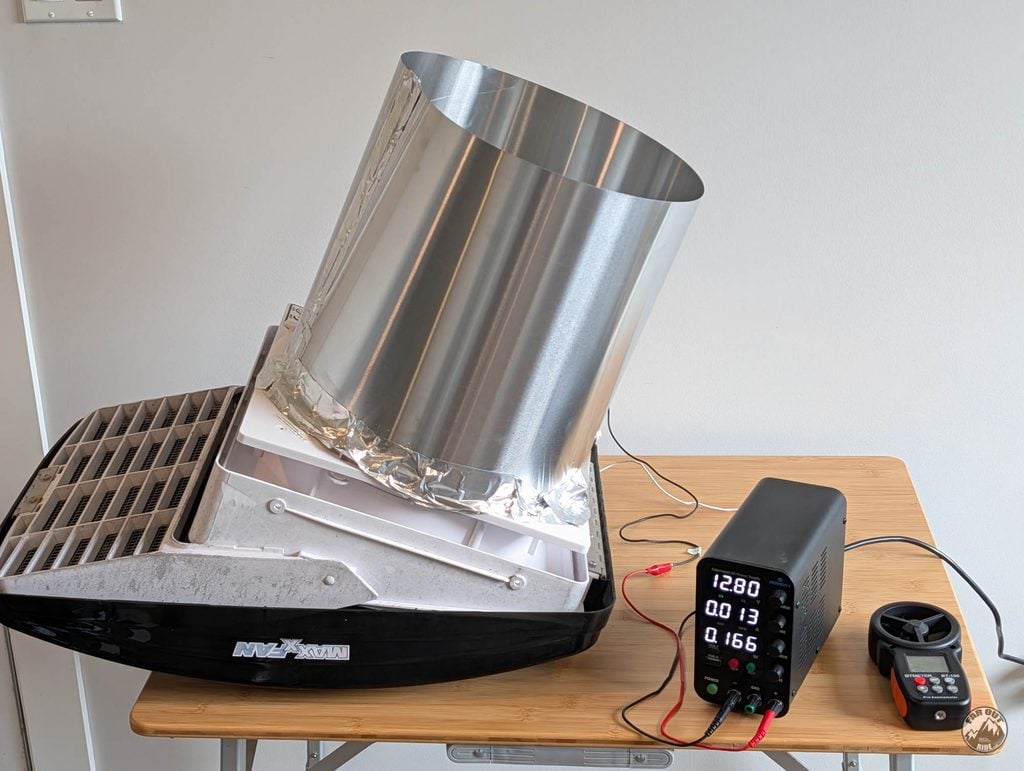
Why not make the cylinder’s throat the same diameter as the anemometer vane?
The fan can’t push air through a hole that small. Airflow is velocity × area, and the pressure needed grows with the square of velocity: forcing all the flow through a Ø85 mm throat means ~40 m/s and roughly 1,000 Pa, while a roof vent fan manages a few tens of pascals at best. It would stall against the restriction. Hence the wide Ø315 mm cylinder: it adds only ~5 Pa, and since the air moves at close to the same speed across the section, a reading over part of it stands in for the whole.
Test conditions: 12.8 V supply, Ø315 mm cylinder, bug screens in place, lid fully open, exhaust mode.
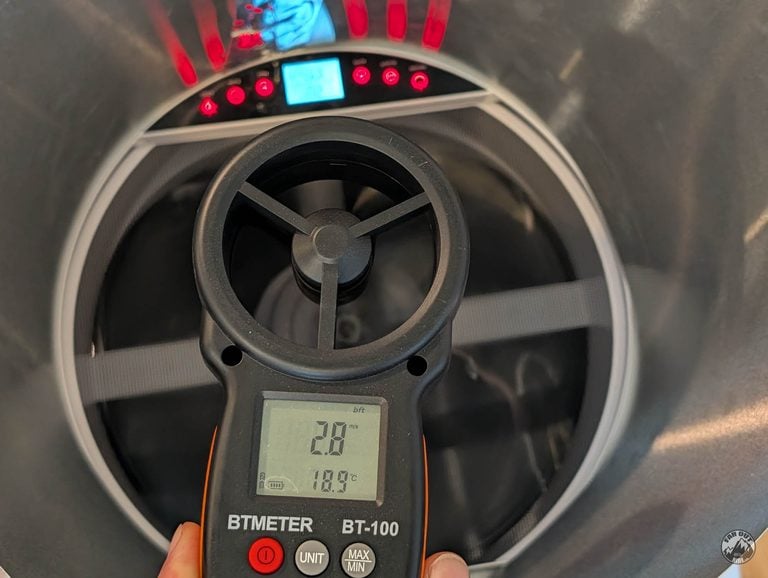
The airflow is derived from the measured velocity and the cylinder’s cross-section:
| Speed setting | Maxxfan Deluxe (CFM) | AirPlus (CFM) |
|---|---|---|
| 1 | 182 | 25 |
| 2 | 314 | 58 |
| 3 | 396 | 149 |
| 4 | 479 | 231 |
| 5 | 561 | 314 |
| 6 | 594 | 347 |
| 7 | 627 | 380 |
| 8 | 661 | 429 |
| 9 | 743 | 479 |
| 10 | 809 | 495 |
Results
The Maxxfan moves more air at every speed, and it’s not close: its speed 1 (182 CFM) already moves more air than the AirPlus’s speed 3 (149 CFM), its speed 2 (314 CFM) matches the AirPlus’s speed 5, and flat out it’s 809 vs 495 CFM, a 63% advantage. The AirPlus also flattens past mid-dial: the top half of its range adds 58% more air while the power draw quintuples, so speeds 4 to 6 are where it does its best work.
That said, in the real world, we rarely run our Maxxfan flat out: it spends most of its time at speeds 3 to 5 (396 to 561 CFM), and the AirPlus can match most of that range at the top of its dial.
Against the ratings: 495 CFM is 28% of the AirPlus’s advertised 1,765 CFM, and nothing about this rig explains a factor of 3.5; the Maxxfan’s 809 CFM lands at 90% of its 900 CFM rating on the same bench. One rating is optimistic; the other is not a rating. Whether the Maxxfan’s advantage costs watts and noise is the question the next two sections answer.
Measured: Power Draw and Efficiency
Data Acquisition
Power comes from the same bench runs as the airflow test: each fan stepped from speed 10 down to 0 at 12.8 V, holding each speed until the reading settled, watts read directly from the bench supply. We report watts rather than amps: watts are what your battery actually pays, and amps depend on the bus voltage; divide by your system voltage if you want amps. (In the van, at charging voltage, expect a bit more: our power data page logged the Maxxfan at 45 W flat out on a 13.2 V bus, vs 39 W here at 12.8 V.)
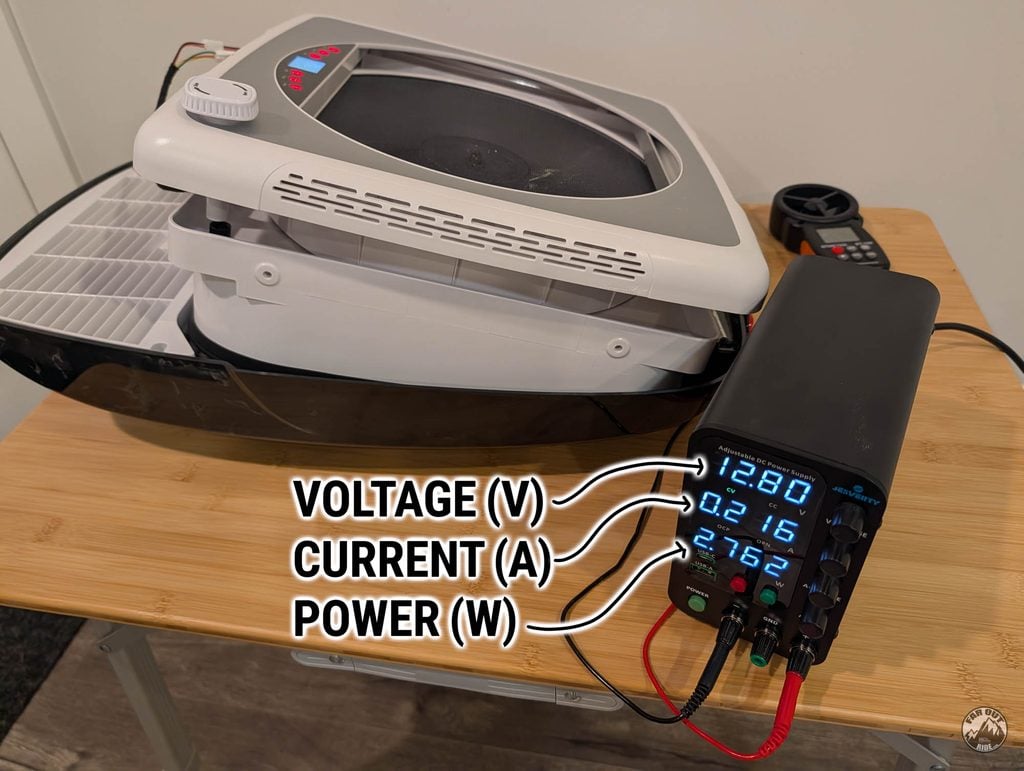
Results
| Speed setting | Maxxfan Deluxe | AirPlus |
|---|---|---|
| 0 (off) | 0.17 W | 0.33 W |
| 1 | 1.5 W | 0.74 W |
| 2 | 2.8 W | 0.95 W |
| 3 | 4.9 W | 1.62 W |
| 4 | 7.9 W | 2.81 W |
| 5 | 12 W | 4.47 W |
| 6 | 14 W | 6.8 W |
| 7 | 17 W | 9.7 W |
| 8 | 23 W | 13.3 W |
| 9 | 31 W | 17.7 W |
| 10 | 39 W | 22.8 W |
Efficiency: CFM per Watt
The Maxxfan is more efficient. For the same airflow, it draws less power than the AirPlus:
Speed settings don’t compare across fans: one fan’s “speed 6” moves a different amount of air than the other’s. Airflow per watt does compare, and for an off-grid van it’s the number that actually matters: how much ventilation you get for each watt your battery pays. Nothing new is measured here; we’re lining up the airflow and power tables above at matched airflow.
| Airflow target | Maxxfan Deluxe | AirPlus |
|---|---|---|
| ~314 CFM | 2.8 W (speed 2) | 4.5 W (speed 5) |
| ~390 CFM | 4.9 W (speed 3) | 9.7 W (speed 7) |
| ~479 CFM | 7.9 W (speed 4) | 17.7 W (speed 9) |
| 495 CFM (AirPlus max) | ~8.5 W | 22.8 W (speed 10) |
We expected the brushless AirPlus to win this table; it loses it, roughly 2-to-1. The motor isn’t to blame; the aerodynamics are: both fans move air through the same hole diameter, so at matched airflow the gap is how efficiently each impeller and hood turn watts into moving air. The Maxxfan covers the AirPlus’s entire range within its first five speeds, and since a fan’s draw grows roughly with the cube of its RPM, running high in the range is where the watts pile up.
In battery terms, it rarely matters: holding about 300 CFM overnight costs 2.8 W against 4.5 W, a 10-hour difference of 17 Wh. It only adds up when running about 480 CFM around the clock in a heat wave, 190 vs 425 Wh per day — and past 495 CFM the comparison ends, because the AirPlus has nothing more to give.
Measured: Noise
Data Acquisition
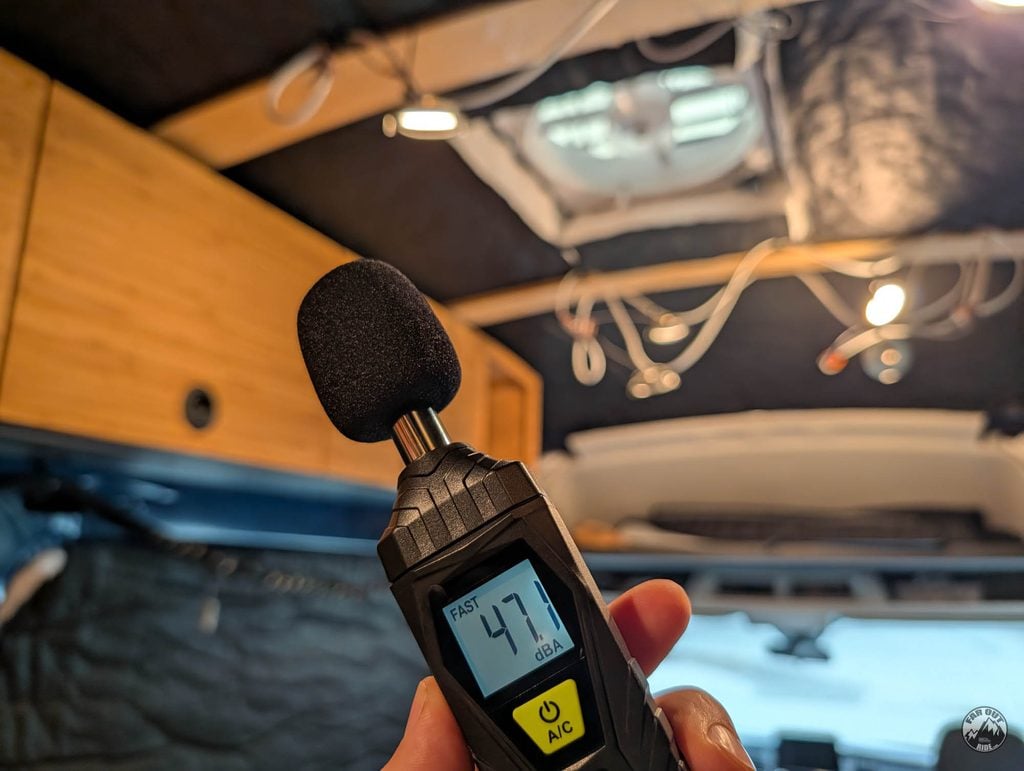
Noise is measured in the van, not on the bench: what matters is what your ears get at the pillow. Protocol: sound meter at 6 in and 2 ft from the fan, bunk window open (no air restriction). Each fan stepped through its speeds in exhaust mode, lid open. Consumer sound meters are only good to a couple of dB absolute, but both fans face the same meter in the same spot, so the comparison between them is tighter than the absolute values.
Results
All values in dBA (A-weighted). A dash means the reading was below the meter’s 30 dBA floor.
| Speed | 6 in | 2 ft | ||
|---|---|---|---|---|
| Maxxfan | AirPlus | Maxxfan | AirPlus | |
| 0 (off) | – | – | – | – |
| 1 | 34 | – | – | – |
| 2 | 39 | 31 | – | – |
| 3 | 47 | 38 | 32 | – |
| 4 | 51 | 42 | 39 | 32 |
| 5 | 56 | 47 | 43 | 34 |
| 6 | 58 | 51 | 47 | 39 |
| 7 | 60 | 56 | 47 | 43 |
| 8 | 63 | 58 | 50 | 46 |
| 9 | 67 | 62 | 54 | 48 |
| 10 | 69 | 64 | 56 | 50 |
Noise vs Airflow
For the same airflow, the Maxxfan is quieter. The chart re-plots the 2 ft readings against measured airflow rather than speed settings, and the Maxxfan curve sits below the AirPlus curve at every airflow both fans can produce. The table pins it down at matched airflows: to hold ~479 CFM at the edge of the bed, the Maxxfan runs at 39 dBA against 48, a 9 dBA gap the ear hears as roughly half as loud.
| Airflow target | Maxxfan Deluxe | AirPlus |
|---|---|---|
| ~314 CFM | below 30 dBA (speed 2) | 34 dBA (speed 5) |
| ~390 CFM | 32 dBA (speed 3) | 43 dBA (speed 7) |
| ~479 CFM | 39 dBA (speed 4) | 48 dBA (speed 9) |
| 495 CFM (AirPlus max) | ~40 dBA | 50 dBA (speed 10) |
Squealing
The dBA numbers above don’t capture everything. The Maxxfan’s brushed motor is known for developing a high-pitched squeal, and the forums are full of owners for whom that was the dealbreaker: a tonal whine is far more annoying than its dBA number suggests, and a subtle squeal running all night can spoil your sleep in a way broadband fan noise doesn’t.
Our experience: the Maxxfan squeals when new, goes quiet after the break-in period, and the squeal can come back as the motor ages. If it does, the motor can be replaced. The AirPlus’s brushless motor takes brush squeal off the table (bearings can still whine with age, but that’s rarer and a different sound), which for light sleepers may be worth more than any chart in this article.
Rattling
The Maxxfan hood is know to rattle when driving, from bumps but also from aerodynamic – especially when the fan is installed in the front (more exposure to airflow, and closest to the driver seat where noise is better heard when driving). With the lid closed there is play in the lift arm, so the hood sits on the seal with slack. At speed, air gets under the leading edge and the hood chatters against the base. You can contact MaxxAir and request a free Maxxfan Deluxe anti-rattle kit. Or, some people solves this by preloading the hood at the rear corners with self-adhesive felt furniture, or EPDM foam, under both rear corners where the hood closes. The lid then closes with slight tension and the slack is gone.
Rain and Driving
Running in the rain is the whole reason this category exists: both fans put a hood over the opening, so the lid stays open and the fan keeps running in the rain. This is the feature that used to make the Maxxfan the only choice; the AirPlus matches it.
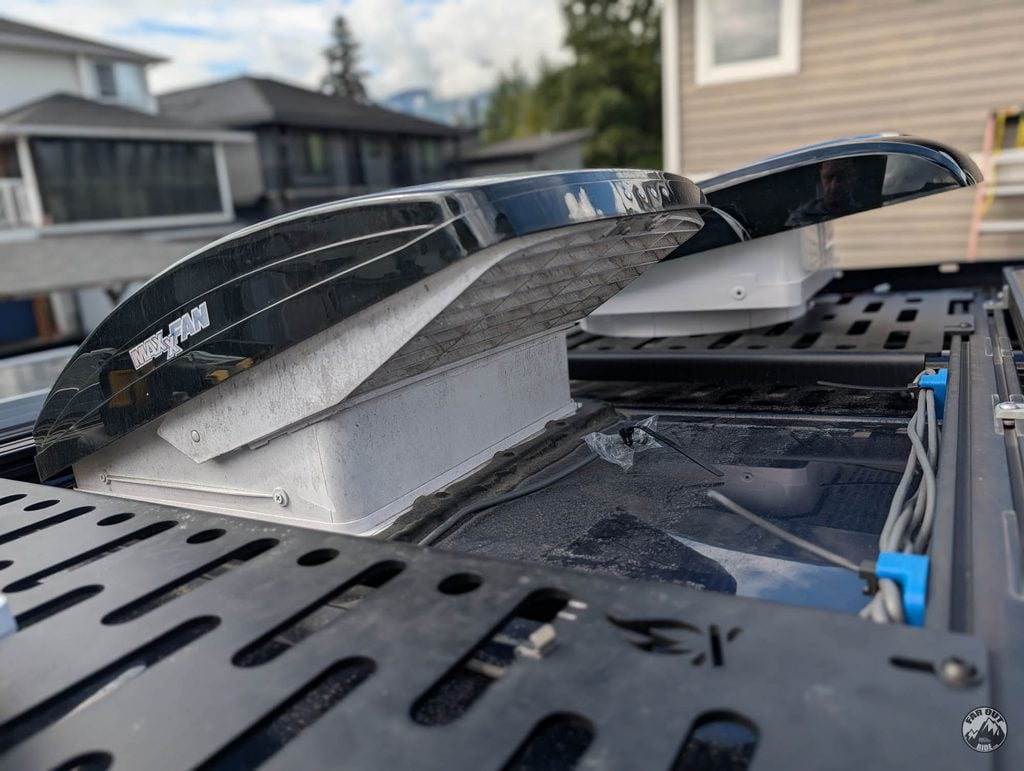
Maxxair supports driving with the lid open (twin lift arms hold it); we’ve driven with ours open for years without issue, though far-forward installs can buffet at highway speeds.
The AirPlus lid opens to a shallower angle, and its manual allows driving with the lid open but tells you to close it in strong wind or heavy rain.
Controls, Blind, and Lights
Remotes and Controls
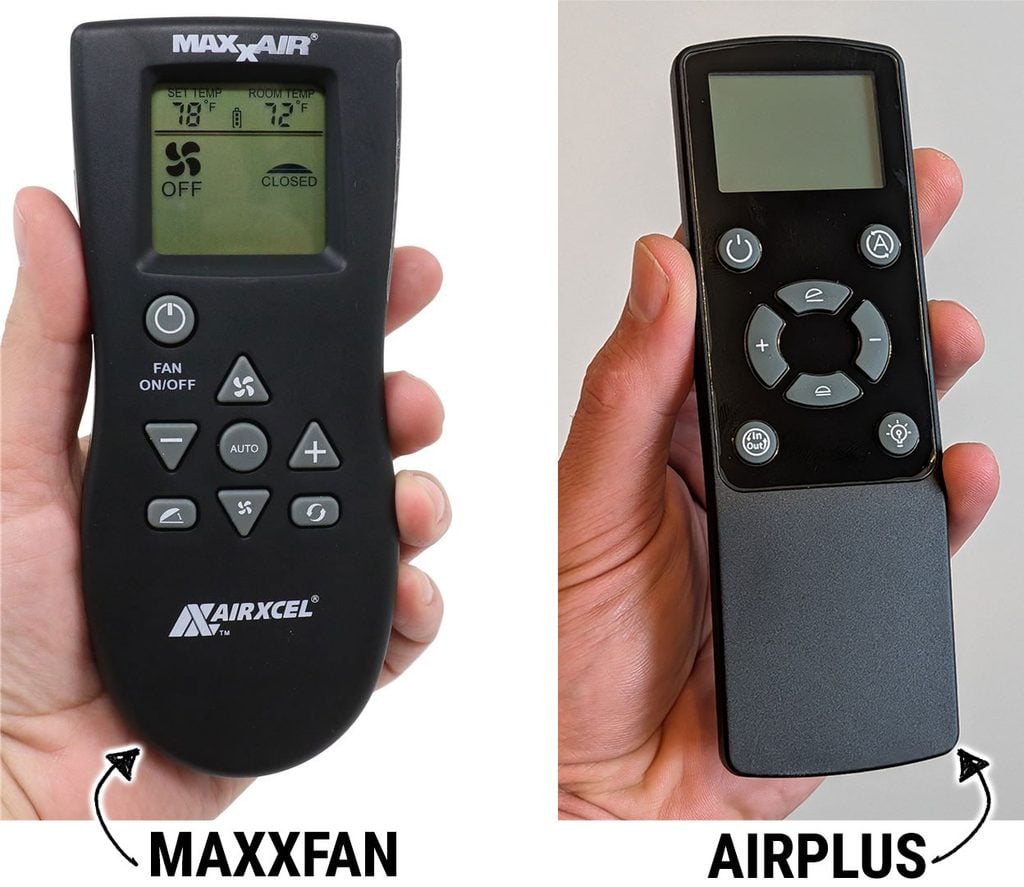
The Maxxfan‘s remote (7500K/7000K models) is infrared: point it directly at the fan and it works, point it elsewhere and it doesn’t. The keypad on the unit does everything the remote does, and the auto mode holds a set temperature.
The AirPlus uses a radio remote with an LCD screen and a wall dock: no aiming required, works from inside a cabinet, and the thermostat setpoint adjusts from -2 to 40°C. Its backlit touch panel on the unit covers the basics.
Blind and Lights
The AirPlus ships with a built-in blackout blind and dimmable LED lights in the interior trim; the Maxxfan has neither, and an aftermarket blind is a separate purchase. If your build plan already includes a shade for the fan opening, that’s real money and hassle saved.
Bug Screen
The bug screen on roof fans gets quite dirty, and has to be cleaned quite often. So removing the bug screen it is routine maintenance.
On the Maxxfan, the bug screen can be easily removed without any disassembly: turn the four tabs, remove the bug screen:
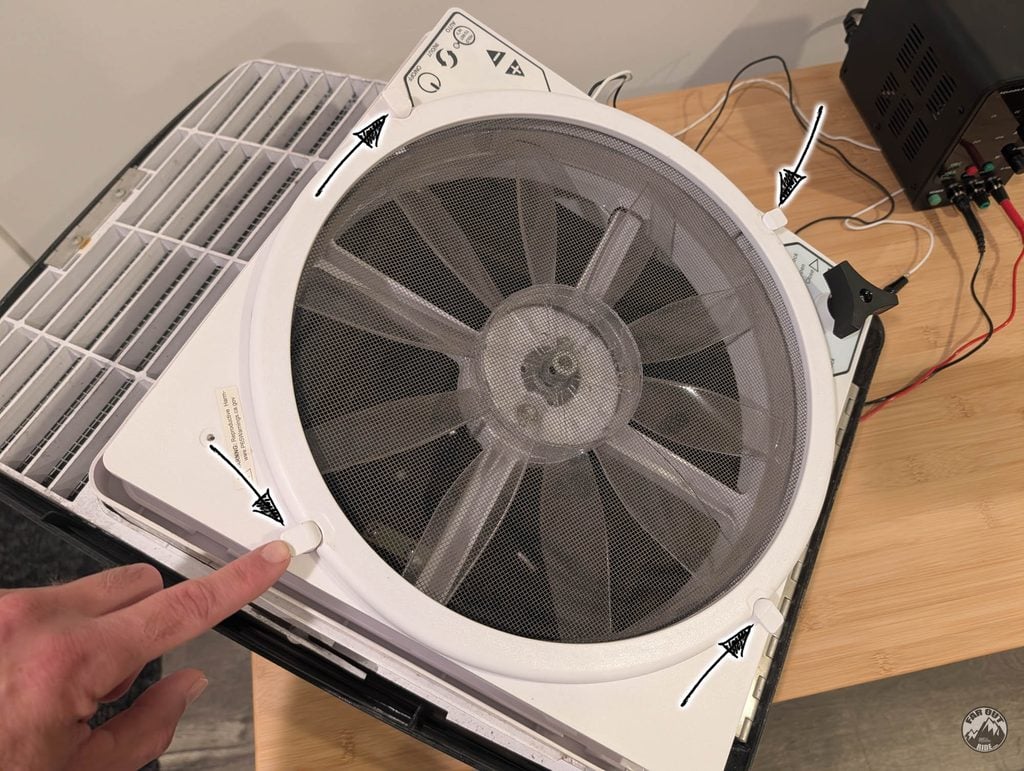
On the AirPlus, the interior assembly – with the control panel, blind, etc. – must be unscrewed from the ceiling, and then the screen removed from the back (by unscrewing 4 screws):
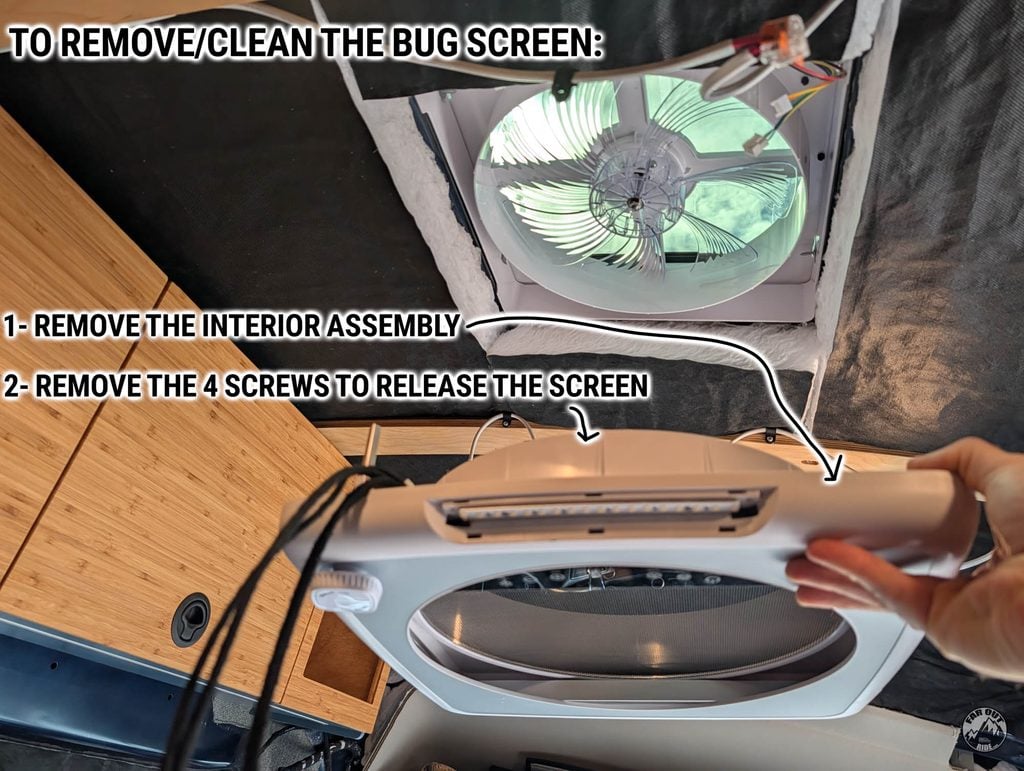
It’s a win for the Maxxfan. Definitely designed for real-world usage.
We heard the bug screen removal will be improved on the AirPlus V2, but we ordered the AirPlus during Summer 2026 and got the V1.
Installation
Swap Maxxfan for AirPlus
Outside
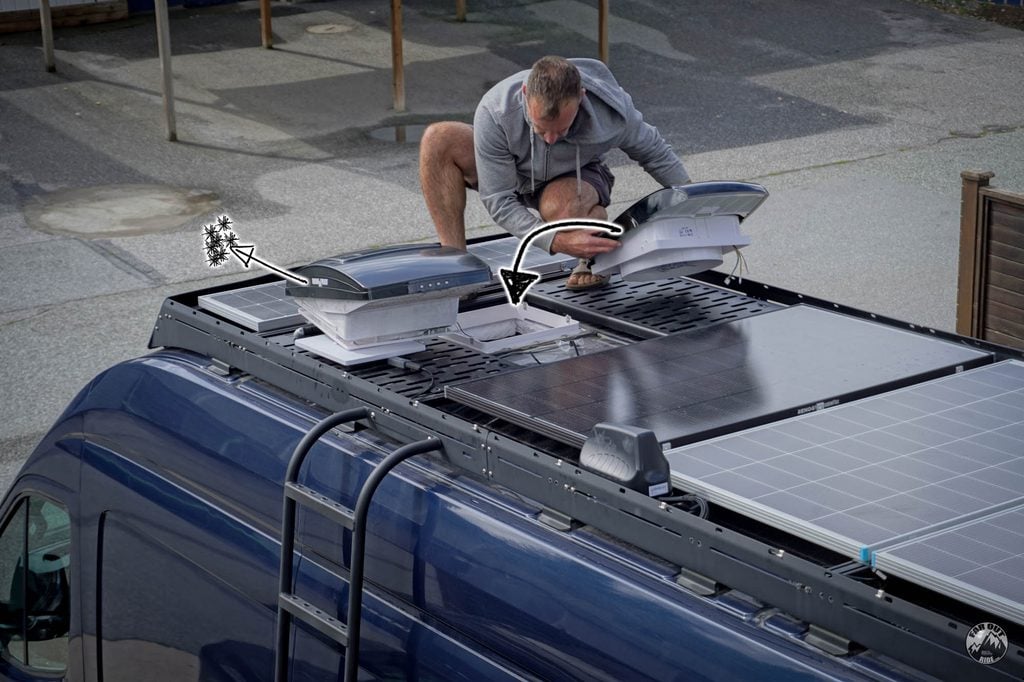
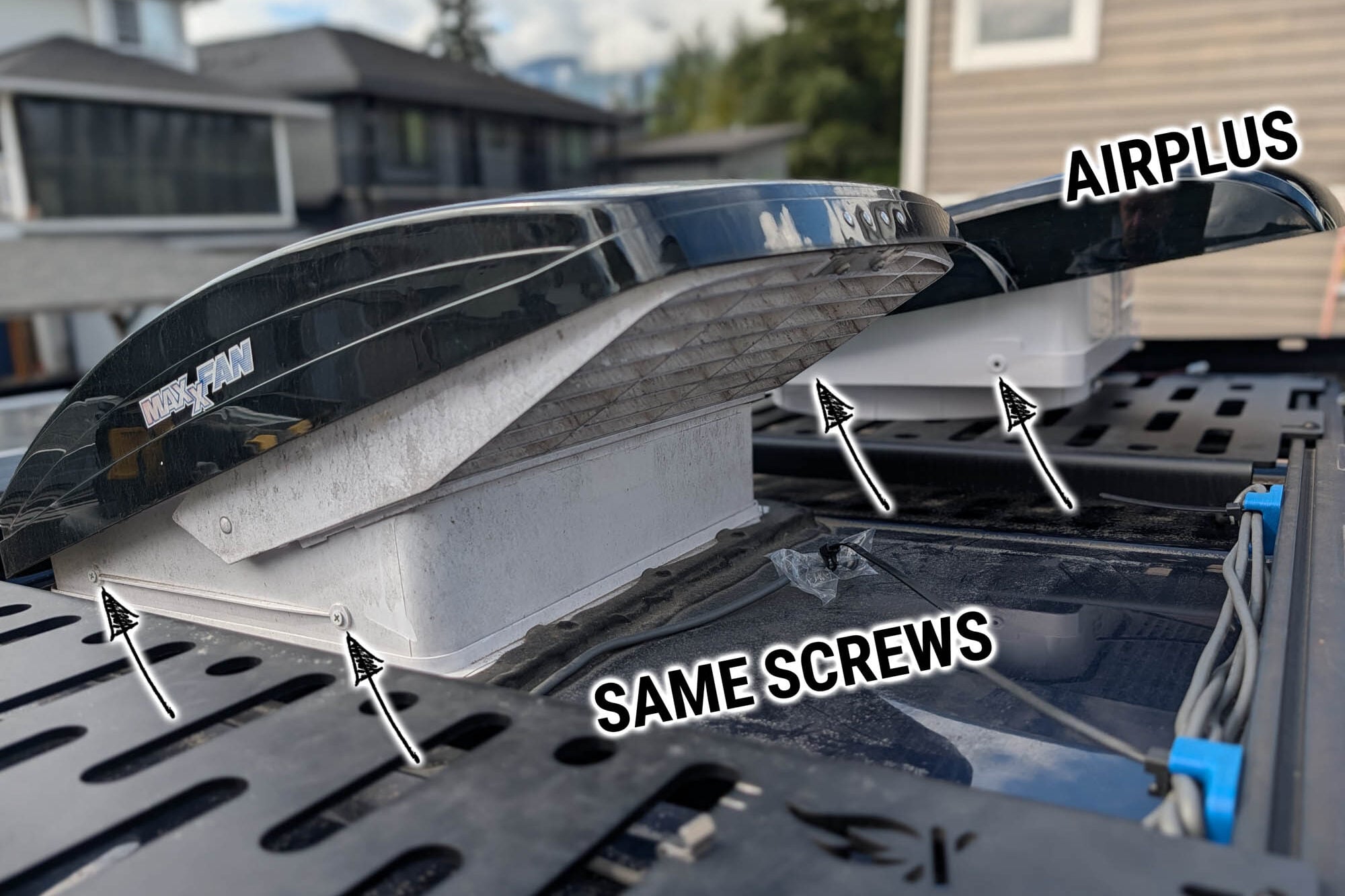
Both fans mount in the standard 14″ x 14″ roof opening, so swapping one for the other means no new holes: unscrew, remove the old fan, install the new fan.
Inside
The differences are inside. The Maxxfan accommodates roof-plus-ceiling thicknesses from 1-1/8″ to 6-1/2″ with its garnish ring. The fan and the controls are a single unit: drop the fan from the top of the roof, and it’s ready to use.
The AirPlus handles 27 to 80 mm (1″ to 3-1/8″) using three included drive shafts of different lengths, and the lid drive engages through those shafts. The fan and the control are 2 separate units: the fan is dropped from the top of the roof, the interior assembly (controls, led, blind, bug screen, etc.) is installed from inside:
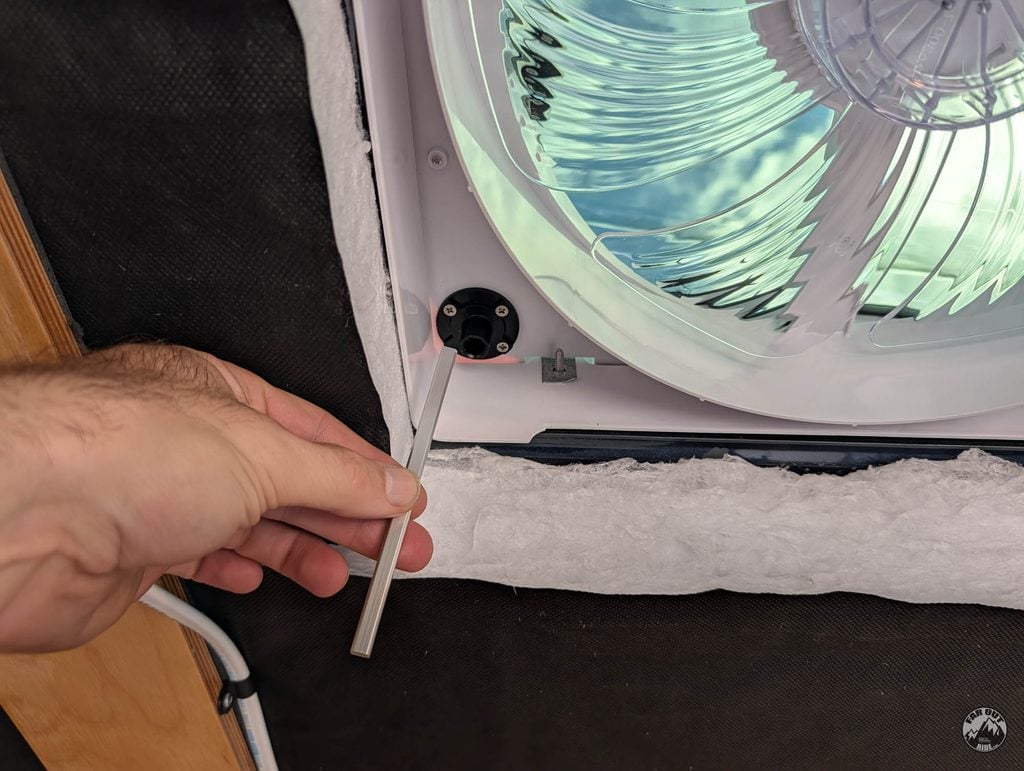
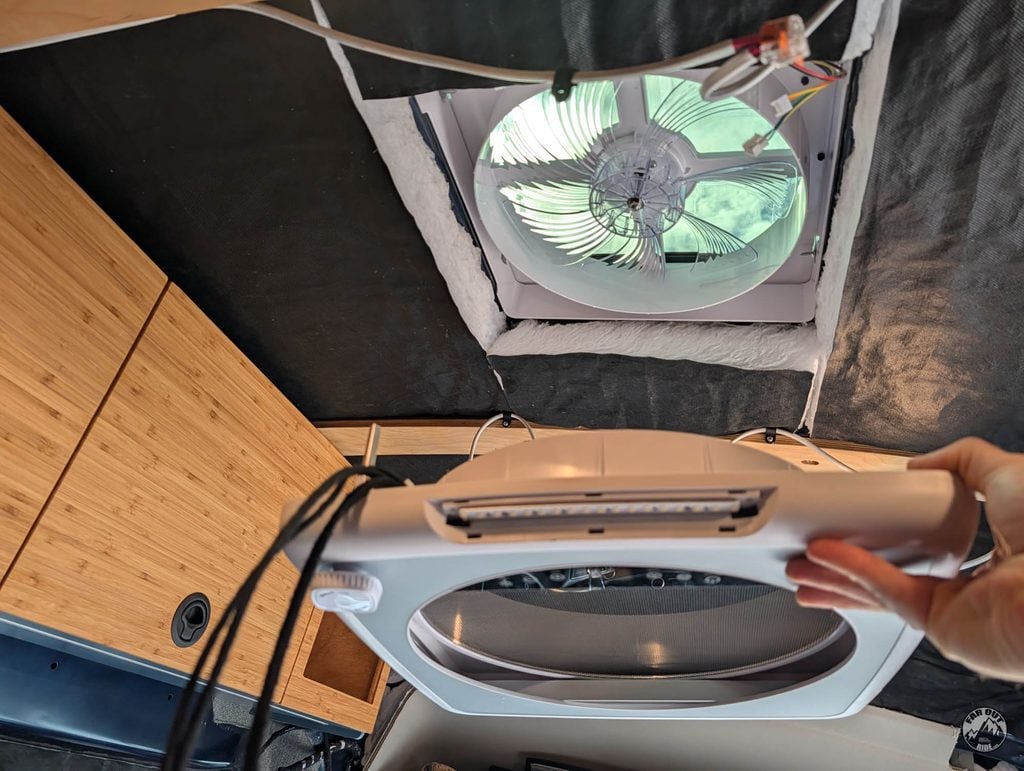
The interior assembly must be screwed to your ceiling (e.g. tongue-and-groove planks, plywood). That means you can’t simply drop the fan from the roof and use it; in a temporary installation (until the ceiling is done), you’ll have to make a temporary holder for it:
The fact that the interior assembly (controls) sticks out an inch or two below the ceiling might be a dealbreaker for some. So if headroom is an issue, the Maxxfan may be a better solution (the interior decorative trim sits flush with the ceiling).
New Installation
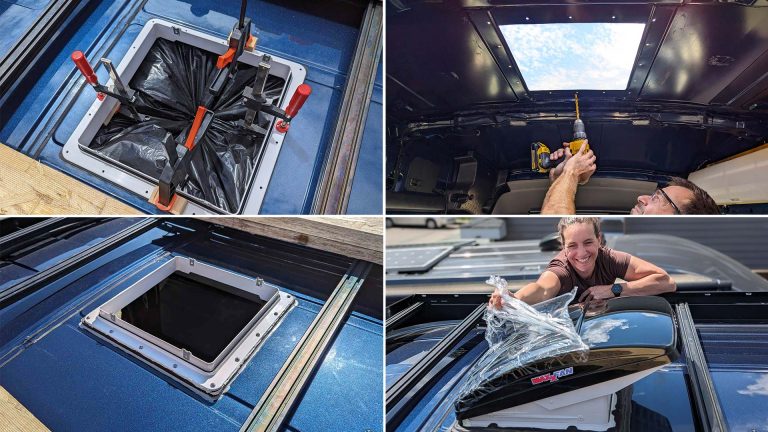
A first install is the same roof work for either fan; our step-by-step guide covers it:
Weight
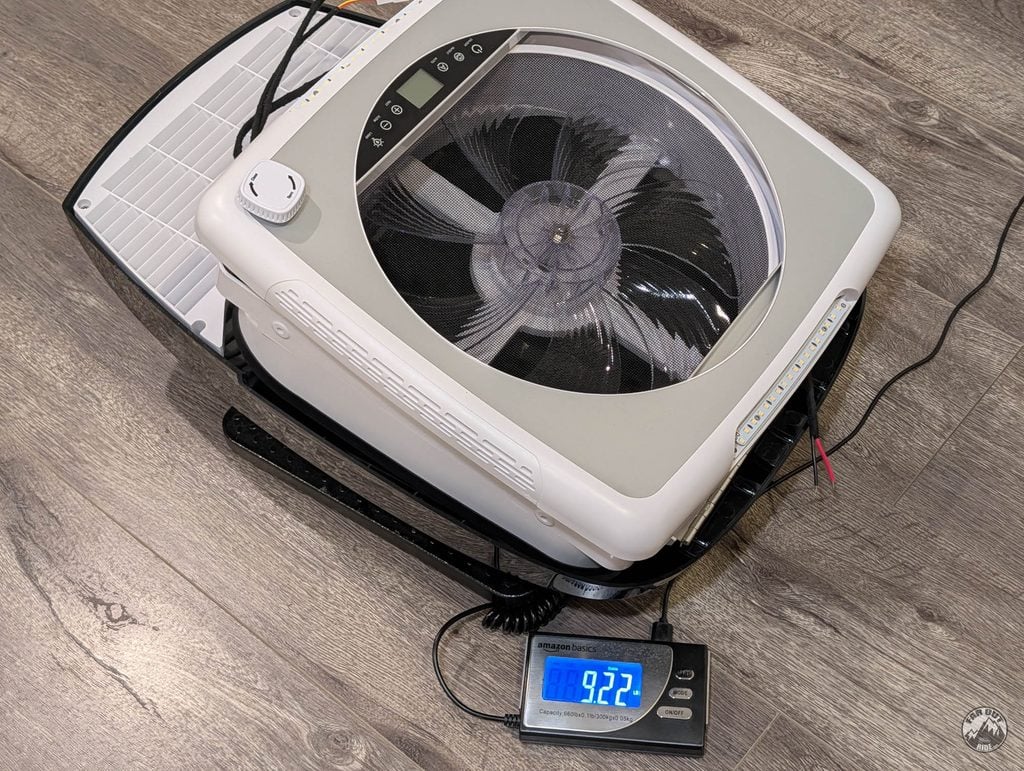
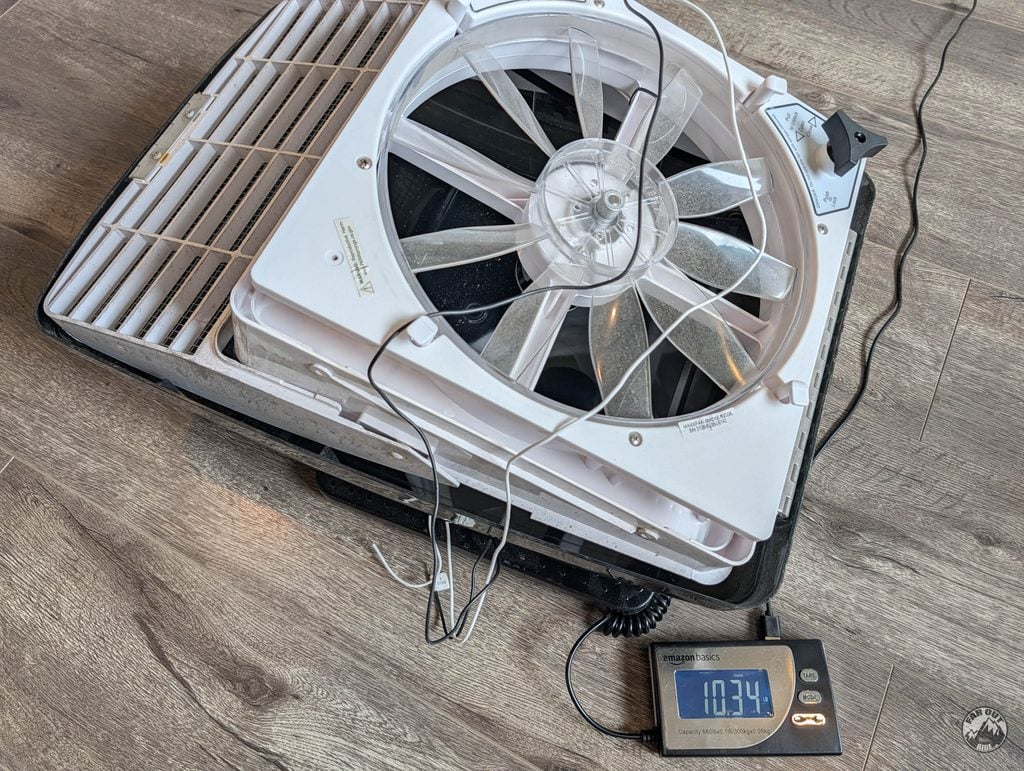
If you’re keeping count:
AirPlus: 9.22 lb
Maxxfan: 10.34 lb
Reliability, Parts, and Warranty
The Maxxfan has two decades of track record, which cuts both ways: its weak points are well documented. Electric-lid models can wear their lift mechanism, the brushed motor is a consumable under heavy use, and the other complaint you’ll read everywhere: condensation can form on the control board and kill it — the board sits up in the roof unit, right in the humid airstream. The flip side is that every one of those parts is sold separately: lids, motors, lift motors, keypads, control boards, remotes. A tired Maxxfan is a repair, not a replacement, and in a damp climate a thin coat of conformal spray on a new board is cheap insurance. Warranty is 2 years, with a lifetime warranty on the lid.
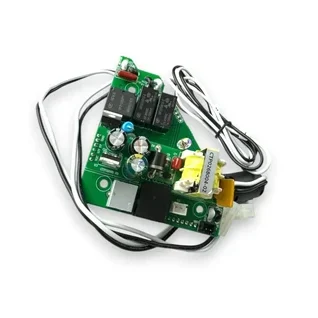
The AirPlus is too new for long-term verdicts; the oldest units in the field are about two years old. Its brushless motor removes the Maxxfan’s main consumable, and the control board accepts 9 to 16 V, a comfortable margin for lithium systems that spend their day at charging voltages. On the other side of the ledger: the warranty is 1 year per the manual, and there is no published spare-parts catalog, so a failure outside warranty likely means replacing the unit rather than a $30 part. Ours went into FarOutVan 2 in early September 2026; we’ll update this section once it has a summer and a winter behind it.
Price and Where to Buy
Street prices as of August 2026. In the US the two cost about the same; in Canada the price depends heavily on which badge you buy.
| Fan | Price | Where to buy |
|---|---|---|
| Maxxfan Deluxe (7500K) | US $300 to $475 CA ~$500 | Campervan HQ (USA), Amazon.ca (Canada) |
| AirPlus 355 (ProBreeze) | US $350 to $390 CA $489 to $645 | Campervan HQ (USA), Tecvan (Canada) |
Verdict
So, here we are. Is the AirPlus as good as is sounds? Yes. And no.
On paper, the AirPlus beats the Maxxfan hands down. But there are a few quirks: the installation is a bit more involved, the mosquito screen is too hard to remove/clean, the CFM claims are straight-out false, the power draw and noise is not as good as the Maxxfan for the same airflow (despite the brushless motor).
That being said, the Maxxfan whining sound at low speed (on some units) is a real dealbreaker, and the control board condensation issue seems to be real (according to online reports).
So which one are we keeping in FarOutVan 2? The AirPlus, with the hope that we’ll be able to retrofit to the V2 with the removable bug screen. Also, we want to gather more data for a long-term review.
AirPlus
Pick it for the features: built-in blind, lights, and radio remote, a brushless motor with no squeal to worry about, and a control board happy at lithium voltages. Its measured 495 CFM covers sleeping and everyday ventilation just fine; it simply isn’t the mover the rating promises.
Maxxfan
Pick it for the performance: 63% more air flat out, and any matched airflow delivered for about half the watts and fewer dBA. Add the flush interior trim, removable bug screen, and a full spare-parts shelf behind it.
When a fan isn’t enough, like muggy nights above 80°F (27°C), see our 12V air conditioner guide.
Long Term Review
Too soon! Come back later!