

We’re planning to ship our van from Canada to Europe around June 2027 for long term travel. This is our living research dashboard — what we know so far, updated as we learn more.
Keep in mind that the info presented in this article is based on research and first-hand reports from readers in the comments, not our own experience (yet).
Some Context
Hello! We’re Isabelle and Antoine 🙂
In 2017 we sold our house (and everything in it), quit our engineering careers, and moved into our self-built campervan. Between 2017 and 2022, we traveled full-time to chase the best mountain biking and skiing in Canada, Mexico, and USA. We’ve since settled in British Columbia (dream #2!) to build FarOutVan2. After completing the new van conversion (2026), our dream is to ship it to Europe and travel full-time over there. Below is an attempt at getting organized and making it happen! So keep scrolling or read more about Our Story.

The Roadblocks

The project turns out to be WAY more complicated than expected, as we are facing many administrative roadblocks. Here is a list of problems that could compromise the project (we don’t have a solution as we are currently writing these lines):
- Vehicles over 3,500 kg (7,700 lbs) require a C1 driver’s license in Europe. | See Weight Limit section below.
- Insurance for vehicles over $75K is hard to find. | See Insurance section below.
- The Schengen 90/180 rule. | Not exactly a problem-without-solution, but it definitely affects the planning & itinerary!
Entry, Duration, Visas
We can’t guarantee the information in this page is accurate and up-to-date. Always check the travel advisory of your respective country:
- Canadians: Travel.gc.ca
- Americans: Travel.state.gov
- Other non-gov source: schengenvisainfo.com
The Schengen Area
Named after the tiny village of Schengen in Luxembourg, where the historic agreement to abolish internal border checks was signed on June 14, 1985. Shitterton, Britain, was not consulted.
The 90/180 Rule
Canadians and Americans can stay in the Schengen Area without a visa for 90 days in any 180-day period. You can stay 90 days, then you must leave until enough time has passed to re-enter. Leaving and re-entering does not reset the counter.
As of 2026, the following countries are part of the Schengen Area:
Austria, Belgium, Bulgaria, Croatia, Czechia, Denmark, Estonia, Finland, France, Germany, Greece, Hungary, Iceland, Italy, Latvia, Liechtenstein, Lithuania, Luxembourg, Malta, the Netherlands, Norway, Poland, Portugal, Romania, Slovakia, Slovenia, Spain, Sweden and Switzerland.

Non-Schengen Countries
As of 2026, the following countries are NOT part of the Schengen Area:
Albania, Armenia, Azerbaijan, Belarus, Bosnia and Herzegovina, Georgia, Kosovo, Moldova, Montenegro, North Macedonia, Russia, Serbia, Türkiye, Ukraine, and the UK.
Non-European countries: Morocco, Algeria, Tunisia, etc.

The political landscape constantly changes, but here are potential countries to visit outside the Schengen Area:
- Morocco: Visa not required for stays of less than 90 days (Canadians and Americans).
- Georgia: Visa not required for stays up to 365 days (Canadians and Americans).
- Turkey: Visa not required for stays up to 90 days in a 180-day period (Canadians and Americans).
- Albania: Visa not required for stays up to 90 days in any 180-day period for Canadians, and up to 1 year from first entry for Americans.
- Montenegro: Visa not required for stays up to 90 days (Canadians and Americans). Register with the local police within 24 hours of arrival.
- North Macedonia: Visa not required for stays up to 90 days (Canadians and Americans). Register with the local police within 24 hours of arrival.
- To be continued…
Strategies

Strategy 1: The Schengen Shuffle (Non-Schengen Countries)
Spend 90 days in Schengen, then rotate out. Morocco (90 days), Georgia (365 days visa-free!), Turkey (90 days), UK (180 days), and the Western Balkans (Albania, Serbia, Montenegro, North Macedonia, Kosovo, Bosnia). Albania is the standout for Americans: up to 1 year visa-free. Or fly back home.
The van can stay parked in Europe during your Schengen-out periods (in a campground or private storage), while you fly or ferry out.
Reader example: a year of shuffling in the Balkans. Jeri (US-plated Transit) did Slovenia and Croatia, then stepped out of Schengen into Montenegro, Albania and North Macedonia for the summer, high up in the national parks to beat the heat. Fall and winter are on the Albanian coast in a cheap off-season apartment with secure van parking, with short Schengen trips like Greece in January, then back into Europe in April with a full 90 days. What they learned:
- Track your days with an app (Jeri uses Schengen Simple) and keep a buffer of days in case the van breaks down.
- Albania’s 1-year clock for Americans didn’t reset after short exits. Jeri learned it only resets after 3 consecutive months away.
- Ferries from several Albanian coastal towns to Bari or Brindisi (Italy) are an easy way in or out of Schengen.
Strategy 2: Digital Nomad Visa
If you want to stay in one Schengen country for a full year+ without juggling borders, some countries now offer digital nomad visas for North-Americans. The two most relevant:
Portugal D8 Visa
Allows non-EU/EEA citizens to reside in Portugal for up to one year, with a monthly income requirement of €3,480 and savings threshold of €36,480. Get Golden Visa
* Still subject to 90/180 rule in other countries.
Spain Digital Nomad Visa
Requires earning at least €2,849/month remotely for a non-Spanish company. You get a 1-year visa convertible to 3-year residency.
* Still subject to 90/180 rule in other countries.
The big caveat for overlanders: both visas require proof of accommodation (a rental contract), which is awkward in a van. It’s not impossible — some nomads use a friend’s address or a co-working/co-living space — but it’s a grey area worth researching further.
EES & ETIAS: New Digital Border Systems
Two new EU systems are changing how non-EU travellers enter the Schengen Area:
EES (Entry/Exit System)

Launched on October 12, 2025. It’s now replacing the old passport stamp system with a digital record of every entry and exit. When you cross a Schengen border, you’ll have your photo and fingerprints taken. The system automatically tracks your 90/180-day usage — so unlike before, there’s no ambiguity or wiggle room. Overstays will be flagged.
ETIAS (European Travel Information and Authorization System)

Is coming next. Think of it like Canada’s eTA or the US ESTA — an online pre-authorization you’ll need before entering the Schengen Area. It costs €20, is valid for 3 years, and is expected to launch in late 2026.
Neither of these changes the 90/180-day rule itself — just how strictly it’s enforced.
How To Ship A Vehicle To Europe
RoRo vs Container
You can ship a vehicle from North-America to Europe via RoRo or container:
RoRo
Roll-On, Roll-Off.
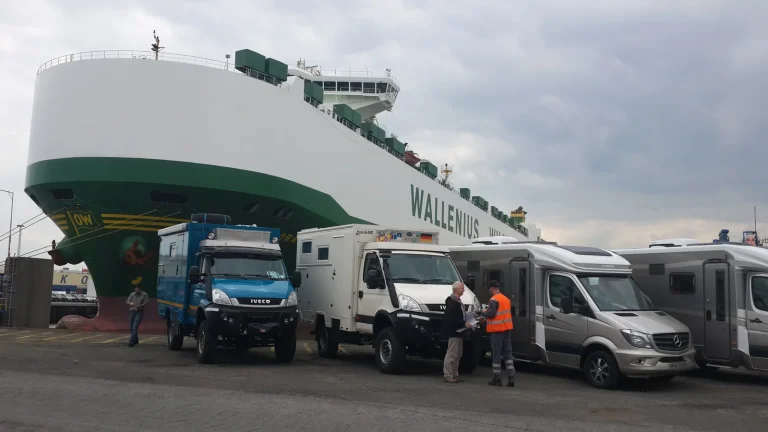
- Vehicle is driven directly onto the ship.
- Cost: We got a quote for $3,500-$4,000 USD (to Belgium).
- Time: 10-20 days depending on the destination.
- More departure/arrival dates.
- More exposed to the elements.
- Vehicle is accessible on the ship, stories of theft are not uncommon…
RoRo Shipping Companies:
Reader report: Jeri shipped a US-plated Transit with Sea Bridge from Baltimore to Antwerp, nothing touched. Sea Bridge advised against shipping from the West Coast and recommends Baltimore or Halifax to Antwerp. Their tips: hide or remove valuables, take the plates off at drop-off, and cover the interior.
Container
It’s a big box.
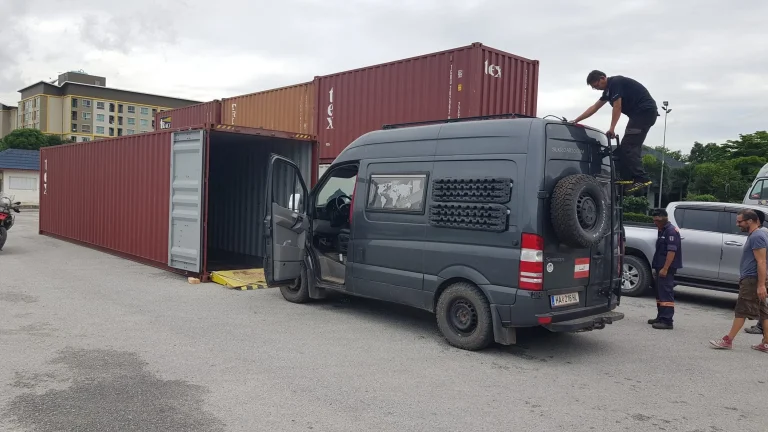
- Vehicle is packaged into a container before.
- Cost: ~$4,500-$6,000 USD.
- Time: Similar to RoRo + packing/unpacking the van.
- Size limitations.
- Better Protection: Container can’t be accessed until unpackaged by you (safe).
Container Shipping Companies:
Most people we know have used RoRo instead of a container, and we plan to do the same.
Insuring a North American Van in Europe
Insurance is one of the most administratively painful parts of bringing a North American van to Europe. Most mainstream insurers have no framework for a foreign-registered vehicle owned by a non-resident, so you end up in specialist territory fast. Plan for more lead time than you’d expect.
There are two distinct types of coverage to think about:
Third-party liability (TPL)
Covers damage or injury you cause to others. It’s legally required to drive anywhere in Europe.
Vehicle insurance
Covers your own van — comprehensive, collision, theft. It’s optional in the legal sense, but obviously important if your van is worth anything.
You can buy TPL on its own, or bundle both under a single policy. Start the conversation a few months before departure. Be ready with: replacement value, year, GVWR, planned countries, trip duration, and home country registration details.
- TourInsure — German company specializing in international motor insurance for campervans. Issues a Green Card valid across all European states and can tailor coverage to your travel plans and duration.
- IVSS (International Vehicle Shipping Services) — Primarily a shipping company, but they explicitly cover foreign non-EU motorhomes for travel within the EU, from 1–12 months at various coverage levels. Convenient if you’re already using them to ship your van.
- Clements International — Specialists in foreign-plated and expat vehicles with experience handling higher vehicle values. Worth a direct phone call rather than a web form.
- Campbell Irvine (UK) — Specialty broker for unusual vehicles and foreign tourists, with Lloyd’s market access.
- GasserKessler (Switzerland) — Known in overlanding circles specifically for high-value North American RVs in Europe.
- Lloyd’s of London (via broker) — The likely destination for truly high-value vehicles. Go through a broker like Clements or Campbell Irvine — you can’t approach Lloyd’s directly.
Note: Clements, Campbell Irvine, and GasserKessler come from overlanding community recommendations rather than verified campervan-specific listings — confirm they cover your vehicle type when you reach out.
The Green Card
The Green Card (Carte Verte) isn’t a separate purchase — it’s the official certificate that proves your insurance policy is recognized under the international Green Card system. Border crossings and police use it to verify coverage; it’s also what the other party’s insurer will ask for if you’re ever in an accident.
Any insurer properly set up to cover you in Europe will issue one. If they can’t, that’s a red flag — their policy likely isn’t recognized under the system, regardless of what it says on paper.
A few things to confirm when your policy is issued:
- Every country on your itinerary is listed. The Green Card covers most of Europe by default, but countries like Turkey, Morocco, and Georgia are often excluded.
- You have a printed copy in the van. Digital isn’t universally accepted, especially at borders in Eastern Europe.
- The Western Balkans are listed. Albania, Montenegro and North Macedonia check for a Green Card at the border. If your policy doesn’t list them, you can buy local insurance at the border (a reader did this in each Balkan country) or online ahead of time. Kosovo doesn’t accept the Green Card at all: insurance is bought at the border.
Vehicle Weight Limit
In Europe, a standard Class B driver’s licence allows you to drive vehicles up to 3,500 kg (3.5 tonnes or 7,700 lbs). It’s the GVWR on the plate that determines the licence category, not the actual loaded weight.
The 3,500kg limit is a hard legal line for Europeans.
For North Americans, based on research on forums and Facebook, some people report that they are getting away with it because at home, our Class B driver’s license allows us to drive up to 11,793 kg (26,000 lbs). But we are getting mixed info about this. We need to dig deeper. Feel free to comment if you have any info!
From online research:
Direct roadside weight checks aimed at campervans are not common in most of Western Europe. Forum members report rarely hearing of campervans being pulled over purely for weight checks, unlike commercial trucks. However, Switzerland is specifically called out as a place where you may be forced to unload until you reach an acceptable weight before being allowed to drive on — this happens most often in mountainous countries. One forum member reports being pulled at the Swiss border every time they crossed, getting a printout, and being closely scrutinized — even when they were technically under 3,500kg.
Potential consequences:
- Insurance companies may not pay out if an overweight campervan is involved in an accident.
- Toll costs are significantly higher for vehicles over 3.5t in countries like Austria, Slovenia, Czech Republic and Poland — in Austria, a one-way trip can run ~€120 vs a cheap vignette for lighter vans.
- In France, it’s mandatory to put blind-spot warning stickers on your van if it exceeds 3,500kg.
- You may not be allowed on the Eurotunnel with a van over 3,500kg without the correct licence.

Carnet de Passage
Good news: you don’t need a Carnet de Passage for Europe. A Carnet is a customs document that acts as a guarantee against selling your vehicle abroad — it’s required in many parts of Africa, South Asia, the Middle East, and Oceania, but not in Europe, North America, or South America.
The one exception to be aware of: shipping into Germany (e.g., Bremerhaven). German customs has been known to ask for a deposit of around 30% of your vehicle’s value as a guarantee that the van will be exported before 6 months. This deposit is refunded on exit. It’s not universally enforced, but if you’re shipping to a German port, confirm the current customs requirements with your shipping company well in advance.
For the rest of Europe, your vehicle title, registration, and shipping documents are sufficient.
How Long Can Your Van Stay in Europe?
The Schengen rules apply to you, not the van. The van is governed by customs/import rules, which are separate. As a temporary tourist import, our Canadian-plated van can legally be in the EU for up to 6 months in any 12-month period before it’s technically required to be formally imported (with duties, EU compliance, etc.).
The official rule
EU customs law allows a non-EU registered vehicle to stay in the EU for up to 6 months in any 12-month period, tax and duty free. After that, the van is technically supposed to be permanently imported — paying customs duty (around 10% of vehicle value), VAT, and converted to EU standards (lighting, emissions, etc.). That’s expensive and complex. Not a realistic path for us.
The “reset” question
The big thing overlanders want to know is whether driving the van out of the EU (to Turkey, Morocco, the UK) resets that 6-month clock. The answer is: probably yes, but it’s not written clearly anywhere. There’s no unified EU legislation on this — each member state sets its own rules, and most set 6 months in any 12-month period. The consensus among long-term overlanders is that exiting the EU and re-entering does reset the temporary import, giving you a fresh 6 months. This is how people have kept North American vans in Europe for 2+ years.
The enforcement reality
Despite the official 6-month rule, plenty of overlanders have left their vans in Europe for years by storing them whenever traveling back home. EU countries don’t have an effective way to track when a specific foreign vehicle arrived, which is why you rarely hear this rule discussed. That said, with EES rolling out and border digitization increasing, this grey area may tighten over time.
The practical strategy for 1-2 years
The cleanest approach is to align your van’s EU time with your Schengen time — both you and the van leave the EU together during your reset periods (Morocco, Turkey, UK, Western Balkans). That way both clocks reset simultaneously and you’re fully compliant. Take the van to Morocco for your 90-day Schengen reset. Drive it to Turkey. Spend time in the UK. The van accrues EU time only when it’s inside the EU, same as you.
If you want to fly home and leave the van parked in Europe, that’s where it gets grey. In practice many people do it and nothing happens. But technically, if the van has been in the EU more than 6 months cumulative without exiting, you’re in informal import territory.
Bottom line: For a 1-2 year trip, the cleanest approach is to move the van out of the EU during your Schengen resets anyway — since most of the good reset destinations (Morocco, Turkey, Balkans) are also outside the EU. It largely solves itself if you plan the itinerary that way. The situation to actively avoid is shipping to Germany and leaving the van sitting in storage inside the EU for extended periods without driving it out.
Storage options
- Campgrounds: Many in France, Spain, and Portugal allow you to leave your van for weeks or months for a modest daily/weekly fee. Some have security; others don’t.
- Dedicated vehicle storage: Private storage facilities exist near major cities and ports — worth researching near wherever you park up at the end of your 90 days.
- Informal options: Facebook groups like “Van Life Europe” and overlanding communities often have leads on trusted private parking spots.
When the van is parked for an extended period, check with your insurer — some policies allow you to downgrade to 3rd party, fire & theft only (no comprehensive) during storage, which can meaningfully reduce costs. Make sure theft is still covered regardless.
Paperwork
Personal
- Valid passport.
- Travel insurance (for long-term travel).
- International Driving Permit.
- Pet paperwork if you travel with one (microchip, rabies vaccination, EU health certificate). A reader crossed every border with their cat, no issues.
- More TBD.
Vehicle
- Original vehicle title/registration.
- Proof of ownership.
- Vehicle insurance certificate.
- ID or passport of the owner.
- Shipping documents.
- Customs clearance.
- More TBD.
Wish List
We’re still very much in the “dream” phase, and our wish list will be populated and detailed as we get closer…
Follow the Weather
Still working on our own plan! In the meantime, here’s how one reader follows the weather in the Balkans (full report):
- Summer: go high. The national parks of Montenegro (Durmitor, Tara River Canyon) and North Macedonia stay pleasant when the lowlands get very hot, with smoke and pollution during fire season.
- Fall to spring: the coast. Albania and Greece stay mild, with swimming into mid-November and cheap off-season rentals.
Possible Itineraries
Two draft itineraries, 1 year and 2 years, that fit everything on this page: the 90/180 rule for Canadians, the van’s 6 months in 12 inside the EU, bike park seasons, the weather and our wish list. They’re drafts, not final plans, and will change as we learn more. Press play or drag the timeline to follow the van, and click a stop for details.
Driving routes are the fastest roads from OpenStreetMap routing, and the dates are a draft, not a booking. Rules checked for Canadian passports.
More Resources
Tools
- Schengen Simple | 90/180 day tracker app that also plans future trips (iPhone and Android).
- EU Short-Stay Calculator | The official 90/180 calculator.
Technical
- Tuck’s Truck:
- Expedition Portal
Reader Reports
- Jeri | Shipping with Sea Bridge (Baltimore to Antwerp) and border crossings with a US-plated Transit.
- Jeri | A year of Schengen shuffle in the Balkans.
Inspiration
- Tuck’s Truck | Overlanding since 2014.
- Char Is Far | Netherlands to Singapore.
- RogueWanderers.com
- Malimish.com
- Wheelingit.us
Any tips or advice about traveling to Europe from North America?
Please let us know in the comments below, we need all the info!




hi I am Francesco from Italy, now I am travelling with my Ford transit van in Brazil. According to me the weight is not a real problem, all the RV in Europe suppose to be 3500kg, but no one is within this weight. As you know just Switzerland sometimes check the weight but doesn’t happen very often.
Regarding the 90/180 days consider also to take a break in Tunisia, is outside Eu, beautiful, safe and cheap (I spent 10 years there).
Thank you!!
Great suggestion on Tunisia Francesco!
hi guys,
Love your blog! We have been doing the Schengen shuffle (currently in the UK). Never had a problem with our drivers license. We did have an issue at the Georgian border because our state just prints our van registration on plain paper. They let us in but we had to leave the same way, so no trip to Armenia. Next time we are in the US I will get our registration apostilled.
Tolls seem to go by height not weight. Get a toll transponder for Norway before you come.
We put the French blind spot stickers on a magnetic sheet so we can apply and remove as needed. Many vans don’t have them but we use them just to be safe.
Another issue is propane. Lots of issues. The appliance pressure is different in Europe so bring a spare regulator. Refilling a tank is technically not allowed. There are businesses in Croatia and Georgia that will refill a tank (maybe more countries). We were able to use a gas station in France but we also got kicked out of a couple of gas stations before we were successful. Using a European bottle is tricky because there are many sizes and connection types. You can buy a tank designed to be refillable but you need the refill port accessible outside the van. Shipping with a removable propane bottle is problematic. SeaBridge told us we could ship an empty removable bottle (we have a 20lb bbq tank). That is one of the reasons we went with SeaBridge. The shipping agent sent their rules in an email that stated no removable bottles allowed. At the port (Halifax) they allowed it but it was stressful for a while. We will buy an adapter from a ACME male to G.12 Female adapter soon so we have a chance to use a European bottle if we need. Be aware that even though Europe uses a 1/4″ or 3/8″ fitting the thread types are different.
Lastly, parts. We have a Ford Transit and assumed that we could get parts from Ford dealers in Europe. nope. Bring oil and air filters.
Thanks for the info, very valuable!
We went full electric on FarOutVan2 (no propane), so one less thing to worry about, I guess.
That’s weird about the oil/filters, I’d assume it’s the same over there…
I am here in Europe/Balkans now and brought a bunch of oil filters with me. I have yet to use one as the shops i go to always ask and double check first if they can get before using mine. So far, so good 7 months in.
Bonjour du Québec ! Nous avons un LTV Unity FX 2025 et je suis en train de le préparer pour le grand voyage en Europe. Comme on ne veut plus rien savoir des américains (du moins 50% d’entre eux), on lève les coudes et on va aller voir nos ancêtres… Je suis dans la préparation administrative également. Notre VR a un PTAC de 5003 Kg et un couple qui a le même LTV mais 2016 est en Europe. Il n’ont pas eu de difficulté côté poids. Ceci dit, c’est du côté assurance que ça se corse. Ils utilisent Tour Insure mais qui sont limités à 75kEuros pour la valeur du véhicule. Le nôtre étant presque neuf, je ne prendrais aps cette “chance”. J’essaye de trouver un autre assureur et c’est très laborieux. Apparemment Allianz FR serait un candidat mais après 2 semaines, toujours pas de retour. Avez-vous des suggestions : valeur 300k$C
Plus on fait de recherche, plus c’est compliqué…
J’ai mis à jour la section “Insuring a North American Van in Europe”. Ceci étant dit, c’est le résultat de recherche en ligne, ce n’est pas basé sur une expérience réelle…
Tenez-nous au courant de vos développement!
Thanks for putting this together. We hope to do the same but maybe 6-12 months behind you so will be following with much interest! Our plan will be to go for 90 days during the summer months, return to CA for the fall, then go back to the EU and the Van for the winter months!
Well, we might by in sync after all… This plan is most likely delayed another year.
Have you look into leaving your van for extended period of time over there? It looks like it may be an issue because it would have to be imported? Don’t quote us on this, but that’s the preliminary info we gathered. We would LOVE if you have info that says otherwise 🙂
You guys should visit Kirkenes, Norway. I’ve heard it’s very beautiful up there on the coast of the Arctic Ocean
Would LOVE to, thanks for the suggestion 🙂
Does anyone know when it will be effective the law permitting a normal European drivers license class B to drive motorhomes up to 4.25t?
Currently this European license class B, which is what might be the equivalent license class for a standard North American drivers license, allows driving vehicles with a maximum gross vehicle weight limit of 3500kg (3.5t) in Europe.
I know conversely that a European class b license allows European tourists in North America to drive much heavier vehicles, because in North America the normal drivers license allows for much heavier vehicles, and not surprising, many RVs or motorhomes are heavier than 3.5t metric…
Of course there are people currently in Europe with RVs or vehicles heavier than 3.5t, but they must have an extra license category for this, in addition to the vehicle being built for that weight.
I’m not sure when the increase to 4.25t for a standard license class B will happen. I heard it is already decided on, but might be end of 2025 before it is official? To be seen when exactly, and if countries in Europe outside of EU adopt this.
Nevertheless countries have different rules for vehicles more than 3.5t (road tax, speed limitations, blind spot sticker for France, etc.) that may not change even if the standard license allows to drive a heavier vehicle, but those are just smaller details that are country specific.
Thanks for posting so much great and detailed info on your van builds and experience!
If you are traveling through the Czech Republic, let me know. I live in the Bohemian Forest and can show you lots of small bike parks or natural enduro trails if you are interested.
One tip for Austria:
Be careful of the weight of your vans there. The police like to weigh your vans and give you fines if you exceed the weight limit (in your case probably 3.5 tons).
Thank you! 🙂
Perhaps shipping in a container would be safer?
Bonjour Isabelle and Antoine,
I shipped a VW Westphalia Camper from New York to France, and back to Los Angeles after 5 months. In 1998 (so, some time ago, things I want to tell have not probably changed much though). We used RoRo both ways. Going from New York to France, things inside the van were stolen. In particular, a nice tool box. Also the license plate (California) at the back was taken. We had one made in France using the local format… In Lille (France) an attempt was also made to steal the front plate.
You probably already know that: do not store any valuable in the van. For the license plate, perhaps take an extra pair with you.
I wish you a very good trip in Europe.
Bon voyage.
Bruno
Thanks for sharing,
We’ve heard both positive and negative stories!
I used Seabridge van transportation from Baltimore, Maryland to Antwerp, Belguim. They were great to work with, all went seamlessly for both drop off and pick up. I live near Tocoma, Washington, less than an hour drive from a port I could have shipped my van from. Seabridge could not guarantee the van safety nor theft protection and strongly discouraged me from doing so. I chose to drive the 5 extra days from Oregon across the U.S. They also suggested hiding all valuables or do not leave in van, remove front and back plates upon port drop off and lay cloth or plastic over the interior as service crew had been known to “take a nap” in vans. Their recommended passages were Baltimore to Antwerp or Halifax, Nova Scotia to Antwerp. I packed bins and strategically packed what was valuable to me so that it would be tough to find. I took my mntn bike, Stand up paddleboard, backpacking gear and life things. I set up a way to see if anything was opened, touched, or removed. No one bothered my van. From Netherlands upon arriving in early April through Belgium, France, Germany, Austria, Slovenia (a favorite for biking and hiking) , Croatia, Montenegro ( another favorite for Tara River Canyon and Durmitor National Park), Albania ( 1 year no visa) , North Macedonia and Greece, I have had no issues at any borders entering or exiting with my U.S. plated Ford Transit, paperwork or my deaf cat. I have had several mechanical issues ( Murphy’s Law) and chose to get a new set of all weather tires, all of which have been completed perfectly and with guarantees. English is spoken everywhere, though not by everyone. Not hard to find someone willing to help/translate. Have not had any issues… yet. I am doing the Schengen Shuffle with other options pending to preclude the limited 3 month stay. Life changing !
Thanks for sharing all the details Jeri, that’s super useful! We don’t get many first-hand reports. Good to hear the borders went smoothly with a U.S. plated Transit, and the cat 🙂 Enjoy the rest of the trip, and don’t hesitate to update us!
Can you tell us more about your Schengen shuffle? What’s your strategy?
Sure, happy to help. The details matter!
Tracking my days
I’m a beta user of the Schengen Simple app and love it, partly because I’m in touch with the developers when I need to be. It’s super easy to use, and you can access and update it from your phone or desktop. You can plug in scenarios, like adding a trip into the Schengen zone, and it calculates how many days you’ll use or whether you’ll go over your 90. When you travel by van, you want a buffer of days in case of a breakdown or some other delay. Using an app is critical for accuracy and for understanding how Schengen days are “acquired”. Border control scans your passport and fingerprints, so it’s a risk not to be totally clear on the 180-day rolling window.
Year one: gathering my days back in the Balkans
For my first year in Europe, I chose to gather my Schengen days back in the Balkans, and I learned quickly that it’s most enjoyable to travel by the weather.
I wanted to see Slovenia and Croatia, so from Croatia I hopped out of the Schengen zone into Montenegro. I spent a month white water rafting, mountain biking and hiking while waiting for my Schengen days to come back. You can spend up to 3 months in Montenegro without a visa. In hindsight, I would have stayed closer to the full 3 months: there’s so much to explore, and the elevation in the national parks made life in the van much more comfortable!
Next was Albania, where I’m permitted to stay 1 year without a visa. The clock starts ticking when your passport is scanned at entry. Something I learned later: because I wasn’t gone from Albania for a full 3 consecutive months, my 1-year clock kept ticking and didn’t reset.
In June, the heat sent me up to the higher elevations around Lake Ohrid. The lake is split in half, one side Albania and the other North Macedonia. I found the water on the North Macedonia side much clearer and the town of Ohrid amazing, so I crossed over and found a lakefront campsite, planning to stay a month or so. I cut a deal with the owner for a monthly rate, but the heat became too much. So I headed up into North Macedonia’s national parks and wild camped at the top for the month. Pleasant, moderate weather for hiking and biking every day, and clean air (pollution and fire season can be a challenge at the lower elevations). Every so often I’d roll just 6 miles down the mountain to a campsite and stay a night or two to shower, cook and share group meals with the other campers. Made some great friends and beat the intense heat, all while gathering Schengen days.
In early fall I moved on to Albania’s coastal towns. It’s the middle of November and the temperatures are still mild: I’m still swimming, biking and hiking.
Tip: I bought car insurance at each border for the Balkan countries, but you can also buy it online ahead of time.
This winter
My Schengen Simple app shows I’m almost back to the full 90 days. I’ll spend January in Greece, in the many coastal towns and on the islands, then return to the Albanian coast to collect more Schengen days until I’m back at the full 90, and head out through Europe in early April.
Off-season rental rates are so reasonable that I’m living in an amazing 1-bedroom apartment with a huge balcony and a 180-degree view of the Adriatic Sea. It includes secure parking for my van and a place to plug in, no extra charge, just included in the rent. It’s a great time to inspect and clean the van and get repairs or maintenance done. It’s so comfortable that I’ve decided to stay a few months and take shorter trips around Albania and Greece this winter, thanks to the mild climate. Still hiking and biking!
Other ways in and out of Schengen
– Turkey: it’s neither Schengen nor EU. Through a bunch of expat meetups I’m making van travel friends, and since I’m in the region I may drive over.
– Morocco or the UK: many van folks go there when they’re further north, visiting Spain and the like.
– Ferries: from several Albanian coastal towns to Bari or Brindisi, Italy. They help folks “jump” into or out of the Schengen zone, depending on what you need.
I’m also applying for visas that would let me stay longer in the Schengen zone without having to worry about the 3-month limit. Those applications are still TBD.
Hope this helps 🙂
Thanks Jeri, this is gold! Going up in elevation to wait out the summer heat while your days come back is a great tip 🙂
A few notes for anyone planning something similar:
– The EU has an official 90/180 short-stay calculator, handy to double-check an app.
– The 1-year visa-free stay in Albania is for US citizens. Other passports get less, so check before you go.
– More in the post on non-Schengen countries, insurance (Green Card) and following the weather.
Bruno, what shipping company did you use? I have been in contact with one company that has had very positive reviews, Seabridge. It is hard to lump them all together regarding safety and Seabridge provides most of one’s paperwork, step -by-step how to info for transporting your rig with them and they speak to directly shipping from Baltimore to Europe as least troublesome with theft. They offer weekly departures, so they are very experienced. I live next to Tacoma port, which is an offering for RO/RO. So easy for me, but Seabridge suggested it worth the drive from one hour to across the U.S. for me to transport safer. That is the current reality of shipping to Europe.