

Battery-powered air conditioners have come a long way. The tech has matured, brands are competing, and real-world data backs up the efficiency claims. That said, it’s still a significant investment — and not the right call for everyone. This guide covers everything you need to decide if it makes sense for your build, choose the right unit, and set up your electrical system to support it.
Do You Actually Need One?
A battery-powered A/C is expensive, power-hungry, and often overkill depending on how you travel. Do you really need one?
✅ It makes sense if…
- You’re a full-timer who can’t always follow the seasons
- You travel in hot climates (desert Southwest, deep South, etc.)
- You have pets that stay in the van while you’re out
- You sleep hot and can’t rest well above 75°F (24°C)
- You have a solid electrical system (400Ah+ at 12V, about 5 kWh, for overnight cooling)
❌ It probably doesn’t if…
- You’re a weekend warrior or part-time vanlifer
- You can easily relocate to cooler areas in summer
- Your budget is tight — the unit is just the start (wiring, battery upgrades add up)
What We Use Instead: Fans and Insulation
Full disclosure: we’ve never owned a 12V A/C. We’re based in Canada, and in both FarOutVan 1 and FarOutVan 2 we went with a roof fan instead: a Maxxfan in both vans, and now an AirPlus in FarOutVan 2. We bench-tested both fans for our AirPlus vs Maxxfan comparison, which gives us real numbers to put next to an A/C:
| Setting | Airflow | Power | 8-hour night |
|---|---|---|---|
| Maxxfan Deluxe, speed 2 | 314 CFM | 2.8 W | ~22 Wh |
| Maxxfan Deluxe, speed 4 | 479 CFM | 7.9 W | ~63 Wh |
| Maxxfan Deluxe, speed 10 (max) | 809 CFM | 39 W | ~310 Wh |
| AirPlus, speed 5 | 314 CFM | 4.5 W | ~36 Wh |
| 12V rooftop A/C, typical average | n/a | ~300–360 W | ~2.4–2.9 kWh |
Flat out, the Maxxfan uses about an eighth of what an A/C averages; at the low speeds you’d run overnight, it’s 40 to 100 times less. That’s why a fan is the first thing we’d install in any van, A/C or not.
The catch: a fan only swaps inside air for outside air. It can’t cool the van below the outside temperature, and it does nothing about humidity. On a 65°F (18°C) night that’s all you need; on a muggy 85°F (29°C) night it’s a breeze, not relief. That’s the line where A/C starts to earn its battery bank. If hot nights are the exception on your trips, put the money into insulation, window covers, and a good roof fan first, and chase shade and elevation. If they’re the rule, budget for A/C, and for the battery that comes with it. More on fans, insulation, and heaters in our climate control guide.
How Battery-Powered A/C Works
The cooling cycle of any air conditioner — battery-powered or not — is the same. A refrigerant absorbs heat from inside the van and dumps it outside. What’s different with a DC unit is the compressor: it runs directly on power from your battery bank, no inverter needed.
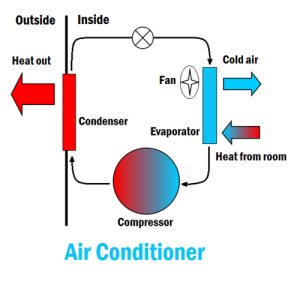
Running a traditional 120V A/C off-grid means converting DC battery power → 120V AC through an inverter, with a 10–15% energy loss in the process. A DC unit skips that conversion entirely. More importantly, modern units use variable-speed inverter compressors — the same technology used in high-efficiency home heat pumps. Instead of cycling hard on/off, the compressor ramps up and down to match demand, which is both more efficient and quieter.
Duty Cycle
An A/C doesn’t run at full power continuously. It cycles on and off (or ramps up and down) to maintain a set temperature. This is the duty cycle:
Duty cycle (%) = (ON duration ÷ Total duration) × 100
In simple terms: It’s the % of the time it’s running
If it’s 95°F (35°C) outside and you’re trying to keep the van at 70°F (21°C), the duty cycle might be 80–90% (it’s ON 80–90% of the time). On a mild night at 75°F (24°C), it might be 20–30% (it’s ON 20–30% of the time). This is why energy estimates vary so much — the spec sheet amp draw is the maximum, not the average. Real consumption depends heavily on outside temperature, insulation quality, van size, and your target temperature.
Heat Pump Mode: Can It Heat Too?
A heat pump runs the same refrigerant loop in reverse: it pulls heat out of the outside air and dumps it inside the van. In this guide, only the two RecPros and the RoamAir R2 have a heat-pump mode; the Dometic, the Velits, and the Nomadics are cooling only.
| Unit | Heating | Draw in heat mode |
|---|---|---|
| RecPro 48V 9,500 BTU | 9,000 BTU | 13.8–23.3A at 48V (~660–1,120 W) |
| RecPro 48V 13,500 BTU | 9,500 BTU | 11–31.5A at 48V (~530–1,510 W) |
| RoamAir R2 | Not published yet | Not published yet |
The catch is temperature. A heat pump gets weaker as it gets colder outside. Typical home heat pumps deliver about 3.5 units of heat per unit of electricity at 47°F (8°C), about 2.3 at 17°F (−8°C), and 1.6 at 0°F (−18°C), with heating capacity more than halved by then (EPRI). None of the van-unit makers publish cold-weather numbers or a minimum outdoor temperature for heat mode.
It’s also a big electrical load: 530 W or more from the battery, every minute it runs. A diesel or gasoline air heater burns fuel for the heat and only uses tens of watts of electricity for its fan and pump once it’s running. Our take: a heat pump is a nice bonus for shoulder-season mornings around 40–50°F (4–10°C), especially when you’re plugged in or the sun is out. For winter, an air heater is still the tool.
Types of Units
Not all battery-powered A/C units are the same. There are a few different form factors, each suited to a different use case.
Rooftop Self-Contained
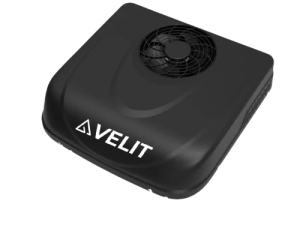
Everything in one housing mounted on the roof. Fits the same 14″ × 14″ cutout as a Maxxfan for most models. Clean install, no interior space used, ideal for full-timers. Most popular option and main focus of this guide.
DC Mini-Split

Separate indoor air handler and outdoor condenser. Can be more powerful, but complex to install.
We’ve seen a growing number of build updates with the condenser installed beneath the van’s floor. We get the idea:
- Keeps the condenser in the shade, which actually helps efficiency — a rooftop condenser in direct sun is fighting extra heat load
- Lowers the center of gravity, which matters on tall high-roof builds
- Frees up roof space for solar panels
- Keeps the install completely stealthy from the outside
That said, there are real tradeoffs:
- Fin fouling from road grime is hard to avoid. The condenser rejects heat by passing ambient air through the fins. Pack those fins with road grime, mud, and insect debris and airflow drops, refrigerant pressure climbs, and the compressor works harder to do the same job. A dirty condenser can easily drop efficiency by 20–30%. It’s the same reason HVAC techs tell you to clean your outdoor home unit every year, except your home unit isn’t driving through mud.
- Refrigerant lines and fittings are fully exposed to road spray, mud, and debris — a stone chip or bad speed bump in the wrong spot means a refrigerant leak requiring a professional recharge
- Recirculated hot air when parked: the condenser fan pulls from under the van, where hot air pools, so it often breathes warmer air than a roof-mounted unit
While we get the idea of the undermount A/C, we still prefer a rooftop A/C in the long run.
Portable Units
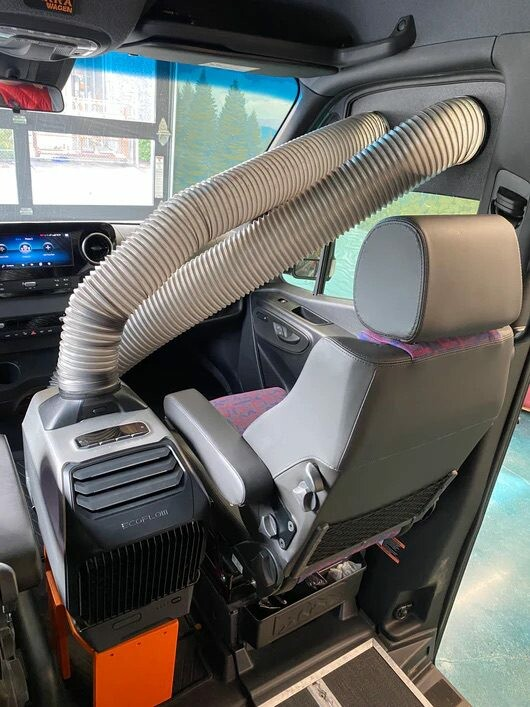
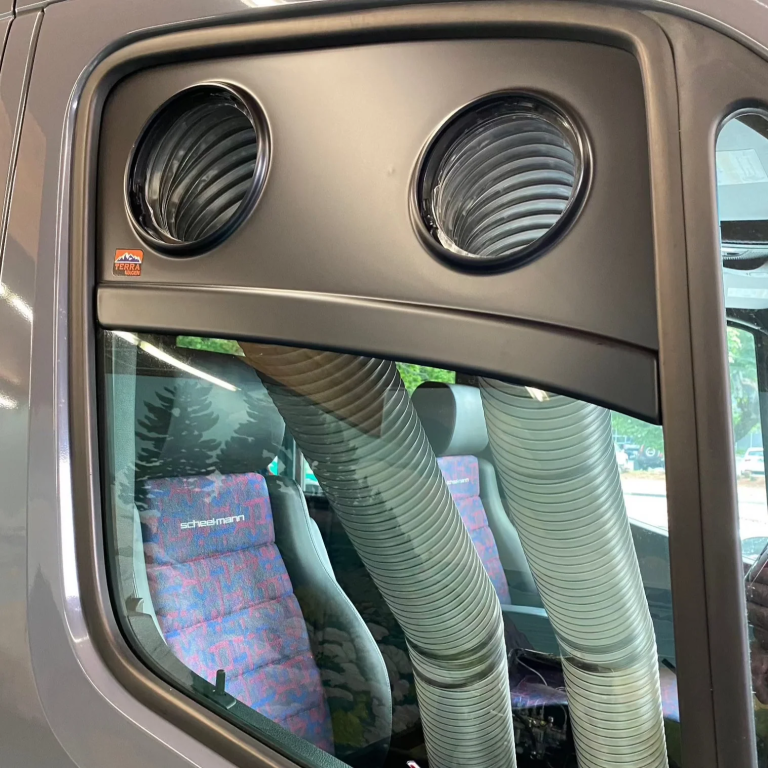
Battery-powered portables like the EcoFlow Wave 3 or Zero Breeze Mark 3. No roof cut needed. Good for occasional use or if you can’t modify the vehicle. Lower cooling power and shorter runtime than rooftop units. We compare the two in Portable 12V Air Conditioners Compared below.
120V Rooftop Units
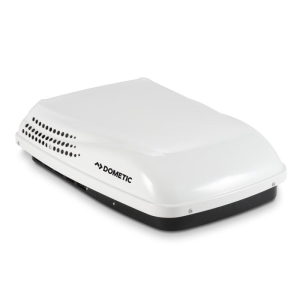
Traditional 120V RV A/C (Dometic Penguin, Coleman Mach, etc.). Massive cooling power at a low price, but dependent on shore power, a generator, or a large inverter and battery bank with a soft-start.
12V & 48V Rooftop Units Compared
The market has grown a lot in recent years. Here are the units worth considering (or jump to our picks):
Comparison Table
| Unit w/ Buy Link | BTU | Eco Draw | 12V | 24V | 48V | Heat Pump | Cutout | Price (USD) |
|---|---|---|---|---|---|---|---|---|
| Dometic RTX 2000 | 6,824 | ~19A | ✅ | ❌ | ❌ | ❌ | 14.5″ × 14″ | ~$3,100 |
| Velit 2000R Mini | 7,500 | ~25A (12V) / ~12A (48V) | ✅ | ❌ | ✅ | ❌ | 14″ × 14″ | ~$1,679 |
| Velit 2000R | 8,000 | ~25A (12V) / ~12A (48V) | ✅ | ✅ | ✅ | ❌ | 14″ × 14″ | ~$1,829 |
| RoamAir R2 | 8,000 | ~20A (12V) / ~10A (48V) | ✅ | ❌ | ✅ | ✅ | 14″ × 14″ | ~$1,975 |
| RecPro 48V 9,500 | 9,500 | ~16.5A (48V) | ❌ | ❌ | ✅ | ✅ | 14″ × 14″ | ~$1,849 |
| Nomadic Helix X2 | 9,484 | ~38A (12V) / ~9A (48V) | ✅ | ❌ | ✅ | ❌ | 14″ × 14″ | ~$3,425 |
| RecPro 48V 13,500 | 13,500 | ~13.8A (48V) | ❌ | ❌ | ✅ | ✅ | 14″ × 14″ | ~$1,999 |
| Velit 3000R | 12,000 | ~18A (24V) / ~12A (48V) | ❌ | ✅ | ✅ | ❌ | 14″ × 14″ | ~$2,155 (24V) |
| Nomadic Helix X3 | 12,893 | ~61A (12V) / ~11A (48V) | ✅ | ❌ | ✅ | ❌ | 14″ × 14″ | ~$3,750 |
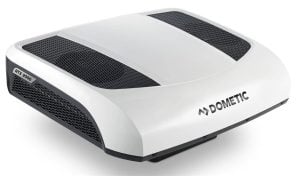
Dometic RTX 2000
Originally designed for long-haul truck cabs, the third-generation RTX 2000 has become one of the most popular DC rooftop A/C units in van builds. Its inverter compressor is exceptionally efficient: 19A in eco mode is the lowest eco draw of any 12V unit here (the Velits’ spec sheets list ~25A), and Dometic’s track record in the European truck market spans over a decade. One important gotcha: it’s 12V only, and it requires a slightly wider 14.5″ × 14″ roof opening instead of the standard 14″ × 14″. If you’re replacing a Maxxfan, you’ll need to trim the opening slightly. Dometic includes a cardboard template to mark the cut. If we were building on 12V today, this is the unit we’d start with: runtime is decided by eco draw, and nothing in this list beats it at 12V.
✅ Pros
- Lowest eco draw of any 12V unit here (~19A)
- Proven tech — 10+ years in the European truck market
- Very quiet thanks to variable-speed inverter compressor
- Works with a smaller battery bank (180Ah minimum recommended)
❌ Cons
- 12V only — no 24V or 48V option
- Requires a 14.5″ × 14″ cutout — not the standard 14″ × 14″
- No fan-only mode
- Lower BTU (6,824) — may fall short in extreme heat or large vans
- Pricey: ~$3,100 once you add the required install and wiring kits
Velit 2000R Mini
The 2000R Mini is Velit’s smallest rooftop unit — and despite the compact 6.3″ profile, it uses the same full-size twin-rotor compressor as the standard 2000R. At 7,500 BTU (8,500 at 48V), it has a minimum draw of 25A at 12V (12A at 48V) per Velit’s spec sheet. The slim profile is a real advantage if roof clearance is tight, and it fits directly in the standard 14″ × 14″ cutout. We’d only pick the Mini over the standard 2000R if roof height is the constraint: it gives up 500 BTU at 12V (1,500 at 48V) and the 24V option to save 0.7″ of height and about $150.

✅ Pros
- Ultra-low profile (6.3″) — great for tight roof clearance
- Available in 12V and 48V
- Lower draw at 48V (~12A minimum)
- Fits the standard 14″ × 14″ cutout
- Includes fan-only mode
- Can run directly off most vehicle alternators
❌ Cons
- No 24V option
- Lower BTU than the standard 2000R (7,500 vs 8,000)
- Newer product — less long-term real-world data than Dometic or Nomadic
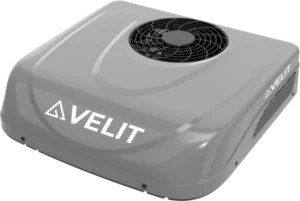
Velit 2000R
The standard 2000R is Velit’s most versatile unit — available in 12V, 24V, and 48V, it covers more build configurations than any other rooftop A/C in this category. At 8,000 BTU at 12V (up to 10,000 at 48V), with a ~25A minimum draw at 12V, it delivers solid efficiency at a price that undercuts the Nomadic significantly. The 7″ profile fits the standard 14″ × 14″ cutout and includes fan-only mode. A strong all-around pick if the Dometic’s 12V-only limitation doesn’t work for your system.
✅ Pros
- Available in 12V, 24V, and 48V — most voltage options in the category
- Good price-to-BTU ratio (~$1,829 for 8,000 BTU)
- Fits the standard 14″ × 14″ cutout
- Includes fan-only mode
- TÜV certified
❌ Cons
- Less real-world long-term data compared to Dometic or Nomadic
- Fewer US dealers and support options
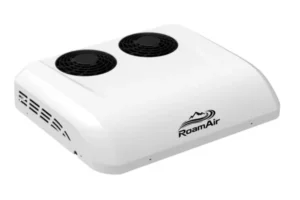
RoamAir R2
The RoamAir R2, from a brand called RoamLabX, is new for 2026 and the newest unit here. Its published cooling and power specs match the Velit 2000R’s exactly (8,000 BTU at 12V, 10,000 BTU at 48V; 750 W and 900 W rated), but it adds a heat pump, which makes it the only unit in this guide that heats and runs on 12V. Minimum draw is ~20A at 12V or ~10A at 48V, it fits the standard 14″ × 14″ cutout, and RoamAir claims no startup surge. The heating output isn’t published yet (manuals are “coming soon”) and there are no owner reviews so far, so we’d wait for real-world reports before buying. The 12V version is backordered anyway; 48V is in stock.
✅ Pros
- Heat pump: cools and heats
- Available in 12V and 48V
- Fits the standard 14″ × 14″ cutout
- No startup surge (manufacturer claim)
- ~$1,975 for 10,000 BTU at 48V
❌ Cons
- Heating output not published yet
- Brand-new: no owner reviews or long-term data
- 12V version backordered (48V in stock)
- No 24V option
- 1-year warranty
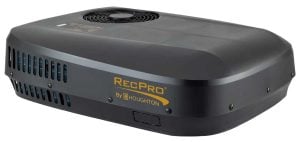
RecPro 48V 9,500 BTU
RecPro’s entry-level 48V unit punches above its price point. At 9,500 BTU, it draws 16.5–26.2A at 48V while cooling (about 790–1,260 W), so it’s not a low-draw unit; the appeal is the price and the built-in heat pump, which doubles as a heater for shoulder-season travel. It’s 48V only, so it requires a higher-voltage system, but if you’re already running 48V (EcoFlow Power Kit, etc.) it’s hard to beat the value.
✅ Pros
- Built-in heat pump — cools and heats (13.8–23.3A at 48V in heat mode)
- Strong value (~$1,849 for 9,500 BTU)
- Fits the standard 14″ × 14″ cutout
- Fan-only and dry modes included
- Touchscreen plenum with remote
❌ Cons
- 48V only — requires a higher-voltage system
- Performance may drop at highway speeds (manufacturer note)
- Less vanlife-specific community support than Nomadic or Velit
Nomadic Helix X2
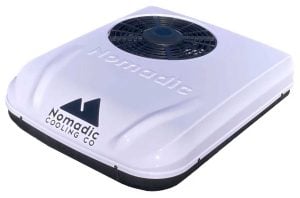
The Helix X2 is the sweet spot in Nomadic’s lineup — compact enough to fit the standard 14″ × 14″ cutout, capable enough to handle serious heat at 9,484 BTU, and now paired with the Helix control system for full remote access via phone or smartwatch. The PWM compressor holds temperatures steadier than traditional on/off cycling, and the sealed back plate with automotive-grade connectors is genuinely road-tough construction. Available in 12V and 48V. It’s the priciest way to get ~9,500 BTU on this list: you’re paying for the control system and US support, not extra cooling, so we’d only go Nomadic if those matter to you.
✅ Pros
- Helix app control — remote access from phone, tablet, or smartwatch
- PWM compressor holds temps steadier than on/off cycling
- Fits the standard 14″ × 14″ cutout
- Available in 12V and 48V
- Fan-only and high humidity modes
- US-based support (Elkhart, Indiana)
❌ Cons
- Premium price (~$3,425)
- No 24V option
- Eco draw still significant at 12V (~38A)
- Needs a solid 300Ah+ battery bank for meaningful runtime
RecPro 48V 13,500 BTU
The larger of RecPro’s two 48V units steps up to 13,500 BTU — enough to cool a large high-roof extended van even in serious heat. Like the 9,500 BTU model it includes a heat pump, four air outlets for even distribution, and a touchscreen plenum with remote. At ~$1,999 for 13,500 BTU, it’s the highest BTU-per-dollar in this lineup, making it a compelling option if you’re already running a 48V system and need serious cooling power.
✅ Pros
- Highest BTU-per-dollar in this lineup (13,500 BTU for ~$1,999)
- Built-in heat pump — cools and heats
- Four air outlets for even airflow distribution
- Fits the standard 14″ × 14″ cutout
- Fan-only and dry modes included
❌ Cons
- 48V only — requires a higher-voltage system
- High BTU means high power demand — needs a large battery bank
- Performance may drop at highway speeds (manufacturer note)
- Minimum draw is still ~13.8A at 48V (~660 W), a bit above the Velits’ ~12A
Velit 3000R
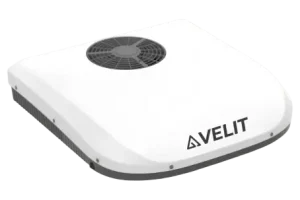
Velit’s flagship rooftop unit steps up to 12,000 BTU at 48V (10,000 BTU at 24V), with a minimum draw of 12A at 48V on Velit’s spec sheet (its marketing quotes as little as 6A). The flush-mount motorized air distribution box is a nice touch for even airflow, and the 7″ profile still fits the standard 14″ × 14″ cutout. Available in 24V and 48V only — there’s no 12V version, so it’s designed for higher-voltage builds from the start.
✅ Pros
- Strong output at 48V (12,000 BTU for 12–25A)
- 12,000 BTU handles large vans and extreme heat
- Flush-mount motorized air distribution box
- Fits the standard 14″ × 14″ cutout
- Available in 24V and 48V (48V currently sold out)
- Compatible with EcoFlow Power Kits (48V)
❌ Cons
- No 12V option — 24V minimum
- Less real-world long-term data than Nomadic or Dometic
- Fewer US dealers and support options
Nomadic Helix X3
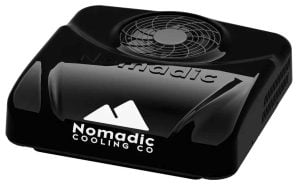
Nomadic’s flagship unit — the Helix X3 is the most powerful 12V-capable unit in this guide at ~12,893 BTU, built for full-timers in extreme climates who need reliable heavy-duty cooling. Like the X2, it comes with the full Helix control ecosystem (app, scenes, schedules, smartwatch), PWM compressor for steady temperature hold, and the same sealed, road-tough construction. Available in 12V and 48V, with a 24V option available through Nomadic directly. The premium price reflects the premium spec.
✅ Pros
- Most powerful 12V-capable unit in the guide (~12,893 BTU)
- Full Helix app control — scenes, schedules, remote access
- Available in 12V, 24V, and 48V
- PWM compressor for steady, quiet temperature hold
- Fan-only and high humidity modes
- Fits the standard 14″ × 14″ cutout
- US-based support (Elkhart, Indiana)
❌ Cons
- Most expensive unit in the guide (~$3,750)
- Eco draw still significant at 12V (~61A, Nomadic’s estimate)
- Needs a 400Ah+ battery bank for reliable runtime
- Provisional specs — final certified numbers pending lab testing
Which One Should You Buy?
We run a 48V EcoFlow Power Kit in FarOutVan 2, so if we added A/C tomorrow, the 48V units would be our shortlist: thinner cables, the standard cutout, and a heat pump on the RecPros.
Best Efficiency on a 12V System
Dometic RTX 2000. The lowest eco draw of any 12V unit here (~19A; the Velits list ~25A). Best choice if you’re running a standard 12V system and want to maximize runtime on a moderate battery bank (180–300Ah).
Best All-Around Value
Velit 2000R. Available in 12V, 24V, and 48V, solid BTUs, standard cutout, and a price that significantly undercuts Nomadic. The most flexible option in the lineup for different build configurations.
Most Cooling per Dollar (48V)
RecPro 48V 13,500 BTU. The highest BTU-per-dollar in this lineup, with a heat pump built in. If you’re already running a 48V system and want maximum cooling power without breaking the bank, it’s the clear pick. If battery runtime matters more than peak cooling, compare minimum draws: at 48V the Nomadic X2 (~9A) and the Velits (~12A) idle lower than the RecPros (~14–17A).
Best Smart Features
Nomadic Helix X2. Full app control, scenes, schedules, PWM compressor, and road-tough construction. If you want the best-engineered vanlife-specific unit with proper remote access and don’t want to go full X3, this is it.
Best for Extreme Heat
Nomadic Helix X3. Full-timers in the desert Southwest or other brutal climates who need maximum cooling power and don’t want to compromise — the most powerful unit in the guide that also runs on 12V.
Portable 12V Air Conditioners Compared
A portable unit is the no-cut way to get A/C: it sits on the floor, exhausts hot air through a window kit, and runs from its own battery. It makes sense for weekenders, rentals, and anyone who can’t (or won’t) cut the roof. The trade-offs are floor space, hoses, and a lot less cooling than a rooftop unit.
| Unit w/ Buy Link | Cooling | Heating | Power | Battery | Claimed Runtime | Weight | Price (USD) |
|---|---|---|---|---|---|---|---|
| EcoFlow Wave 3 | 6,100 BTU | 6,800 BTU | ~640–690 W rated | 1,024 Wh add-on | 2–8 h | 33.7 lb | ~$849 (~$1,369 with battery) |
| Zero Breeze Mark 3 | 5,280 BTU | 5,800 BTU | 150–500 W | 1,022 Wh | 3–5 h (cool), 5–7 h (sleep) | 22 lb | ~$1,299 (~$1,899 with battery) |
Neither runs straight off a 12V house battery. The Wave 3 runs on its own battery or a wall outlet and recharges from solar (up to 400 W), a car socket, or EcoFlow’s 800 W alternator charger. The Mark 3 is a 48V unit, so on a 12V system it needs Zero Breeze’s 48V booster, which pulls at least 42A from your 12V battery.
Take the BTU numbers with a grain of salt. Most plug-in portable A/Cs sold in the US advertise a DOE “SACC” rating, which accounts for hose heat and air leaking around the unit and reads well below the older ASHRAE number (around 5,000 SACC for a unit rated 8,000 ASHRAE, per Sylvane). Neither brand publishes a SACC figure, so their numbers aren’t directly comparable, and the hot exhaust hose itself puts some heat back into the van.
Our take: a portable is a good way to try A/C for a weekend or a rental without cutting metal. If you’d run it most summer nights, a rooftop unit wired to your main battery bank wins on cooling, floor space, and runtime.
Managing Expectations
A battery-powered A/C is not a home central air system. It won’t hold 68°F (20°C) when it’s 105°F (41°C) outside and you’re parked in direct sun with no insulation. What it will do — realistically — is drop the interior temperature by 10–20°F (6–11°C) and control humidity, which is often the difference between sleeping well and not sleeping at all.

Variables That Affect Performance
Outside Temperature
The single biggest factor. Duty cycle can swing from 20% on a mild night to 90%+ in extreme heat. Your energy consumption changes dramatically with the weather — don’t size your system around the worst-case scenario or you’ll overbuild everything.
Insulation
A well-insulated van holds cool air much longer between compressor cycles. If you haven’t insulated properly, fix that first — it will have a bigger impact on comfort than the A/C unit itself. See our insulation guide.
Window Covers
Windows are the biggest weak point for heat transfer. Insulated window covers make a noticeable difference and take significant load off the A/C — probably the best passive upgrade you can pair with it.
Van Size
A standard Transit cargo van is ~250 cu. ft. A high-roof extended is closer to 500 cu. ft. A single unit rated at 6,800 BTU will work harder — and run longer duty cycles — in a big van than a small one.
Sun Exposure
Parking in direct sun — especially in a dark-colored vehicle — dramatically increases heat load. Shade, even a windshield sunshade or a reflective roof cover, makes a real measurable difference to how hard the A/C has to work.
Opening Doors
Every time you open the van, a volume of hot air replaces the cool air you worked to create. It adds up more than you’d think, especially when it’s 95°F+ (35°C+) outside.
Tips to Maximize Runtime
- Pre-cool the van while driving or during peak solar hours — it’s much easier to maintain a cool temperature than to drop it from 100°F (38°C)
- Use eco mode as much as possible — the power savings between eco and full blast are significant
- Set a realistic target temp — cooling to 72°F (22°C) costs meaningfully more than 78°F (26°C)
- Park in shade whenever possible, especially during the afternoon heat peak
- Use insulated window covers — a good passive upgrade for A/C efficiency
- Run a fan on cool-enough nights — save the A/C for when you actually need it
Electrical System
Battery Bank Sizing
A/C is the most power-hungry thing you’ll add to your van. To size your battery bank properly, use our Van Electrical Calculator. Use the average current draw — not the max — and be realistic about daily usage hours. In typical conditions, 25–30A at 12V (about 300–360 W, or ~6–8A at 48V) is a reasonable average to plug in for a 12V-class unit.
Skip AGM for A/C: taking an AGM below ~50% every night shortens its life fast, so you’d need twice the bank for the same usable energy. LiFePO4 is the practical choice.
| Usage Scenario | Minimum LiFePO4 Bank |
|---|---|
| Occasional overnight use, mild temps | 200Ah |
| Regular overnight use, warm temps | 300-400Ah |
| Full-day off-grid cooling in hot climates | 400Ah+ |
Keep in mind these numbers are for A/C only and don’t include induction cooking or other high-draw appliances running simultaneously. If you’re going all-electric, size up accordingly.
A Note on Voltage (12V / 24V / 48V)
Most units now come in multiple voltage variants. If your system runs at 24V or 48V (like our EcoFlow Power Kit), running the A/C at that voltage means the amp draw halves (24V) or quarters (48V) — even though wattage stays the same. That means smaller wire gauges, less stress on your busbars, and a more capable system overall.
Wiring
Download our High-Power wiring diagram and use the addendum below to connect the A/C. A few key points:
- Use a 400A fuse with 4/0 AWG cable at the main connection
- Nomadic X2: connect via a 100A breaker — use the Wire Gauge Calculator for the correct AWG (1 AWG works for any run under 30 feet total: 15 feet red + 15 feet black)
- Dometic RTX 2000: connect via an 80A breaker — a 24ft wiring harness is included with the unit
- Stick with a 2000W inverter/charger — going to 3000W risks overloading the system when the inverter and A/C both peak simultaneously
- In the wiring diagram’s built-in calculator, use the dropdown menus and enter all the wire lengths to get the correct wire gauges (demo: youtu.be/9MEGls0qLZY)

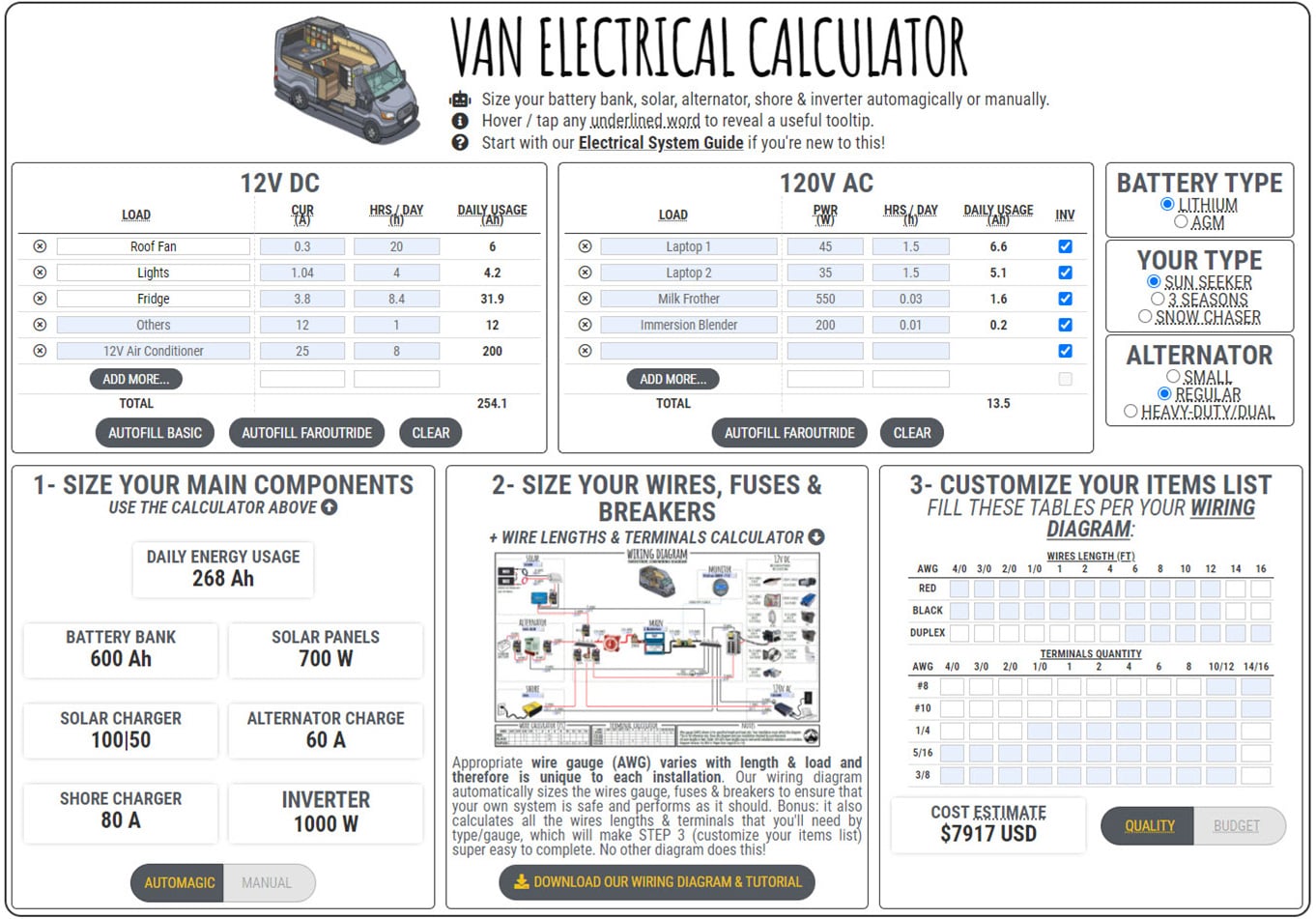
You can use our Van Electrical Calculator to customize your own system. We’d recommend sticking with a 2000W inverter/charger (you can force the calculator to do so by switching to “manual” mode). For the Nomadic Air Conditioner, use 25A current (that’s the average current draw, per manufacturer claim) and something like 8 hours for daily usage. For example:
Solar Charge
Can solar run the A/C? Partially — and it matters a lot for daytime use. A 600–800W array producing 40–50A on a sunny day can roughly offset eco-mode consumption, meaning your battery barely drains during peak sun hours. Don’t count on it for overnight cooling — that’s all battery. But solar significantly extends daytime runtime and makes the whole system much more viable over a multi-day trip.

Alternator Charge
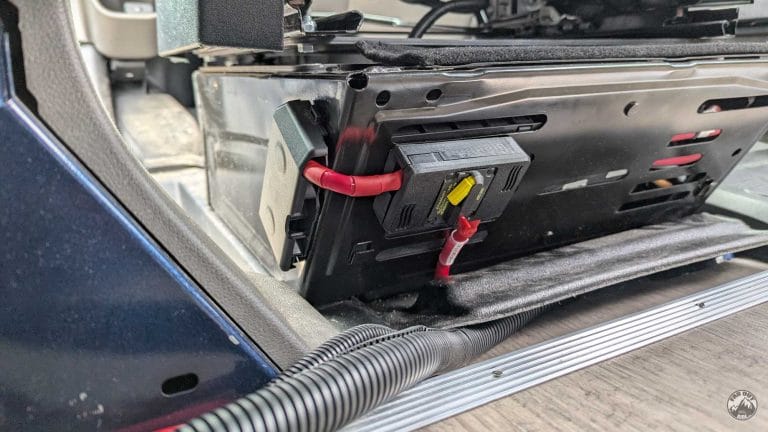
Driving is one of the most reliable ways to recharge after a night of A/C use. A properly sized DC-DC charger (also called a B2B charger) pulls from your alternator while the engine runs and pushes a controlled charge into your lithium battery bank. A 40A DC-DC charger puts back roughly 40Ah per hour of driving — so a 2–3 hour drive after a hot night goes a long way toward recovering what you spent. Our EcoFlow Power Kit features a 100A DC-DC charger, which is quite impressive.
Shore Charge
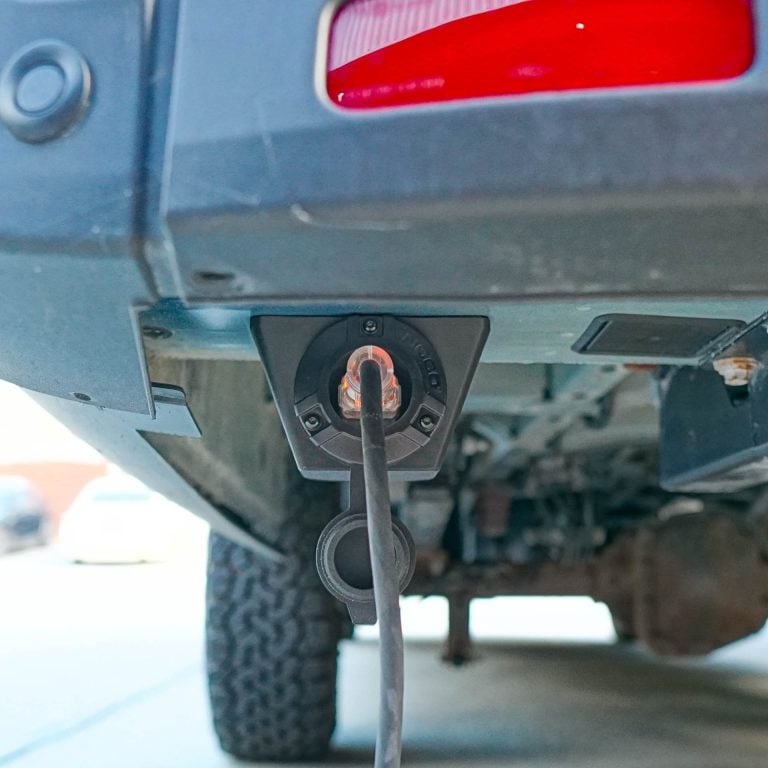
When you have access to a campground hookup or a power outlet, shore power is the fastest and easiest way to fully recharge your battery bank. Your inverter/charger handles this automatically — plug into 120V shore power and it switches into charge mode, pushing amps back into your batteries at whatever rate your charger is rated for (typically 50–100A depending on the unit). If you’re doing back-to-back hot nights at campgrounds, plugging in even for a few hours between sites can make a big difference. It’s also worth knowing that at a 30A or 50A campground pedestal, you can run the A/C directly off shore power rather than draining your batteries at all — just make sure your inverter/charger is set up to pass shore power through to your loads.
Installation
Roof Cutout
Most units (Nomadic, Velit) use the standard 14″ × 14″ opening — same as a Maxxfan. If you already have that cutout, installation is straightforward. The Dometic RTX 2000 requires a 14.5″ × 14″ opening. It’s a small difference but it means trimming an existing cutout if you’re replacing a fan. Dometic includes a cardboard template to mark the cut accurately.
Adapter Kit
Most van roofs are corrugated, so you can’t bolt an A/C unit flat against the roof without creating gaps. An adapter kit solves this — it creates a perfectly flat sealing surface and includes framing strips to add structural support for the extra weight of the A/C unit compared to a fan. Make sure to get the correct kit for your specific van model (Transit, Sprinter, ProMaster). The framing strips are installed inside the van when beam spacing is 18″ or more.
FAQ
How Long Can a Battery Run a 12V Air Conditioner?
Divide the usable energy in your battery by the unit’s average draw. With this guide’s 25–30A average at 12V (about 300–360 W), a 400Ah 12V lithium bank (~5 kWh) covers roughly 14–17 hours of A/C on its own: one hot night plus some margin for everything else. In a heat wave, with the duty cycle at 80–90%, expect less. Solar and driving are what make the second night possible; plug your own numbers into our Van Electrical Calculator.
Can I Run a Regular 120V RV Air Conditioner on Batteries?
Yes, but it’s a big load. A 13,500 BTU 120V rooftop unit like the Coleman Mach 10 draws up to 16A at 120V while running (around 1,900 W) and up to 63A for a split second at startup. You’ll need a 3,000 W-class inverter, a soft-start (Micro-Air claims its EasyStart cuts starting current by up to 75%), and a large battery bank. It works best on 24V or 48V systems; on 12V, owners report the startup surge tripping the battery’s low-voltage cutoff.
Is There a 12V Air Conditioner That Doesn’t Need a Roof Cutout?
Yes: portable units vent through a window kit instead. Under-bench units like the Velit 2000U (12V, 24V, or 48V; 7,500 BTU at 12V) avoid the roof too, but still need two 6″ vent holes through the floor or wall.
Can a 12V Air Conditioner Heat the Van?
Only the heat-pump units: the two RecPros and the RoamAir R2 in this guide. Heat pumps lose output as it gets colder, so for winter an air heater is still the better tool (see Heat Pump Mode above).
Can I Run the A/C While Driving?
Yes. The A/C runs from your house battery, and the alternator refills it through your DC-DC charger as you drive. A 40A DC-DC charger puts back roughly 40Ah per hour, which more than covers a 12V unit in eco mode, so a drive roughly breaks even while the A/C runs in eco mode. Velit also says the 2000R Mini can be powered directly by most vehicle alternators.
Resources
- Roof fan installation guide — same process for cutting and sealing the roof opening
- High-Power wiring diagram — use with the A/C wiring addendum above
- Wire gauge calculator — get the right AWG for your run length
- Van electrical calculator — size your full battery bank with A/C factored in




great article thank you
Would it be ill-advised to run a 12v AC off of an AGM battery bank? We have 640Ah of Victron AGM batteries. Since AGM batteries should not be drained below 50% SOC, we effectively have 320Ah of battery capacity. How much AC runtime could we realistically get if no other devices are drawing from the batteries? Thanks
So, I have the Ecoflow wave 2. I believe it is 5,000BTU. It is just ok—-as you describe the rooftop—it will cool the van 10-15 degrees. I keep looking at these units, but by the time I invest in the unit, the installation, and the upgrade to my battery bank—just ok cooling would be a bust.
Hello there! I’m reading all the information and I’ve a question about the AC unit. I’m planning in have a 24v system just because this, seeing that having a 24v AC unit will use half of AH than one that is 12v, so the autonomy of the battery bank it will much longer, I’m wrong? Thanks!
Hey guys! I really appreciate your work here. I’m new to vanlife and trying to figure it all out.
Is it possible to connect the dometic rtx 2000 12V to the bluetti AC200P?
I thought that it was possible to run the dometic on eco mode (only 19A) through the DC aviation port (up to 25A) but I can’t figure out how I would wire that large 4awg aviation plug to the aviation plug.
please help! thank you so much.