

Choosing the right van is one of the biggest decisions in a campervan build. This page breaks down the three most popular full-size vans for DIY conversions in North America — the Ford Transit, the Mercedes Sprinter, and the Ram ProMaster — covering dimensions, specs, costs, and our honest opinion.
Side-By-Side Comparison
Specs
| FORD TRANSIT | MERCEDES SPRINTER | RAM PROMASTER | |
|---|---|---|---|
| Starting MSRP (2026 cargo van) | ~$48,000 | ~$49,000 | $44,960 |
| Engines | 3.5L V6 (275 hp) or 3.5L EcoBoost (310 hp), gas | 2.0L 4-cyl diesel (168 hp / 208 hp HO) — gas version dropped in 2023 | 3.6L V6 (276 hp), gas |
| Drivetrain | RWD or AWD | RWD or AWD | FWD only |
| Interior width (max) | 70.2″ | 70.4″ | 75.6″ (widest) |
| Standing height (interior) | Low 56.9″ Med 72.0″ High 81.5″ (tallest) | Std 68″ High 79.1″ | Low 65.4″ High 76.2″ Super High (2023+) 86.6″ |
| Cargo length (at floor) | Regular (130″ WB) 126.0″ Long (148″ WB) 143.7″ Extended 172.2″ | 144″ WB 132.9″ 170″ WB 173.6″ 170″ Ext 189″ | 118″ WB 105.1″ 136″ WB 122.8″ 159″ WB 145.9″ 159″ Ext 160.3″ |
| Annual repair cost (RepairPal, 350/2500 trims) | $888 | $1,778 | $1,147 |
| Electric version | E-Transit — 89 kWh, ~159 mi, from ~$53k | eSprinter — 81/113 kWh, up to ~249 mi, from ~$64k | ProMaster EV — 110 kWh, ~162 mi, from ~$58.6k |
U.S. Sales
Manufacturer-reported U.S. sales, compiled by GoodCarBadCar and CarFigures. *Sprinter 2025 is Mercedes’ official rounded figure for its U.S. van division.
Short Version
The Transit is the easiest van to own (dealers everywhere, cheap parts, AWD available, tallest interior). The ProMaster gives the most usable space per dollar — widest body, straight walls, low floor — as long as you can live with front-wheel drive. The Sprinter wins on diesel range and badge appeal, and costs you accordingly, both at the dealer and after the warranty ends.
Ford Transit
Overview
The Transit is the best-selling full-size van in the USA. Since the 2020 overhaul it offers AWD and modern driver-assist tech, and for 2026 the engine choices are a 3.5L V6 (275 hp) or the 3.5L EcoBoost (310 hp) — the strongest in the segment — through a 10-speed automatic. If you’re ordering new, our Ford Transit Order Guide covers every option worth ticking (and the ones to skip).


Build And Price
Style
- Cargo Van
- Passenger Van
Length
- Regular 18.5 ft (130″ WB)
- Long 20 ft (148″ WB)
- Extended 22 ft (148″ WB)
Height
- Low Roof (83.2″)
- Medium Roof (100.8″)
- High Roof (110.2″)
Engines
- 3.5L Direct Injection (Gas)
- 3.5L EcoBoost (Gas)
Drivetrain
- RWD
- RWD LSD (Limited Slip Differential)
- AWD (All Wheel Drive)
Use the Ford.com “Build & Price” interactive tool to build your own Ford Transit (and find out the price). Try it, it’s neat:
Exterior Dimensions

Interior Cargo Dimensions
All photos credit: https://www.adriansteel.com/item/cargo-vans/dimensions/
REGULAR LENGTH (130WB)
LOW ROOF

MEDIUM ROOF

LONG LENGTH (148WB)
LOW ROOF

MEDIUM ROOF

HIGH ROOF

EXTENDED LENGTH (148WB)
HIGH ROOF

Repair & Maintenance
$888 USD ANNUAL REPAIR COST (SOURCE: REPAIRPAL.COM)
Ford, Mercedes, or Ram: regardless of makes and brands, repair and maintenance is inevitable in the long run. Sure, you might get a free espresso at the Mercedes dealer, but Ford dealers are all over the map (dealer locator), are way cheaper, and have VERY good parts availability. That’s one of the main reasons to go for the Ford Transit in our opinion.
How reliable is the Ford Transit? After nearly a decade of full-time Transit ownership across two vans, we publish every dollar we spend in our maintenance log & repair journal — real numbers, not estimates.
Our Opinion
WHAT WE LIKE
- Reasonable ownership cost.
- Extensive dealership network.
- Get parts cheap and fast.
- Drives like a minivan.
- AWD + tallest interior of the three.
WHAT WE DON’T LIKE
- Rear brakes wear fast. Keep an eye on them.
INITIAL COST: Back in 2015 we looked for a Sprinter (because that’s what everybody did), and quickly realized we could get a brand-new Ford Transit — full warranty, no previous owner, our exact options — for pretty much the price of a used Sprinter.
TEST-DRIVE: We test-drove both. The Transit felt like a minivan (nimble, predictable); the Sprinter felt like a full-size cargo van.
COMMON SENSE: “If we had to buy a car, would we buy a Mercedes or a Ford?” We’d rather spend the difference on mountain biking gear and adventures than on a badge.
We bought a brand-new Transit in 2016, then did it again in 2021 for FarOutVan 2. That’s our review in one sentence.
Resources
MODIFICATIONS & OEM GUIDELINES
ONLINE COMMUNITIES
Mercedes Sprinter
Overview
The Sprinter is the original camper-van icon, and the current generation got a meaningful update: since the 2024 model year every Sprinter runs a 2.0L 4-cylinder diesel (168 hp standard, 208 hp high-output) through a 9-speed automatic — the gas engine and the old V6 are gone. The legendary 4×4 was replaced by a proper AWD system in 2023. It still offers the best fuel economy of the three and the longest options list, and it’s still the most expensive to buy, service, and repair.
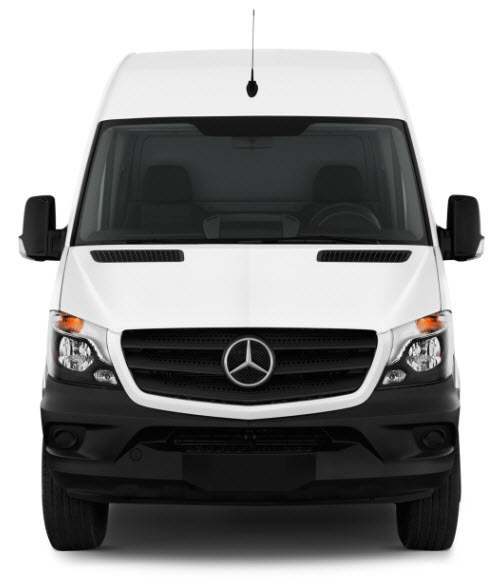


Build And Price
Style
- Cargo Van
- Passenger Van
Length
- Standard 19.5 ft (144″ WB)
- Long 22.8 ft (170″ WB)
- Extended 24.15 ft (170″ WB)
Height
- Standard Roof (96.3″)
- High Roof (110″)
- Super-High Roof (120.1″)
Engines
- 2.0L Turbo (Gas)
Drivetrain
- RWD
- AWD
Exterior Dimensions

Camper-relevant configs: 144″ WB High Roof (132.9″ cargo length), 170″ WB High Roof (173.6″), and 170″ Ext High Roof (189″). Interior width 70.4″, standing height 79.1″.
Interior Cargo Dimensions
All photos credit: https://www.adriansteel.com/item/cargo-vans/dimensions/
STANDARD LENGTH (144WB),
LOW ROOF:

LONG LENGTH (170WB),
HIGH ROOF:

EXTENDED LENGTH (170WB), HIGH ROOF:

Repair & Maintenance
$1,778 USD ANNUAL REPAIR COST (SOURCE: REPAIRPAL.COM)
Sprinters are great until things go wrong. Dealers are concentrated in major cities, parts & labor are costly, and parts availability can take time. The 4-cylinder simplification may help long-term, but a diesel with modern emissions equipment (DEF, DPF, EGR) is never the cheap option to keep healthy out of warranty.
Our Opinion
WHAT WE LIKE
- Good mileage.
- Free espresso at the dealer.
WHAT WE DON’T LIKE
- High ownership cost.
- High risk of turning into a money pit on wheels.
Resources
MODIFICATIONS & OEM GUIDELINES
Body And Equipment Guidelines (BEG):
ONLINE COMMUNITIES
Ram ProMaster
Overview
The ProMaster got a real refresh in 2023: new front end, updated interior, a 9-speed automatic behind the 3.6L V6 (276 hp), and a new Super High Roof option for standing height the others can’t match. It remains the budget-friendly choice — and the box is the best in the business: the widest interior (75.6″), nearly vertical walls, and the lowest load floor (~21″). If maximizing build space per dollar is the goal, this is the van. One thing hasn’t changed: it’s still front-wheel drive only — no AWD option.


Build And Price
Style
- Cargo Van
- “Window” Van
Length
- 136″ WB 17.75 ft
- 159″ WB 19.75 ft
- 159″ WB Extended 20.85 ft
Height
- Low Roof (88″)
- High Roof (99″)
Engines
- 3.6L Pentastar (Gas)
Drivetrain
- FWD
Use the RamTrucks.com “Build Your Van” interactive tool to build your own ProMaster van:
Exterior Dimensions

Interior Cargo Dimensions
All photos credit: https://www.adriansteel.com/item/cargo-vans/dimensions/
136″ WHEELBASE
LOW ROOF:

HIGH ROOF:

159″ WHEELBASE,
HIGH ROOF:

159″ WHEELBASE EXTENDED,
HIGH ROOF:

Repair & Maintenance
$1,147 USD ANNUAL REPAIR COST (SOURCE: REPAIRPAL.COM)
Mechanically it shares plenty with the wider Stellantis parts bin (the 3.6L Pentastar is everywhere), so ownership costs stay reasonable and most shops can work on it.
Our Opinion
WHAT WE LIKE
- With its “square” cargo area, the ProMaster is the widest of all vans, and straight walls are easier to build in.
- Reasonable ownership cost.
WHAT WE DON’T LIKE
- Front Wheel Drive (thumbs down, that’s right). A converted van has more weight on its rear axle, which means more traction on the rear wheels. Here in British Columbia, we frequently have to go up very steep 4WD high-clearance roads to get access to our favorite mountain-biking trails or backcountry skiing zones; a front wheel drive doesn’t have enough traction to do this. Seeing the astonished reaction of people when we arrive on top of what’s considered a rough 4WD road doesn’t get old 🙂 “Is that van four wheel drive?”

Knowing that MORE WEIGHT = MORE TRACTION, we’re glad our van is RWD!

We get more traction when climbing a steep incline, because there is even more weight on the rear axle!
Reality Check
We reached out to a friend who lived in his Sprinter van for 4 years and just switched to a ProMaster (full time as well). Keeping the same habits, he says that he got stuck as much in 3 months as he did in 4 years in his Sprinter. So while we have nothing against the ProMaster (we have absolutely no affiliation with any brand), it might not be the best vehicle to take on the back roads.
Resources
BUILD & PRICE YOUR OWN RAM PROMASTER

MODIFICATIONS & OEM GUIDELINES
Design Recommendation
Frame Alterations
Wiring
Etc.
ONLINE COMMUNITIES
What About Electric? (E-Transit vs eSprinter vs ProMaster EV)
All three vans now exist in electric form, so the question comes up a lot. The honest engineering answer for 2026: not yet for full-time travel, plausible for regional weekenders.
- Ford E-Transit — 89 kWh battery, ~159 miles of rated range, from ~$53,000.
- Mercedes eSprinter — up to 113 kWh and ~249 miles, the range champ, from ~$64,000.
- Ram ProMaster EV — 110 kWh, ~162 miles (city-biased rating), from $58,590.
Those are empty-van ratings. Add 2,000+ lbs of conversion (see our weight breakdown), a roof full of gear, winter temperatures, and highway speeds, and real-world range shrinks fast — and the chargers are rarely where the good trailheads are. We’re watching this space; we’re just not betting our home on it yet.
Best Van for Campervan Build: Our Humble Opinion
We’ve put our money where our mouth is twice now: a brand-new Transit in 2016, and another one in 2021. For how we travel — full-time, four seasons, up rough forest roads to trailheads — the Transit’s combination of ownership cost, dealer coverage, AWD, and the tallest interior is still the right answer in 2026.
But “best” depends on how you travel. If you stay on pavement and want maximum living space for minimum money, the ProMaster’s wide, square, low-floor box is a legitimately better building platform. Pick the van that fits your build and your roads — then check out our build journals to see what comes next:


THAT’S IT FOLKS, HOPE THAT HELPS!





I’ve been driving a Ford Transit (14 passenger) for work (hauling people and their luggage to/from the airport) for 2 years now. My own personal vehicle was a Grand Am and I had never driven anything bigger in my life. I was scared just standing NEXT to the Transit! Now that I’ve been driving them for 2 years I’M IN LOVE with them! It actually took about 2 weeks for me to fall in love with them. They drive like cream. Easy to maneuver. I’m a female, almost 59 and am now looking to buy a used Transit to build out and live in permanently. I’m SO EXCITED! If anyone out there is hesitant….don’t be. I’m not affiliated with Ford or anything…..I just love their Transits!!!
Great site. Thanks for the information. We ordered the plans and will use it as a guide for our build.
We do have a question. Do you think the extended is a must or would you have been satisfied with the long (non extended)? Are there circumstances where you find the extra lenght a hindrance?
We wouldn’t go with anything shorter than the extended, but keep in mind that:
– We are two persons in there living full time;
– We have our 2 mountain bikes, snowboards and avalanche gear;
– Oven, toilet, sink, fridge, etc, etc…
So depending on your situation you don’t need the extended length; that’s kind of personal.
We don’t find it too long to navigate and to park; you quickly get use to it!
Cheers
Awesome site, with such clear information! Hands down the best for planning a build out. I was wondering when it comes to the dimensions for the height of the van, what exactly is this measuring? Bottom or top of the corrugations on the floor? For the ceiling is it measured from the bottom or top of the “ribs”? Hope this isnt confusing. Thanks
Hi, we extracted this information from the manufacturer’s specs, so it’s hard to tell exactly.
Nice summary guys and I can’t fault your decision to go with a Transit. I’ve built up a Promaster myself. I’m hoping you’ll include some comments about the backroad capabilities of your Transit. While I haven’t had any of the traction issues you allude to, even on snow it’s been great, the juddering, squeaking, and rattling is so intense on even the mildest of dirt roads that I’m seriously considering a different vehicle. Seems that about 15 km/hr is a fast as I’m comfortable driving on washboard. This imposes some serious limitations on where I can take the van.
Such an intelligent, beautiful website and camper van. We are a retired couple who want to do something similar but on a smaller scale. We live in a condo with underground parking which requires that the Transit cargo van has a low roof and regular wb. We will use it for cross country trips, we aren’t engineers and we will be paying someone to do the installation.
Any suggestions on a kit?
Bonyenne! Vraiment une grosse job tous ce que vous nous offrez! Merci. Diminue grandement l’anxiété!
Je n’ai pas encore acheté la van (je penche pour le SMaster 159 HT) car j’hésite beaucoup sur l’année vs le budget! C’est l’Alaska en 2022 que je vise! Yé!
But the AWD transit is only available on the new 2020, correct? If so, how is a previous year transit any more desirable versus a promaster in terms of the thumbs down you gave the promaster? Because right now the ability to buy a used model of either and save 10-20k is huge for me and ability to spend more on the build out.
I was wondering the same….
Antoine! Your site is amazing! I am an eye surgeon so unfortunately I cannot go van life full time, but I plan on building an adventure van next year. Found your site and LOVE it. Question: I saw a comment on the extended vans that since the rear overhang behind the wheels is large so that you can scrape bottom of the van. I noted that you actually commented on it [https://faroutride.com/van-tour/]. Has this kept you from going any where that you would want? I’ve also heard that the large wheel base means that you may not be able to back-up and turn around to get out of places. Have you had any issues with this? I’m guessing both these issues apply more to the extended Sprinter, but wanted to ask your experience with the Transit extended. Blessings and thank you in advance!
Damn, this is the most comprehensive review I’ve ever seen. Wow. Excellent job guys. Leaning towards the transit now.
Thanks, glad we could help!!
We crossed the US twice and traversed the Alaskan highway (skiing and returning in winter), then cleaned and shipped our van to Australia in October of 2019. We are currently 1/4 way through the Western Territory on lockdown on the Bunbury Coast. We don’t think we could have returned from Alaska without the 4×4 capabilities and raised clearance height (all factory). We did have several minor issues like broken brake calipers (Alaskan terrain) and starter replacement issues, but as long as you follow the prescribed maintenance schedule, these will work themselves out. But not many vans can beat a Mercedes diesel for longevity. Not many 3.6L gas ford or dodge engies make it past 150k miles as you can see on craigslist anywhere, many of which start having issues at 50k, but diesel Mercedes are often sold with 200-300k plus miles. Many diesel work vans aren’t turned over until 500k. But if not doing high elevation, heavy ice/snow/overland, or venturing into the outback (sand), the off road 4-way locking differential is overkill along with the increased weight and fuel mileage of a diesel engine/chassis. If touring just the USA and not planning to keep the van over 100k miles, we would definitely have gone with the looks and feel of the Promaster.
I’m pretty torn between the EcoBoost and the 3.7. I live in Colorado and routinely drive at elevations between 8,000 and 10,000 ft. How is the high elevation performance of your 3.7 all loaded down with the conversion? Your site is amazing! Thank you for all you do!
We can definitely feel the loss of performance at high elevations, but we can still go from point A to point B. The Ecoboost might be more well suited for that. It will help with the re-sell value of the vehicle (Ford does not produce the Transit with the 3.7 anymore).
Cheers!
Please dont take this wrong. More power to all of you who can afford these vans. But there are many who cannot afford them. Many have to stick with regular used cargo vans due to initial costs. There is even a growing group using mini vans for conversions. So it appears we now have 3 groups of van dwellers which means something for everyone. Much of the construction info can be adjusted to fit what ever van one has. Naturally, most van conversion biz are geared to the high end cause thats where the profit is. Not everyone is a carpenter, cabinet maker, electrician, etc and it is hard to find an “all around” person to do the lower priced conversions. But if one searches enough maybe they can find the needle in the haystack. Lucky you.
Your site is an amazing resource. I just picked up a brand new 2020 AWD 350 Transit today. I’m planning on spending the next couple of months building it out in preparation for full time living for next several years. This site is on the top of my list for resources. Thank you for making such a detailed effort to educate us all.
1. Excellent site – thank you so much for the wealth of information!
2. I have some questions related to your thumbs down for the front wheel drive on the Promaster. Is it the case that all van builds put more weight on the rear axle compared to the front and therefore hinder the front drive traction? Has anyone actually measured the f/r weight ratio of their van after a build? Seems like by appropriate design choices (eg battery and water forward) that the front wheel drive would be no issue. In addition, a build with too much rear weight (even for a rear wheel drive car) could inhibit the steering performance of these builds.
Thanks in advance for your thoughts on the f/r weight issues.
We actually measured ours and we have way more weight in the back; don’t remember the exact weight, sorry. I’d say it’s generally the case that there’s more weight in the back then in the front.
We just met folks with a ProMaster here in Mexico, same weight as us. They were loosing traction going up a very steep street made of “flat rocks”; were were not. Just an anecdote…
Cheers!
Is there a specific reason you went with the 250 instead of the 150? Is a 250 necessary (in your opinion) if you’re going the Transit route?
We’re above the weight limit of the 150, and just OK with the 250. You might even want to consider the 350…
Our weight: faroutride.com/weight-summary
Have a good one!
Forgive me if you have mentioned fuel mileage on your site already. I’m curious to know what your fuel mileage experience is?
We get about 16.5L / 100km on average (city, highway, mountain, combined). We’re quite heavy and big, but we drive slow! 😉
I think it’s hard to go wrong with any of the vans. The purchase/mpg/insurance/repair costs for all of them (except Sprinter) are in the same ballpark, so it comes down to preference IMO.
I went with the a 159″ PM and really like it. Zero problems with it fulltime off-grid. Huge interior space, feels liek a studio apartment. 🙂 I did get it stuck in a deep gravel creek bed on a 4×4-only trail in Big Bend one time, but that wasn’t its fault, LOL!
I think if Nissan made the NV high top with factory 4×4 from the Titan it would sell like hotcakes.
Hey Antoine,
I like both the Transit and Promaster but ultimately bought a Promaster because I was able to buy it new at 25% off.
There are some great things about the Promaster and I’m seeing many more builds pop up using it as a platform.
The 159” has the same length as the 144” sprinter but has about 2’ additional interior cargo length… and the total vehicle length is under 20’.
From window to window, the width is 6’5” so we can sleep wall to wall and that gives us more layout options.
The high top is the least tallest which made a big difference when we were going under some short in city bridges in Boston.
The bumper is made of 3 separate components that make it easy to swap out if one gets damaged. I believe it’s about $70 to replace the side of the bumper and the rear bumper is also made of 3 components.
The floor height is lower and doesn’t have the awkward step (this is somewhat subjective).
All high top Promasters have a built in shelf above the driver and passenger seats for storage.
The battery compartment is easily accessible from the interior as well as the fuel tank which makes it easy to add a fuel operated heater.
Those things being said, I wish the Promaster had a more powerful engine but if one needs torque, a diesel is available.
Both the Transit and the Promaster are great vehicles. I don’t think the Mercedes is worth the money nor the hassle.
Great info, thanks for sharing!
Super site ! Je me dirige mentalement vers un ford pour les mêmes raisons que vous évoquées. Par contre, je me demandais si, avec votre expérience, la différence entre 22 pieds (extended) et 20 pieds a pu être un enjeu. Est-ce que les limites Camping Nationaux sont majoritairement à 21 pieds ? En fait, avez vous éprouvé des ennuis (stationnement en ville etc) avec cette décision ? Évidemment, the longer, the better et je ne compte pas faire du gros hors-route. Plus en mode “Stealth” … merci !
Le 22 pieds n’est jamais un problème pour nous. Oui c’est plus difficile de trouver du stationnement des fois et ca diminue la capacité en offroad, mais c’est le prix à payer pour pouvoir avoir tout avec nous (vélos, planches à neige, toilette, four, gros fridge, lavabo, lit permanent, etc). On irait pas plus petit c’est certain! Maintenant, à toi de voir selon ton style de vie et ton équipement!
I like the way the Transit drived and I’m sure it’s a quality vehicle but on a test drive in Arizona the small tires and poor clearance left me getting stuck in places where the van I have now – GMC Savana – gives me no problems.
Unfortunately GM offers no hitop. I’ve found the clearance very helpful in the backroads – particularly rocky desert backroads.
I discarded the Sprinter – poor reliability, Promaster – worries about that, Transit – lovely van but tires and clearance. If I had to do it again I might go with a hitop Nissan which was not mentioned – big burly van w lots of clearance.