Most products from Our Store now ship tariff and tax free to the USA - no fees at delivery. Free shipping on orders of $150 USD or more.

12V Air Conditioners: Battery Powered for Off-The-Grid Vanlife

Photo of author
By Antoine | Updated: February 21, 2026 | 35 comments
Category:
Subcategories:

12V "battery powered" air conditioners for off-the-grid usage are starting to hit the market. Manufacturers like Nomadic Cooling Co. and Dometic claim those 12V A/C units can be 70% more efficient than traditional 120V A/C rooftop units and are, therefore, suited for vanlife. In the following guide, we will compare 120V VS 12V air conditioning and define an electrical system that can support it and provide an acceptable autonomy. Keep cool and carry on!

Logo-FarOutRide-Winter-Vanlife-(nov-2019)

Disclosure: This post contains affiliate links, which means that if you click a product link and buy anything from the merchant (Amazon, eBay, etc.) we will receive a commission fee. The price you pay remains the same, affiliate link or not.

Portrait-FarOutRide-Isabelle-Antoine-Van

1- 120V VS 12V Air Conditioner

1.1- What's The Difference?

120V or 12V, the cooling cycle of a heat pump (air conditioner or refrigerator) remains the same. The main difference on a 12V air conditioner is that it uses a highly-efficient compressor designed to work on 12V DC current. On a 120V air conditioner, the current coming from the battery bank must be converted from 12V DC to 120V AC and there is always an energy loss of about 10-15% associated with that conversion.

This might remind you of 12V vs 120V refrigerator (faroutride.com/fridge-guide)! In both cases, it’s the 12V compressor that makes it so efficient.

1.2- Efficiency

Nomadic Cooling Co. claims their 12V “battery powered” air conditioners are 70% more efficient than traditional 120V air conditioners. Unfortunately, we’re not in a position to verify this claim as it would require testing both 12V and 120V units on our van in real-world situations. So let’s take a look at the maximum current specification for both units:

Nomadic Cooling Co.
2000 | 9,830 BTU

75 amps

max current at battery bank (12V)
Dometic Penguin II
11,000 BTU ("High-Efficiency" model)

~175 amps

max current at battery bank (12V)

That gap doesn’t prove that the Nomadic Cooling Co. is more efficient as the Dometic – being more powerful – might run less often (shorter duty cycle). However, it’s a good indication that the 12V unit is more suited for off-the-grid usage…

1.3- Cost

Nomadic Cooling Co.
2000 | 9,830 BTU

$3,300

USD Approx.
Dometic Penguin II
11,000 BTU ("High-Efficiency" model)

$1,275

USD Approx.

Well, that’s a massive price gap. So what can possibly justify the purchase of a 12V unit when it’s about 3x the price? See our decision tree below…

1.4- Decision (120V vs 12V)

Off-The-Grid

Arrow-down-left
12V Air Conditioner
(Battery Powered)

Shore Power

Arrow-down
120V Air Conditioner
(Serviced Campgrounds/Generator)

If you really want off-the-grid air conditioning, 120V is just not an option. Don’t get us wrong: you can actually make a 120V A/C run from the battery bank, but you’ll have a few minutes/hours of autonomy at best (even going with, let’s say, 600Ah of Lithium batteries. That’s over $6,000 in batteries alone). Not convinced? Here is a question we got recently (and we get similar questions occasionally):

Hello. I have a Victron 3000w multiplus inverter/charger and a Dometic brisk 2 on the roof […], and after I connected the Victron it drained the batteries quickly with only brief use of the ac fan and a couple of minutes of actual ac. Do you have any feedback?

Our feedback is: there’s probably no issue at all with your setup, except that, unfortunately, you had the wrong expectations about air conditioning… The solution here is to use your AC on shore power only or to upgrade your electrical system (battery bank most notably) and your AC for a 12V unit. We’ll show how below.

2- Buying a 12V Air Conditioner

We’d personally go for the Nomadic Cooling X2 because it’s easy to install (it fits a standard 14 x 14 Maxxfan fan cutout) and easy to wire. (The Nomadic X3 model is more powerful, but power consumption is quite high for off-the-grid usage):

Nomadic Cooling X2 12V/48V Air Conditioner

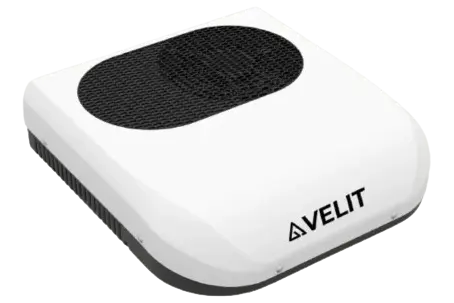
UPDATE: Velit 12V/24V/48V Air Conditioners are getting increasingly popular, and that’s not much surprise because they offer a good product at a good price:

Velit 12V/24/48V Air Conditioners

3- Electrical System

3.1- Wiring Diagram & Items List

Download our “High-Power” wiring diagram (faroutride.com/wiring-diagram), use the addendum (image) below to wire the 12V air conditioner and make sure to use a 400A fuse with 4/0 AWG cable (“MAIN”) as annotated below:

12V-Air-Conditioner-Van-(Sprinter,-Transit,-ProMaster)-Wiring-Diagram-Nomadic-2000
Addendum for High-power wiring diagram. Download the diagram here: faroutride.com/wiring-diagram

A few clarifications:

  • Use the dropdown menus and input all the wire length, in order to get all the correct wire gauge  (e.g. youtu.be/9MEGls0qLZY)
  • Because the air conditioner increases power demand on the electrical system, we’d recommend selecting a 2000W inverter/charger. It’s possible to go with a 3000W inverter/charger, but be aware that this might overload the system during peak power (e.g. when the inverter and the air conditioner are both running simultaneously at max power).
  • NOMADIC 2000: The 12V air conditioner is connected to the bus bars via a 100A breaker. The correct wire gauge varies with the length and can be determined with this calculator: WIRE GAUGE CALCULATOR. Or simply put, 1 AWG gauge will work for any length under 30 feet total (15 feet red + 15 feet black).
  • Dometic RTX2000: The 12V air conditioner is connected to the bus bars via a 80A breaker. 24ft of electrical harness is included with the RTX2000.

3.2- Customize Your Own Wiring Diagram & Items List

You can use our Van Electrical Calculator (faroutride.com/calc) to customize your own system. We’d recommend sticking with a 2000W inverter/charger (you can force the calculator to do so by switching to “manual” mode). For the Nomadic Air Conditioner, use 25Ah current (that’s the average current draw, per manufacturer claim) and something like 8 hours for daily usage. For example:

Image extracted from faroutride.com/calc

In the calculator, scroll down to retrieve your entire items list. Make sure to download the High-Power version of our wiring diagram (and use the addendum of the section 3.1 above the connect the air conditioner).

3.3- Managing Expectations

We have to accept how energy-hungry air conditioning is… To make it work off-the-grid, we need to invest in highly-efficient 12V air conditioner but ALSO on a large battery bank. That’s quite a financial commitment.

But yeah, it can be done.

That doesn’t mean you’ll be able to maintain the interior of your van at 68F 24/7 when it’s 95F outside though…

Reasonable expectations, for example, would be more like using the A/C to lower the temperature/humidity just a few degrees as it can makes the difference between a good night of sleep VS no sleep.

And keep in mind the calculations above do NOT include induction cooking, which is another energy-hungry appliance. “All-electric” builds are very appealing, but keep it real!

Bottom word: manage your expectations and remember that HOW YOU USE IT will have a tremendous impact on your autonomy.

3.4- Variables affecting Energy Consumption

A cooling machine (such as a fridge or an air conditioner) does not constantly work. It cycles between ON and OFF to regulate the temperature. This is called the DUTY CYCLE:

Duty Cycle (%) = (ON duration / Total duration) x 100

For example, if the air conditioner is ON for 1 minute then OFF for 3 minutes, the duty cycle is 25% (1 minute ON per every 4 minutes).

It’s very important to realize that the energy consumption will vary greatly from day to day. Indeed, there are many variables that affect how hard the air conditioner has to work (duty cycle) to maintain a certain temperature:

Installation

Always read the manual and make sure you meet the requirements. For example, a fridge evacuates the heat through its coils in the back. If the fridge is installed in a cabinet without any ventilation, the heat pumped out of the fridge has nowhere to go and the coils won’t be able to do their job.

Maintenance

A heat pump evacuates heat through its coils; if these coils are full of dust, efficiency is greatly reduced and energy consumption increases. Follow the maintenance schedule prescribed by the owner’s manual!

Outside Temperature

The ambient temperature outside has a massive impact on energy consumption. To make an analogy with our fridge, we observed that the duty cycle can get as low as 10% in winter and goes as high as 75% on a very hot summer day. Huge difference!

Inside Temperature

Trying to maintain the interior of the van at a very low temperature will obviously consume way more energy than at a moderate temperature.

Volume

Size matters! It takes much less energy to cool a fridge (~5.8 cu. ft.) compared to a small van (~250 cu. ft.) or a larger van (~500 cu. ft.)

Insulation

Compared to a fridge, a van is poorly insulated and the heat transfer rate is way higher. That’s especially true for the windows, so investing in good insulated window covers is a must.

Sun Exposition

Parking directly under the sun is good for solar charging, but quite bad for heat; especially for dark colored vehicles…

Opening the doors

It’s normal having to enter/exit the van in our daily life. But each time, a lot of heat is transferred and the A/C has to work harder to compensate.

4- Installation

The Nomadic Cooling Co. air conditioner fits into a “traditional” 14″x14″ cutout; that’s the same cutout as for a Maxxfan roof fan (see our installation guide). We personally didn’t install an A/C on our van because we’re lucky enough to have the flexibility to follow the seasons (in other words: drive north in summer!). That being said, here is some info to get you started:

4.1- Air Conditioner Adapter

To create a perfect seal and prevent water infiltration, the air conditioner needs to be installed on a perfectly flat surface. The roof of most common vans (Transit, Sprinter, ProMaster, etc) have corrugations on them, but the use of an Air Conditioner Adapter Kit that’s model-specific (Transit, Sprinter, ProMaster) will solve that issue:

The roof adapter (gasket) creates a perfectly flat surface:

Air Conditioner Adapter Gasket (Transit, Sprinter, ProMaster)

The kit includes framing strips to increase support for the extra weight of the A/C:

Air Conditioner Adapter Framing Strips (Transit, Sprinter, ProMaster)

The framing strips are installed inside the van if there is 18″ or more spacing between the beams:

Framing-Strips-for-Roof-Fan-installation-(Van-Conversion)
Air Conditioner Adapter Kit
Select the appropriate variant for your usage (e.g. "AC adapter for Nomadic")

Where to Next?


Continue with

Guides

More About this topic

Want More?


We're just getting started.

Stay in Touch!


Join the 40,000+ Of Us

About Us


Nice to Meet You.

About-Us-Narrow

Hello! We’re Isabelle and Antoine.

In 2017, we sold our house (and everything in it), quit our engineering careers, and moved into our self-built campervan. Every day is an opportunity for a new adventure... We’re chasing our dreams, and hopefully it inspires others to do the same!

Exclusive Deals!


35 thoughts on “12V Air Conditioners: Battery Powered for Off-The-Grid Vanlife”

  1. Would it be ill-advised to run a 12v AC off of an AGM battery bank? We have 640Ah of Victron AGM batteries. Since AGM batteries should not be drained below 50% SOC, we effectively have 320Ah of battery capacity. How much AC runtime could we realistically get if no other devices are drawing from the batteries? Thanks

    Reply
  2. So, I have the Ecoflow wave 2. I believe it is 5,000BTU. It is just ok—-as you describe the rooftop—it will cool the van 10-15 degrees. I keep looking at these units, but by the time I invest in the unit, the installation, and the upgrade to my battery bank—just ok cooling would be a bust.

    Reply
  3. Hello there! I’m reading all the information and I’ve a question about the AC unit. I’m planning in have a 24v system just because this, seeing that having a 24v AC unit will use half of AH than one that is 12v, so the autonomy of the battery bank it will much longer, I’m wrong? Thanks!

    Reply
  4. Hey guys! I really appreciate your work here. I’m new to vanlife and trying to figure it all out.
    Is it possible to connect the dometic rtx 2000 12V to the bluetti AC200P?
    I thought that it was possible to run the dometic on eco mode (only 19A) through the DC aviation port (up to 25A) but I can’t figure out how I would wire that large 4awg aviation plug to the aviation plug.
    please help! thank you so much.

    Reply

Leave a Comment