Wire Gauge Calculator
Made with ❤ in our van.
Sharing this tool with others is the best way to say thanks if you found it useful. Thanks for supporting us and for keeping this website alive! See you on the road 🙂

How this wire calculator works
I know the current
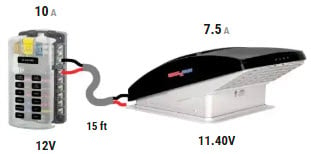
Checks:
- Voltage Drop. The calculator finds the minimum wire cross-section to keep the voltage drop under the selected limit (5% in this example).
- Fuse. The calculator finds a fuse based on standard sizing of 125% of max load current.
- Ampacity. The calculator checks if the wire found at step 1. can handle the fuse rating without overheating. If not, a larger wire is recommended.
I know the fuse
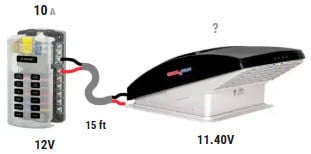
Checks:
- Voltage Drop. The calculator back-calculates load current from the fuse (fuse ÷ 1.25) and finds the minimum wire cross-section to keep voltage drop under the selected limit.
- Ampacity. The calculator checks if that wire can handle the fuse rating without overheating. If not, a larger wire is recommended.
Derating Factors:
Wires can carry a certain amount of current continuously and no more; more current means the wire will overheat (and melt) as it cannot dissipate the heat that is generated by too much current flow. That characteristic is called AMPACITY (maximum current that a wire can carry continuously without exceeding its temperature rating). Certain factors reduce the ampacity rating of wires and the voltage drop as well:
Ambient temperature of 50°C (122F) or more
A wire located in ambient temperature of 50°C (122F) or more loses its ability to dissipate heat, and, therefore, its ampacity is reduced by 15%. (note: this is per ABYC standards “In Engine Room”). This is most likely the case for a wire running in the wall/ceiling of a van because temperature in there is much higher than in the living space (that’s especially true for darker color vans).
Load runs continuously for 20 minutes or more
A wire that carries a current flow for a long duration (~20 minutes) builds up more heat. As the temperature of a wire increases, so does the resistance to current flow = more voltage drop. To mitigate this factor, the load current is increased by 25% for the voltage drop calculation (but not for the fuse/breaker size calculation). This is not an ABYC requirement at the moment; however, it is generally accepted by marine product manufacturers (such as Blue Sea).
Wire in conduit, insulation, or bundled with 2 (or more) wires
A wire located in a conduit, sheath, running through insulation, or bundled with 2 (or more) wires loses its ability to dissipate heat, and therefore, its ampacity is reduced by 30%. This is not an ABYC requirement at the moment; however, it is generally accepted by marine product manufacturers (such as Blue Sea).
REFERENCES: ABYC E-09 1990 (pdf) | Blue Sea Circuit Wizard | West Marine DC Wiring Basics
Making things easy
Did we mention you actually don’t need to use this calculator? 😛 Our wiring diagram features customizable components (solar, alternator, shore, inverter, 12V loads), a built-in wire gauge (AWG) calculator, and it will output the wire lengths & terminals you need to purchase. It doesn’t get easier than this! Here it is in action:

Maxxfan Wire Sizing Example
We are wiring a MaxxFan: 7.5A load, 15 ft from the fuse box, on a 12V system. The wire runs along the ceiling (hot), and the fan runs for extended periods. We allow up to 5% voltage drop:
1. I know the current
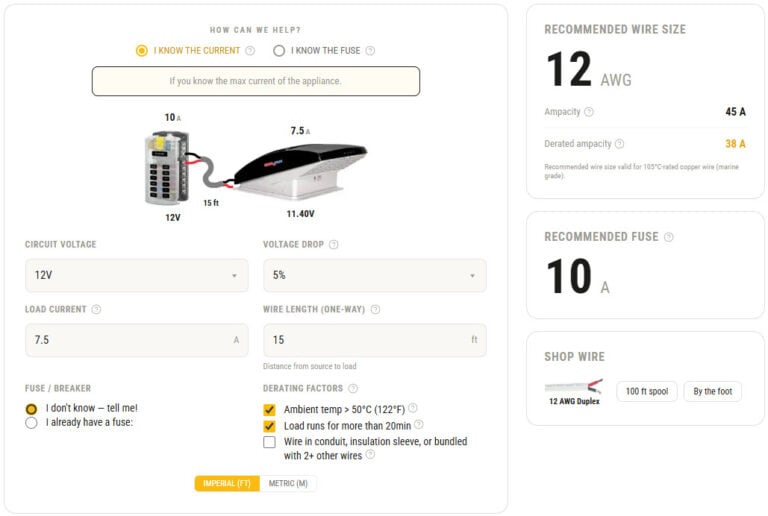
Check 1 — Voltage Drop
Current flowing through wire loses voltage to resistance. Longer wire and higher current = more loss. The formula calculates the minimum wire cross-section (in circular mils) to keep that loss under 5%:
CM = (10.75 × Amps × Duration Factor × Round-Trip Length) ÷ (Voltage × Drop%)

CM = (10.75 × 7.5 × 1.25 × 30) ÷ (12 × 0.05)
   = 5,039 circular mils
A few things to note:
- Round-trip length = 30 ft (15 ft × 2 — current flows to the fan and back)
- Duration factor = 1.25 because the fan runs continuously (25% safety margin per ABYC E-11)
- 10.75 is a constant for copper resistivity
5,039 CM falls in the AWG 12 range (3,702 – 5,832). Voltage drop says: AWG 12 minimum.
Check 2 — Ampacity
Can AWG 12 physically handle the fuse rating (10A) without overheating?
AWG 12 is rated for 45A (105°C marine-grade copper). But the wire is buried in the ceiling where temps exceed 50°C, so we derate by 15%:
Derated ampacity = 45A × 0.85 = 38A38A >> 10A. No need to go bigger.
Check 3 — Fuse Protection
The fuse protects the wire, not the fan. It must blow before the wire overheats. Standard sizing is 125% of load current:
Min fuse = 7.5A × 1.25 = 9.4A → next standard size = 10AThe wire (38A derated) can handle far more than the 10A fuse. If something shorts, the fuse blows long before the wire is in danger.
Result
Wire: 12 AWG duplex (4 mm²)
Fuse: 10A
Ampacity: 45A base / 38A derated
2. I know the Fuse
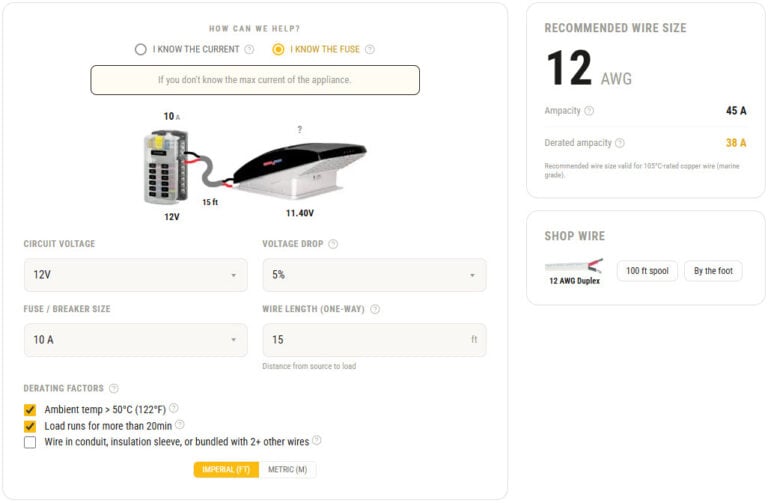
Check 1 — Voltage Drop
The calculator back-calculates the load current from the fuse size (fuse ÷ 1.25), then runs the same voltage drop formula:
Estimated current = 10A ÷ 1.25 = 8A

CM = (10.75 × 8 × 1.25 × 30) ÷ (12 × 0.05)
   = 5,375 circular mils
5,375 CM falls in the AWG 12 range (3,702 – 5,832).
Check 2 — Ampacity
The wire must handle whatever the fuse lets through. AWG 12 is rated for 45A, derated to 38A for high temp:
Derated ampacity = 45A × 0.85 = 38A38A >> 10A fuse. No need to go bigger.
No fuse sizing step here — the user already has one.
Result
Wire: 12 AWG duplex (4 mm²)
Ampacity: 45A base / 38A derated