


The Sterling Power BB1260 battery to battery charger (aka “DC-to-DC” or “B2B”) plays a major role in keeping our camper van electrical system balanced and healthy. How’s that? The battery to battery charger uses the van alternator power to charge our house (auxiliary) battery while we drive. It’s an install-and-forget device: it turns itself ON/OFF automatically when driving the van, doing its things without user intervention. Neat! It means that we don’t have to worry about running out of power, AND the house battery lifespan is maximized. Sounds too good? Keep reading this review as we get into more details…

2024 Update: Victron Orion XS
For 2024, Victron released the 50A Orion XS DC-DC battery-to-battery charger. It is a complete redesign of the previous 30A version (non-XS), and it’s better in every way compared to the Sterling: more power, more efficient, smaller dimensions, better heat management (no fan = no noise!).
While the information in this review is still relevant (how battery-to-battery chargers work, benefits, etc.), we now recommend the 50A Victron Orion XS over the Sterling.
The Victron is a drop-in replacement for the Sterling (per our Wiring Diagram), except you should use 70A breakers instead of the 100A breakers recommended for the Sterling. The Orion XS accepts wires up to 4AWG, which will work for most people with vans.
Victron Orion XS

How does the Sterling Power battery to battery charger work?
The Sterling Power battery to battery charger is installed “between” the van battery and the house battery (more installation details further in this article). There is no switch or button to initiate the charge! You see, when you start your vehicle, the alternator kicks-in and raises the voltage of the van battery in order to charge it. The B2B charger senses the higher voltage and turns itself ON automatically. Now when you turn your vehicle OFF, the alternator stops and the voltage of the van battery drops; the B2B charger senses the dropped voltage and turns itself OFF. All of that happens without user intervention (well, except the part where you drive your vehicle!).
What are the benefits of a battery to battery charger?
Each type of battery (Gel, AGM, Lithium, etc.) requires a specific charging profile (bulk, absorption, float). Charging with the wrong profile might result in:
- Incomplete charge (cannot reach 100%);
- Reduced lifespan (waste of $);
- Sulfuration (reduced total capacity) of Lead Acid batteries (AGM).
If a lead acid battery doesn’t get a proper multi-stage charge (bulk, absorption, float), it loses its total capacity and that’s non-reversible (knowledge is power: we recommend reading the Charging Profile section of our Electrical System page to really understand what that means). Bad charge = wasted money (the battery has to be replaced more often), so we think the B2B charger pretty much pays for itself in the long run.
Battery to battery charger vs Isolator: what’s the difference?
- A B2B charger provides the adequate charge profile to the house battery (see paragraph above for benefits); in other words, it charges and keeps the battery in good health in the long term.
- An isolator is simply an automatic “switch” that connects and disconnects the house battery to the starter battery. An isolator does NOT provide an adequate charge profile (bulk, absorption, float), and, therefore, might not be able to charge the house battery to 100%, might reduce its lifespan or reduce its total capacity. The only real advantage of an isolator is that it’s cheaper upfront (but not in the long term as you might have to change your house battery more frequently).
Are solar power AND alternator power (battery to battery charger) both needed?
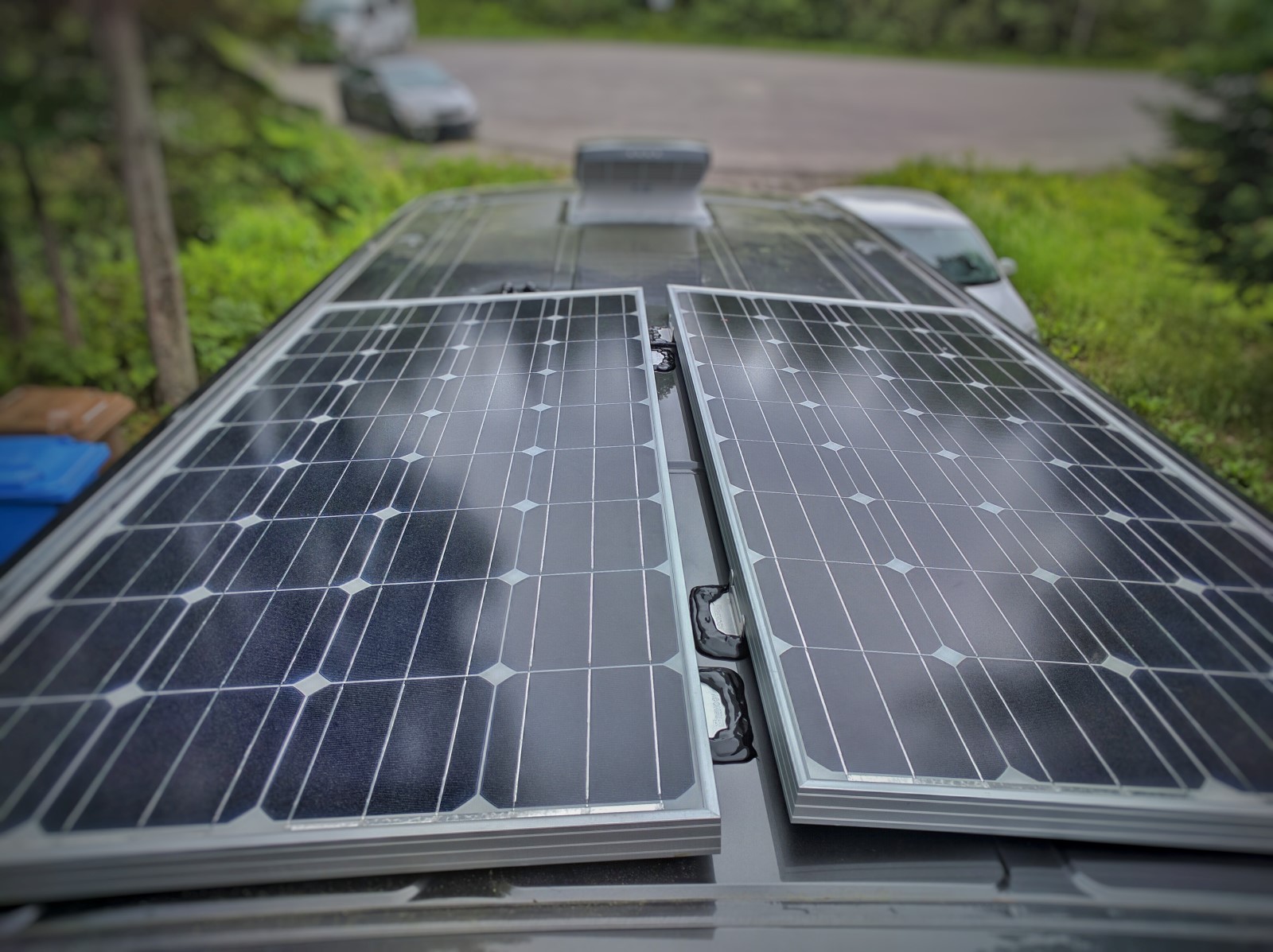
Here’s what we think about that:
- If you live full time in your van, we say a B2B charger is a must. Energy is a basic need, it’s not cool worrying about running out of it…
- If you take your van for adventures in summer only, you can probably live without it as solar can provide the bulk + absorption charge on its own.
- For fall and spring adventures, we highly recommend it as the solar days get shorter and weaker. Alternator power is a good way to quickly go through the bulk charge, then solar power can complete the absorption stage.
- For winter there’s no question about it, our opinion is that you want it. The sun angle is too low, the solar day is too short and overcast weather is more common (for USA and Canada at least).
What we Like…
- Surprisingly easy to install (scroll down for installation write-up).
- Install-and-Forget!
- Fast Charge.
- Provides a nice multi-stage charge that keeps the battery (Gel, AGM, Lithium, etc.) healthy in the long run.
What we Don’t Like …
- The internal cooling fan is quite noisy; think of a tiny hair dryer. If possible, install the Sterling charger further back away from driver/passenger seats to minimize the noise.
Models & Where to Buy
There are a few variants of the Sterling Power Battery to Battery charger, so make sure to select the appropriate one according to:
- Input voltage (most likely 12V…)
- Output voltage (most likely 12V…)
- Input current (30A, 60A or 120A).
It basically comes down to either BB1230 (Input: 12V, 30A. Output: 12V, 22A), BB1260 (Input: 12V, 60A. Output: 12V, 45A) or BBW12120 (Input: 12V, 120A. Output: 12V, 90A). We highly recommend the BB1260 for a faster charge (so a short drive goes a long way 🙂 ), unless of course 60A is over the maximum current recommended for your battery.


*But before selecting the BBw12120, please consider the following:
- Batteries generally have recommended and maximum charge current. Going overboard is a waste of space (this charger is bigger) and money.
- Check your battery manual or data sheet to find out.
- Make sure your alternator can handle that much current so that you’re not draining your van battery.
- For example there are two alternator options on the Ford Transit: basic (150A) and Heavy-Duty (230A). It is believed (not official info) the Transit needs roughly 70A for itself (lights, radio, etc.), so we’re left with 80A extra current with the basic alternator and 160A extra current with the Heavy-Duty alternator. If you have the basic 150A alternator (80A extra current) and you’re charging your house battery at 120A, it probably means you are “borrowing” that extra power from the van battery…
- Overworking an alternator might reduce its lifespan.
- The BBW12120 has, according to Sterling Power, reduced cooling capacities due to the fact that it’s waterproof. Therefore it’s not ideal to install that in a van. Instead, they recommend installing two BB1260 in parallel to get a higher output.
Breakers
Sterling Power recommends to use the following breaker/fuse size:
- BB1230: 50A breakers (Buy on Amazon)
- BB1260: 100A breakers (Buy on Amazon)
Installing the Sterling BB1260 battery to battery charger
First of all, as always, make sure to read the manual (choose the latest version). The manufacturer knows their product better than anyone else.
Location
Make sure to install the B2B charger in a well vented space, and do not obstruct the hot air exhaust:

Wiring and Electrical
It’s honestly quite simple. Here are the required connections:
- Positive Input (From vehicle battery)
- Positive Output (To house battery)
- Negative (Common to vehicle and house battery)
- Optional Temperature Sensor (Recommended for lead acid batteries (AGM), but not for Lithium. Connects to house battery negative post. This is to correct the voltage according to temperature change)

Follow this wiring diagram (faroutride.com/wiring-diagram) to make sure your B2B charger works as it’s intended to. The wiring diagram had a built-in calculator for fuses/breakers, wire gauge, and wire length/terminal count. Pretty neat!

Ford Transit Connection:
POSITIVE:
This official Ford SVE Bulletin shows how to connect to POSITIVE for the SINGLE or DOUBLE battery variant: SVE Bulletin Q-226 (.pdf):

Ford Transit with twin batteries configuration, year 2020 & up:
Since 2020, the Transit with dual batteries configuration comes with two (2) CCP (Customer Connection Point) located on the driver seat pedestal (on the door side). The CCP2 is rated for up to 175A, so it’s an ideal connection point (positive) for a B2B since there is no need to remove the seat:


Negative (ground):
Ideally you want to use a ground point recommended in the BEMM (BEMM included in our Builder’s Package), and it’s a good practice to use one as close as possible to the battery (which is located under the driver seat). In our van, we are using the ground point located between the passenger/driver seat:

Mercedes Sprinter Connection:
Please check the Mercedes Sprinter “Body And Equipment Guideline” on how to use the battery power (alternator):


Default Options
Here are the factory options for the Sterling BB1260 Charger:
- MODE: 1
- (Mode 2 is identical to mode 1, except it needs a live signal on the ignition feed input in order to charge)
- ACTIVATION VOLTAGE: vehicle battery above 13.2v (for 5 seconds)
- TURN-OFF VOLTAGE: vehicle battery below 13.2V
- TURN-OFF TIMER: 240 seconds
- (A timer is required to complement the regenerative braking aspect of modern Euro 5 / 6 + engines – where the alternator’s voltage can drop below 13V for a short period of time)
- Because our Ford Transit 2016 does not have regenerative braking, we changed the turn-off timer to 30 seconds (procedure in manual). This prevents draining the van battery, especially when running errands (multiple short drives).
First Time Use
The unit will enter “config” mode at first startup; this is your opportunity to change the charging profile according to your battery type.
- The configuration can be changed later, check the manual.
- To find out which charging profile to select, check your battery manual.
First Time Use Configuration Sequence:
- To initiate the first startup, turn on the vehicle and wait a few seconds. To indicate the battery to battery charger has turned ON, LEDs will light up, a beep will sound, and the fan will run for 5 seconds. If none of that happens, try to “force-start” the unit: simply press and hold SETUP/ENTER for 5-9 seconds.
- At this point, an LED is flashing to indicate the battery type (default = lead acid).
- To change the battery type, press and hold SETUP/ENTER buttons for 10-12 seconds (up to 20 seconds); all LEDs are now flashing.
- Scroll down (SELECT button) or up (ENTER button) to select your battery type; Press and hold SETUP/ENTER buttons for 2-3 seconds to confirm the selection.
- At this point, the B2B charger will restart.
- If you have a battery monitor, such as the Victron (faroutride.com/victron-review), you can observe that the B2B is charging the house battery…
- That’s it! Go for a ride!
To change the configuration later or for advanced options, check the manual.
Operation
Once the installation and initial setup completed, just drive and let the Sterling Power battery to battery charger do its thing!
Reliability
We installed the Sterling Power BB1260 battery to battery charger in October 2018; so far so good! We will keep you updated if anything happens! Subscribe to our Mailing List to be notified.
Resources
- BB1260 Manufacturer Website (product info, manual, regenerative braking compatibility, etc.)
Runner-Up
New for 2019, Renogy is now offering a DC to DC charger (B2B). We haven’t tested it ourselves, but Renogy is known for their good, reasonably priced products, so it’s most likely a safe buy. That being said, READ THIS BEFORE BUYING:
- The Renogy B2B starts the charge when the ignition is set to “ON”, even if the engine is not running. Consequently, you could drain your starter battery (when listening to music, for example). For this reason, we would personally stay away from it.
- The Renogy B2B requires a connection to the ignition signal of the vehicle, making the installation a bit more complicated than with the Sterling Power.


Renogy also released the DCC50S which combines a DC to DC charger & Solar (MPPT) charger. As opposed to the Renogy B2B charger above, this model starts the charge based on the starter battery voltage (so it won’t drain your battery when your engine is not running, that’s better). Looks like a sweet product, but be aware of the limitations:
- Maximum alternator charging current: 25A
- Maximum solar charging current: 25A
- Maximum solar voltage: 25V (so if using multiple panels, series connection is not possible)


Hi, excuse my ignorance about things electrical, but is it possible with this to use the house batteries to “jump” the vehicle starter battery if necessary?
Yeah I can’t see why not! It’ll work.
A piece of feedback about the Renogy B2B units, since you mention them and this website has significant readership:
The Renogy units are NOT activated by voltage sensing. In other words, they do not automatically turn on or off based on the voltage from the alternator. They have an input that turns them on and off instead. So, you need to connect 1 additional wire to something like the ignition switch, to tell it when to turn on. And, because they are not voltage detecting, they will charge your house battery off the starter battery if this input is high, even if the engine isn’t running. So you need to be extra careful, and you could drain your starter battery if you did something like leave the ignition switch on to listen to the radio. You also could have a charging load on your starter battery when trying to start the vehicle, which is not ideal.
In my opinion, these downsides make the Renogy unit a significantly less appealing option than Sterling, Ctek, or Victron.
Good info, Kyle.
I’ve updated the page to reflect that. “The Renogy B2B starts the charge when the ignition is set to “ON”, even if the engine is not running. Consequently, you could drain your starter battery (when listening to music, for example). For this reason, we would personally stay away from it.”
Thanks for your input!
antoine
Hi Antoine,
FYI, I have 2 x 100Ah Battleborn and the higher output BBW12120 (120 Amp) charger.
You mention concerns about overcharging your battery bank, and you are right that folks think about that.
But if you buy the remote with this device, you can define the “Current Limit” from 100% down to 30%, which gives you a scalable solution, even if you are starting with 1 x 100Ah battery.
For the record, I leave mine at 100%, and have never seen more than 92 Amps going into the sytem, which is in line with the recommended charging rate (0.5c = 100Amps on a 200Amp bank). For the recored, 92 amps occurred when I was at about 50% DOD. I never really get below that. I might get more amps from the 12120, if my DOD was below 50%, or if — as you suggest – I chained two BB1260s.
Note: I have the HD alternator (230Amps) and similar daily amp usage as you.
Just thought I’d share.
Cheers,
Dave
Thanks for sharing! We get 45 Amps from the BB1260, not 60A as one might expect. I’ll add this data to the article.
Cheers
My charging rate is about the same, ~48 amps.
I did a little research and the 60 amps of the 1260 is the max input current, at least according to this site https://marinehowto.com/understanding-the-sterling-power-pro-batt-ultra-battery-to-battery-charger/
The efficiency is 86%, which gets one closer to our observed output current.
I’ve also been very happy with (2) Lithium batteries and the Sterling 1260. A short drive and I am usually able top off the batteries, no solar required so far.
Bonjour! Serait-il une bonne idée de placer le B2B près de la batterie du camion sous le ”hood”?
Pour le Transit (et la plupart des van similaires), la (les) batteries sont sous le siège conducteur. De plus, il serait mieux de l’installer à l’intérieur ca c’est pour ça qu’il est conçu (pas 100% waterproof).
Au plaisir.
Thank you for all your information on one site.
I like the Sterling setup other than the noise of the fan (have not made purchase yet).
So I am researching for alternative and have found Victron’s Orion TR Smart DC-DC 12/12/30.
Realize this is only 30 amp but my system is simple.
Any thoughts on the Orion vs Sterling.?
Mark
I haven’t tried/tested the Victron myself, but I’d trust Victron. As you mentioned, they only downside I see with the Victron (looking at the specs) is it’s only 30 amps. But if you can live with it, it’s all good!
Mark, you can parallel the Orions to get 30 or 60 or 90 etc. charge amps. They say an unlimited amount. Of course that makes the cost a major consideration but it can be done.
I’ve liked using the Sterling B2B charger with Lithium Batteries in a truck camper and travel trailer. As a result, I have delayed indefinitely the install of roof mounted solar. I can go 3 to 5 days on my battery without a charge and that’s about as long as I’m going to be in a spot before driving again. Normally, I’m driving more frequently and because the B2B tops the battery off quickly, it’s be a great solution.
Why did you choose to go directly to the battery terminal rather than CCP? I have read of people wiring B2B to the CCP.
Thanks,
If you have the dual batteries, there’s an auxiliary terminal available; it’s easier than wiring 2 CCP connections in parallel (each CCP is 60A, i’d be worried of using only one). But both solutions work, so feel free to use the one you like better!
Hello faroutride/Antoine,
Thank you for your wonderful writeup and we’re glad our unit has impressed you and worked to your needs perfectly.
I should note, however, that we typically aren’t comfortable recommending people to fit a BBW12120 inside vans as it is a waterproof product. Waterproof products are obviously very sealed and thus the cooling can be more difficult. Inside of a van where there is, I believe it is fair to say, normally not perfect ventilation or cooling the fact that it is waterproof ends up being a detriment as it may be prone to overheating or losing efficiency. Only fit waterproof products in areas where you do need the unit to be waterproof. It’s not a cool extra feature, it’s a product to fulfil a purpose.
If you do need to reach closer to 120A rather than just 60, running two BBs, either a BB1230 and a BB1260 or two BB1260s, in parallel will give you the higher A output.
Thank you again,
Thanks for the clarification. We updated the article accordingly.
Renogy has a pretty neat new unit out that is MPPT and Battery to Battery all in one. Might be one readers here would be interested in!
RENOGY DDC50S.
Thanks for taking the time in sharing your product review
I understand an alternator on its own will only charge to 80%, is this the same for the VSR?
I understand the B2B will charge to 100%. Is that correct? Thats the selling point right there. Making use of a potential 20% loss. I mean in terms as a generic summary, using a run of the mill leisure battery and start battery you only ever get to use between a range of 50%-80%. So with multiple batteries, thats a loss of 20% per battery within your power bank.
I do however, acknowledge with newer technology allows us to use 100%, but comes at a premium.
So if my R&D serves me well, then this would be the best solution above the rest.
I have a calcium 5000 Yuasa 100ah battery as starter, and two Banner 100ah leisure batteries.
I plan to live in it full time, and am a gamer an a bit of a film buff. Of course this is when I am not driving, travelling and taking my family away and enjoying the beautiful world around us.
I wish you well in your endeavours.
Thanks
Jason
How are these battery chargers different from the Current Limiting Voltage Sensing Relays?
A B2B charger is programmable to deliver the appropriate charge profile (bulk, absorption, float: current VS voltage) according to your specific battery chemistry (Lead Acid, AGM, Lithium, etc). While a relay doesn’t have the ability to do charge profiles.
At the end of the day, the result seems identical: your battery is charged. But with the B2B charger you’re taking care of your battery and it’ll last much longer. More info here: https://faroutride.com/electrical-system/
Hope that makes sense!
I purchased your wiring diagram and have found it to be very helpful. Two quick questions regarding the sterling B2B charger- your diagram called for common wire running to the negative terminal on the starting battery- the fitting on that battery does not accommodate additional cables so can I run that cable to a factory installed ground point on the vehicle instead? Also, the sterling manual called for 100 amp fuses on either side of the charger, but the diagram that you guys provided calls for 70 amp (I bought the 60 amp sterling charger you specified). Please let me know. Thank you!
1- Yep, we used the ground point between the driver/passenger seat.
2- The manual was recently updated to a 100A fuse (it used to be 70A); so yeah go for 100A (but we personally don’t have a 100A and it works fine).
Cheers!
When you connected to the starter battery did you go through the CCP and if so did you only need one since they are rated with a 60A fuse themselves, also I see your using 4AWG wire which seems a bit large for the small CCP terminals. Or did you go straight to the battery positive post. I only have a single starter battery and the 150A alt so as per the bulletin you posted if i go to the pos post I would need another terminal but there is no part number only for additional CCPs. Unfortunately my local Ford dealer technicians won’t answer my questions.
One last thing, I have 3 100ah BattleBorn batts with 600w of panels all in my 2018 Transit. Would you suggest the 60a or 30a B2B?
We didn’t used the CCP, we used the auxiliary positive terminal on the battery as shown here: https://faroutride.com/wp-content/uploads/2018/09/Ford-Q-226R1-Access-Battery-Power.pdf
I’d definitely go for the 60A sterling.
Good luck!
Hi, finaly, did you go for the 30 or the 60 amp? I have the same set-up (single battery and 150 amp alt) and hesitate between both. And did you use the CCP or the battery born? Thanks
Hi,
Thanks for all the info and wiring diagram. I am reading that the recommended charging rate for AGM batteries is 20% of the capacity (0.2C). I have a 200 AH AGM battery and would like to get the 1260 with 60A of charging but that is 0.3C. Did you have any issues charging your 220 AH AGM with the 60A Sterling? Should I get the 1230 or 1260? THANKS.
In reality, we get 45A from the BB1260. So that’s perfect for your 200Ah AGM battery. I would get the BB1260!
Hi, DO you know anywhere it is documented on how to attach to the vehicle battery? Also what size lugs are needed?
You mention 70amp breakers, whereas the sterling manual mentions 100amp fuse? Any reason for using 30 amp less?
Thanks
Hi!
Don’t know for all the vans, but here’s for the Ford Transit: https://faroutride.com/electrical-system/#alternator (go to section “3.2.3- ACCESSING BATTERY POWER ON THE FORD TRANSIT”).
They just updated the Sterling manual for 100A fuse for some reasons (it used to be 70A). We have 70A and it works fine, but you can buy 100A fuse to follow the manual…
Cheers!
With the new dual 250A alternators offered by Ford for the 2020 Transit, would the BBW12120 be an appropriate B2B?
Considering that the Single Heavy Duty alternator (230A) can run the BBW12120, I’m sure the dual alternators (250A) will be able to handle it as well! 🙂
Hello! This might sound like a silly question, but I noticed from your wiring diagram that the negative bus bar is connected both to the sterling AND the alternator. why is that?
If you look at the Sterling manual, that’s how it’s suppose to be done 😉
Van/house battery negative must be common.
Cheers,
antoine
Thanks again, I will read the whole manual once I get the sterling 🙂
Cheers!
What’s the difference between this b to b compared to a battery isolator? I use this battery isolator in my truck camper with no problems. https://www.amazon.com/gp/product/B001HBYXVS/ref=ppx_yo_dt_b_search_asin_title?ie=UTF8&psc=1
– An isolator put your house battery in parallel with your van battery. As a result, the house battery receive a “random” charge profile and might not get up to 100% in some case. Also, the alternator might overwork.
– A B2B charges the house battery with a proper profile (bulk/absorption/float, just like a smart charger would) and also act as current reducer so the alternator doesn’t overwork.
A battery charged with a B2B will last longer (especially flooded/gel/agm).
Cheers
Question: I have been to a major battery supplier and asked about Lithiom Batteries. FYI… they sell millions of dollars of batteries yearly. I was told they were not safe. They supply batteries to major custom boat builders and said they cause alot of fires. Please advise.
In 2015 when we designed our van, we went with AGM (not lithium) because of safety concerns. Fast forward now to 2019, Lithium batteries now come with built-in BMS (Battery Management System): the BMS will disconnect the battery if any parameter is out of range (charge/discharge current, temperature, short circuit, etc). Technology has come a long way and many MANY people use Lithium them in their van/RV now. My advise would be to go for a major brand (Battle Born, Trojan, Relion, Renogy) and not worry about it. I think in 2019 Lithium is the way to go (until your battery is install outside your van and you’re dealing with freezing temperatures).
Cheers!
Hi there,
About to install the B2B charger (60amp) and I had a question about charging. When I normally charge from a plug-in 120v charger I shut down all the loads on the battery so it can charge correctly in three stages. When I do this I have the input go to an extension with two outputs, one for the charger and the other to plug my fridge in while charging so no load is on the battery during charging.
I am wondering if turning off loads while charging is needed with the Sterling charger? And if so, how do you approach?
Id like to be able to charge while driving and keep the fridge on but do not want to damage the batteries while charging them. Please let me know if you have solved for this or have any suggestions, thanks!
Hey! We always leave our loads ON (fridge mostly) when charging with the B2B, no issues here.
Our Samlex charger (120V) has a setting for “Battery with loads”, see page 21 of the manual: https://samlexamerica.com/documents/manuals/11001-SEC-1250-2425UL-0218_Hrez.pdf. It disables the absorption stage.
Hope that helps,
antoine